

1.6 preview: original Clicky Sketch and Drive, typed chat/history, offline Windows voice, local jobs/routines, Browser Link, reviewed MCP tools, dictation and narrated recordings. Read what changed and what still needs live testing. Configure these from the panel's Settings, Sketch, and Work & routines controls.
An AI teaching companion that lives next to your cursor. Ask it anything about your screen — it points, explains, and guides you step-by-step, like a real tutor sitting beside you.
Clicky is a Windows port of farzaa/clicky (originally macOS/SwiftUI). Built with Python 3.11+ and PyQt6, runs fully in the background, and works with every major AI provider.
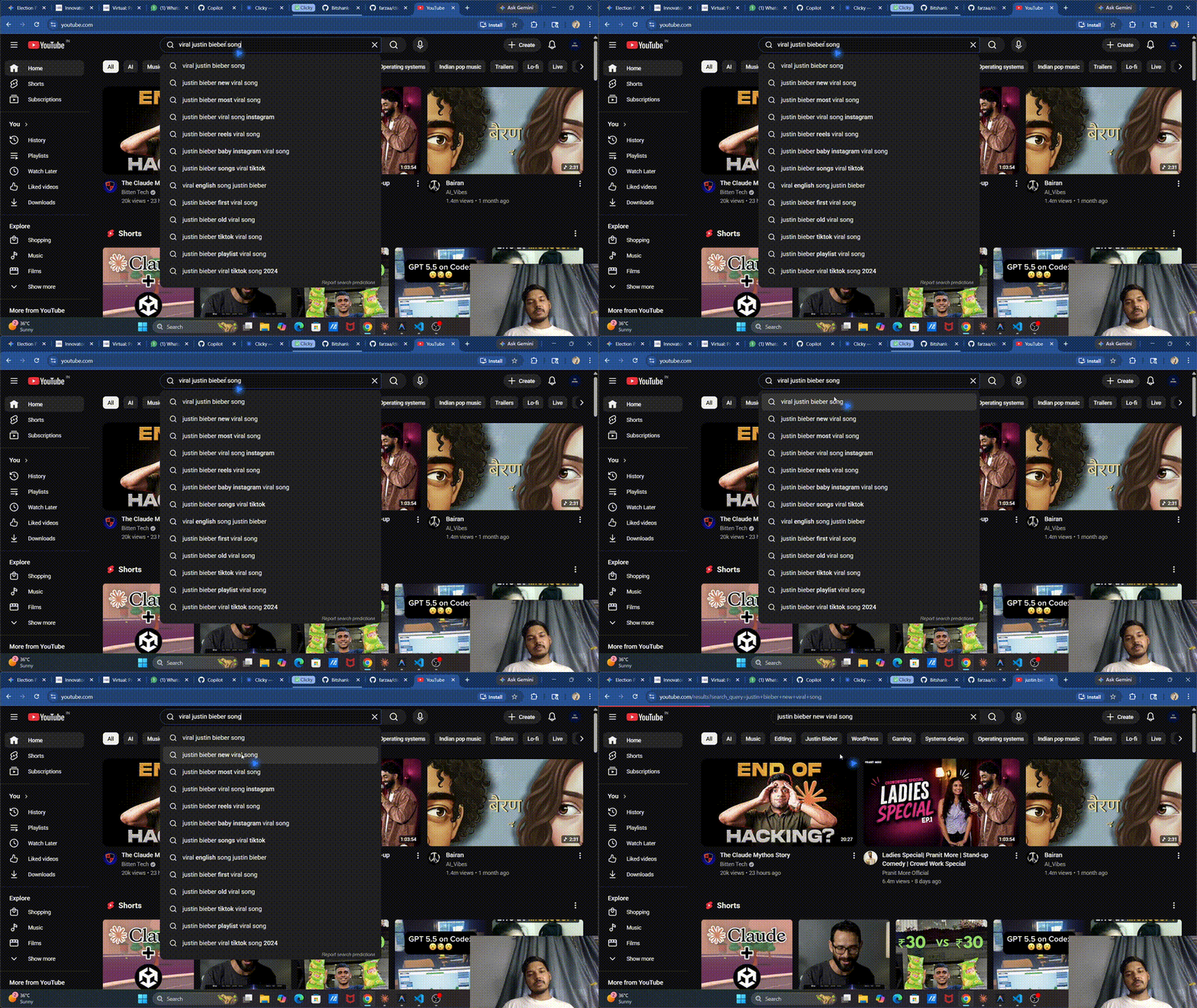
Clicky is a little AI buddy that lives next to your cursor. Hold a hotkey, ask it something about your screen, and it talks back — pointing at buttons, walking you through steps, drawing arrows on your screen. Think of it as a patient tutor sitting beside you while you learn anything: video editing, coding, a new app, whatever.
No more Alt-Tab to ChatGPT. No more typing out descriptions of what's on your screen. Just hold Ctrl + Win, speak, and Clicky handles the rest.
Works 100% offline with Ollama or LM Studio, or plug in your Claude / OpenAI / Gemini / GitHub Copilot key for the full experience.
┌─────────────────────────────────────────────┐
│  Your screen (browser, IDE, Premiere, etc.) │
│                                             │
│          🔵◂ ← Clicky, your blue buddy      │
│          (floats beside your real cursor)   │
│                                             │
│  ┌───────────────────────────┐              │
│  │  Clicky  [Claude]     —   │  ← panel     │
│  │  ● Thinking…              │              │
│  │  "The search bar is       │              │
│  │   right here ↗"           │              │
│  │  Model: claude-sonnet-5…  │              │
│  └───────────────────────────┘              │
└─────────────────────────────────────────────┘
The blue triangle sits 35 px right / 25 px below your real cursor. When you ask it to point at something, it flies there along a smooth bezier arc (teacher pace), dwells with a pulsing highlight ring, then flies back.
- Hold Ctrl + Win and speak — or tap it once and talk; Clicky answers when you stop
- The mic stays closed until you press it. For hands-free, turn on the "Clicky" wake word from the tray
- Press Esc to stop any response or TTS mid-stream
- Full multi-monitor screenshot on every query
- Describes only what it sees — never hallucinates
- Detects active window title for per-app memory
- Two-stage grid locator works with any vision LLM — Claude, Copilot, OpenAI, Gemini, Ollama, LM Studio
- Stage 1: draws a numbered 12×8 grid on the screenshot, the LLM picks a cell
- Stage 2: zooms into that cell and runs a 6×6 fine-grid pass for sub-cell precision
- Bezier arc flight with configurable teacher pace
- Pulsing highlight ring + speech bubble label on the target
- Works on any DPI scale (4K, HiDPI, multi-monitor setups)
- Locate queries → points + 1-sentence explanation (no generic text directions)
- Multi-step tasks → breaks into steps, says "Say 'next' when ready"
- "Next" / "Continue" → advances the lesson without a new LLM call
- "Repeat" → replays the last answer via TTS without re-querying
- "Stop" / "Cancel" → cancels generation instantly
- DuckDuckGo HTML scrape + concurrent page fetch — no API key needed
- Optional Tavily upgrade for deeper results
- Responses grounded in today's data with
[1],[2]citations - Always knows today's date — never gives stale answers
| Provider | How to unlock |
|---|---|
Claude (Anthropic) — default claude-sonnet-5-5 |
Tray → Setup & Diagnostics → API Keys… (or ANTHROPIC_API_KEY in .env) |
OpenAI — default gpt-6-sol |
Tray → Setup & Diagnostics → API Keys… (or OPENAI_API_KEY in .env) |
| GitHub Copilot | Free for students — device-flow login via tray |
Gemini — default gemini-3.8-flash |
Tray → Setup & Diagnostics → API Keys… (or GOOGLE_API_KEY in .env) |
| Ollama (local) | Run ollama serve — free, always available |
| LM Studio (local) | Start the local server in LM Studio's Developer tab — free, no key |
Priority chain (auto-detected): Claude → OpenAI → Copilot → Gemini → Ollama / LM Studio
Switch mid-session from the system tray — takes about a second, no restart needed.
- Claude, OpenAI, Gemini: live model list fetched from vendor APIs, 24-hour cache — a new release shows up within a day
- Lists are ordered newest-first with the recommended default on top. The first entry is the model Clicky starts on, so the default is a deliberate choice per provider: the fast, vision-capable tier of the newest generation
- Only models that can actually hold a conversation are listed: OpenAI's deprecated and Responses-only models, and Gemini's image / speech / live-audio models, are filtered out
- GitHub Copilot: live
/modelsendpoint, each model verified with a real request, 6-hour cache - Your selection survives a background refresh
- Reasoning models (GPT-5+, o-series, Claude 5, Gemini 3) are set to low effort so spoken answers start quickly instead of waiting on hidden thinking
| Provider | Quality | Key needed |
|---|---|---|
| ElevenLabs | Premium voice clone | ELEVENLABS_API_KEY |
| OpenAI TTS | High quality | OPENAI_API_KEY |
| Windows SAPI | Offline system voice (local default) | None |
| Edge TTS | Internet neural voices (optional) | None |
| Provider | Speed | Key needed |
|---|---|---|
| Deepgram | Fast, accurate | DEEPGRAM_API_KEY |
| OpenAI Whisper | Very accurate | OPENAI_API_KEY |
| whisper.cpp | 3–5× faster, local | None (pip install pywhispercpp) |
| Faster-Whisper | Local, free fallback | None |
- Separate conversation history per active application
- Context never bleeds between Premiere, VS Code, Chrome, etc.
- History cap: last 20 messages per app
- Every Q&A automatically logged to a local SQLite database
- Ask "what did we cover today?" → summary of today's session
- Ask "what did we cover this week?" → weekly digest
- SM-2 spaced repetition — Clicky reminds you to review topics at optimal intervals (1 → 3 → 7 → 14 → 30 → 60 → 120 days)
- Say "quiz me on what I should review" → flashcard session from your journal
- Journal stored at
%LOCALAPPDATA%\Clicky\journal.db
- Drag a PDF, DOCX, TXT, MD, CSV, or code file onto the Clicky panel
- Clicky reads it and uses it as context for your next questions
- Or use Tray → Journal → Attach document… for a file picker
- Supports multi-file: attach several docs and ask cross-document questions
- When your query mentions "fine print", "small text", "read that", etc., Clicky runs Tesseract OCR on the screenshot
- Extracts text too small or low-contrast for the LLM's vision to read
- Requires the Tesseract binary from UB-Mannheim/tesseract
- Gracefully skipped if Tesseract isn't installed
- Detects VS Code, Cursor, IntelliJ, PyCharm, Vim, Neovim, Sublime, etc. by window title
- Automatically injects a code-specialist system prompt addendum: prefers code blocks, includes language tags, explains algorithms step by step
- Toggle: Tray → Tutor Mode → Code Mode (auto)
| Toggle | What it does |
|---|---|
| Slow Mode | 1.7× slower bezier flight + longer dwell — easier to follow |
| Quiz Mode | Clicky asks you questions instead of answering; evaluates in one sentence |
| Privacy Guard | Skips the screenshot when a password manager / banking window is detected |
| Code Mode (auto) | Code-specialist prompt when an IDE is active |
| Multilingual | Auto-detects language, replies in kind, switches TTS voice |
| OCR Fallback | Runs Tesseract on screenshots when fine text is mentioned |
- Detects query language via
langdetect+ Unicode script heuristics - Responds in the same language automatically
- Switches the Edge TTS voice to match (Hindi → HiRA-Neha, French → fr-FR-DeniseNeural, etc.)
- 15+ languages supported: EN, HI, FR, DE, ES, PT, AR, ZH, JA, KO, RU, IT, NL, PL, TR
- Toggle: Tray → Tutor Mode → Multilingual
- Records the screen at 8 fps as an MP4 alongside a Markdown transcript of all Q&A
- Start: Tray → Lesson Recording → Start recording
- Stop: tray menu → produces
lesson_YYYY-MM-DD_HH-MM.mp4+lesson_YYYY-MM-DD_HH-MM_transcript.md - Saved to
%LOCALAPPDATA%\Clicky\recordings\(each session includes raw video, narration WAV, narrated MP4, and transcript).
Clicky can draw directly on your screen as it explains:
[ARROW:x1,y1->x2,y2]— animated arrow between two points[CIRCLE:x,y,r:label]— pulsing circle with optional label[UNDERLINE:x,y,w]— underline beneath text[LABEL:x,y:text]— floating text label
Annotations fade out after ~4 seconds and clear automatically on the next query.
- Records your mouse clicks and keystrokes while you work
- Start: Tray → Workflow Capture → Start capturing my clicks
- Stop: Tray → Workflow Capture → Stop + send to Clicky
- Ask "What did I just do?" → Clicky narrates your workflow step-by-step
- Requires
pynput(included inrequirements.txt)
- Switch TTS voice mid-session: say "change voice to [voice name]"
- Edge TTS voices:
AvaNeural,JennyNeural,GuyNeural,AriaNeural, etc. - List all 400+ voices:
python -c "from audio.tts.edge_tts_provider import EdgeTTSProvider; print(EdgeTTSProvider.list_voices_sync())"
Detects sensitive windows and skips the screenshot entirely:
- Password managers: KeePass, Bitwarden, 1Password, LastPass, Authenticator
- Sensitive pages:
login,sign in,banking,.envfiles,credit card
Create your own voice triggers — no pull request needed:
# ~/.clicky/skills/my_skill.py
import asyncio

SKILL = {
    "name": "open_calculator",
    "trigger": r"(open|launch|start) calculator",
    "description": "Opens Windows Calculator",
    "handler": open_calc,
}

async def open_calc(transcript: str, manager) -> str:
    import subprocess
    subprocess.Popen("calc.exe")
    return "Opening calculator for you."
Place skill files in ~/.clicky/skills/ — Clicky auto-loads them on startup.
- Windows 10 / 11 (64-bit)
- Python 3.11, 3.12, or 3.14
- A working microphone
git clone https://github.com/Bitshank-2338/clicky-windows.git
cd clicky-windowspip install -r requirements.txtInstalled a release build? You don't need to touch a file — open the tray
icon → Setup & Diagnostics → API Keys…, paste your key, and hit Save. The
first-run wizard offers the same screen. GUI saves are encrypted for your Windows account in %LOCALAPPDATA%\Clicky\credentials.bin; nonsecret preferences are stored separately in settings.json. Legacy developer .env files are still read, but GUI saves no longer write plaintext keys there.
Running from source? Create .env in the project root (copy from
.env.example):
# ── LLM (add whichever you have — at least one required) ──
ANTHROPIC_API_KEY=sk-ant-...
OPENAI_API_KEY=sk-...
GOOGLE_API_KEY=AIza...

# ── STT (all optional — falls back to Faster-Whisper) ──
DEEPGRAM_API_KEY=...

# ── TTS (all optional — falls back to Windows speech) ──
ELEVENLABS_API_KEY=...
ELEVENLABS_VOICE_ID=...

# ── Web Search (optional — falls back to DuckDuckGo) ──
TAVILY_API_KEY=...

# ── Ollama (local AI) ──
OLLAMA_HOST=http://localhost:11434
OLLAMA_MODEL=qwen2.5vl:3b

# ── LM Studio (local AI, OpenAI-compatible server) ──
LMSTUDIO_HOST=http://localhost:1234/v1
LMSTUDIO_MODEL=

# ── Customise ──
CLICKY_HOTKEY=ctrl+win
WHISPERCPP_MODEL=baseTray → Model → Sign in to GitHub Copilot…
→ visit github.com/login/device → enter the code shown in the terminal
Token cached at %LOCALAPPDATA%\Clicky\github_token.json. Default model: gpt-4o-mini (free tier).
python main.pyA blue dot appears in your system tray. Clicky is now running.
No API keys at all — uses local AI, local STT, free TTS:
There's nothing to configure — Clicky's default is qwen2.5vl:3b (3.2 GB), one model that reads your screen and answers text questions.
- Install Ollama → run
ollama serve(or install LM Studio and start its local server instead) - Pull the model:
ollama pull qwen2.5vl:3b(the first-run wizard does this for you) pip install -r requirements.txtpython main.py
Clicky has two Ollama model slots: a vision model for screen-aware questions (pointing, "what's on screen?") and a text model for Code Mode / journal Q&A. Both default to the same model, so there's only one download. Switch either anytime from the tray: Tray → Ollama → Vision model / Text model.
Why qwen2.5vl:3b and not something newer? We benchmarked the newer families (Qwen3.5, Qwen3-VL, Gemma 3, MiniCPM-V 4.6) against it on a 4 GB laptop GPU and on CPU only, using Clicky's real prompt including web-search results. The newer ones read a screen slightly better in places, but Qwen3.5 and Gemma 3 take over a minute per answer on CPU-only machines, Qwen3-VL can't be told to skip its hidden reasoning (so replies come back blank or slow), and Gemma 3 sprays pointing tags at questions that aren't about the screen. qwen2.5vl:3b answered in about 2 seconds on CPU, kept answers short, and correctly said so when the search results didn't contain the answer. If you have a GPU with 8 GB or more, qwen2.5vl:7b is the natural upgrade: it was the most accurate model we tested (6/6 on answering from search results, 10/10 on reading a dense screen), though on a 4 GB laptop it needed 4–12 seconds per answer.
Recommended free models (Tray → Ollama → Pull recommended…):
| Slot | Model | Size | Good for |
|---|---|---|---|
| Vision + text | qwen2.5vl:3b |
3.2 GB | Default — accurate, concise, fast even without a GPU |
| Vision + text | qwen2.5vl:7b |
6 GB | Same family, stronger — for 8 GB+ graphics cards |
| Vision | qwen3.5:4b |
3.3 GB | Newest; reads screens very well but needs a GPU |
| Vision | llava:7b |
4.7 GB | Older fallback |
| Text | qwen2.5-coder:7b |
4.7 GB | Code questions — excellent |
| Text | llama3.2:3b |
2 GB | Fastest text-only model |
| Text | mistral:7b |
4 GB | General Q&A |
Limitations vs. paid providers: slower responses, web search uses DuckDuckGo only.
For sharing with friends without Python:
# 1. Generate icon
python assets/make_icon.py

# 2. Build
pip install pyinstaller
pyinstaller clicky.spec --clean --noconfirm

# 3. Distribute
# → dist/Clicky/  (entire folder)
# → or build Setup.exe with Inno Setup using installer.iss
dist/Clicky/Clicky.exe runs on any Windows machine without Python installed. Use Settings → Manage protected API keys for encrypted per-user credentials. Legacy developer .env files and environment variables remain supported.
See BUILD.md for full packaging instructions, including the Inno Setup installer.
| Say | Action |
|---|---|
| "Where is the search bar?" | Points at it + 1-sentence explanation |
| "How do I export this video?" | Step-by-step lesson mode |
| "What's on screen?" | Screen description |
| "Search for [topic]" | Web search + cited answer |
| "next" / "continue" | Advance to next lesson step |
| "repeat" | Replay last answer via TTS |
| "stop" / "cancel" | End current lesson |
| "quiz me" | Quiz mode on current screen |
| "what did we cover today?" | Today's journal summary |
| "what should I review?" | Spaced repetition flashcards |
| "what did I just do?" | Workflow capture narration |
| "change voice to Jenny" | Switch TTS voice |
| Key | Action |
|---|---|
Ctrl + Win (hold) |
Push-to-talk |
Esc |
Stop response / TTS immediately |
Right-click the tray icon → full menu including:
- Provider switcher (Claude / OpenAI / Copilot / Gemini / Ollama / LM Studio)
- Tutor Mode submenus
- Lesson Recording controls
- Workflow Capture controls
- Journal (view folder, attach doc)
- Show/Hide Panel
main.py
  ├── CompanionManager          # async state machine + orchestrator
  │     ├── AmbientListener     # always-on mic + wake-word
  │     ├── STT provider        # Deepgram / OpenAI Whisper / whisper.cpp / Faster-Whisper
  │     ├── screen.capture      # multi-monitor JPEG (physical px + DPI metadata)
  │     ├── tutor.py            # classifiers, privacy guard, window detection
  │     ├── tutor_features/
  │     │     ├── journal.py          # SQLite Q&A log + SM-2 spaced repetition
  │     │     ├── pdf_context.py      # PDF/DOCX/TXT text extraction
  │     │     ├── ocr.py              # Tesseract OCR fallback
  │     │     ├── code_mode.py        # IDE detection + code prompt addendum
  │     │     ├── lesson_recorder.py  # MP4 + transcript recording
  │     │     ├── multilang.py        # langdetect + Edge TTS voice switching
  │     │     ├── workflow_capture.py # pynput click/key recorder
  │     │     └── collab.py           # opt-in trusted-LAN sharing
  │     ├── skills/             # user-extensible voice triggers
  │     ├── ai.web_search       # DuckDuckGo + Tavily + citation builder
  │     ├── ai.element_locator  # Claude Computer Use → exact (x, y) pixel
  │     ├── ai.model_registry   # live model lists, 24h cache, newest-first
  │     ├── LLM provider        # Claude / OpenAI / Copilot / Gemini / Ollama / LM Studio
  │     └── TTS provider        # ElevenLabs / OpenAI / Edge TTS
  ├── CursorOverlay             # transparent click-through Qt window
  │     ├── Blue triangle buddy (spring-follows cursor)
  │     ├── Bezier arc flight   (teacher-pace pointing)
  │     ├── Highlight ring      (pulsing circle on detected element)
  │     ├── Speech bubble       (label while dwelling)
  │     ├── Whiteboard annotations (arrows, circles, underlines, labels)
  │     ├── Waveform bars       (listening state)
  │     └── Spinner arc         (thinking state)
  ├── CompanionPanel            # optional chat panel with model dropdown
  └── TrayManager               # system tray + full context menu
Screenshot → JPEG (1280px max, for LLM tokens)
                │
                ▼
Claude Computer Use analyses the screenshot
→ returns (x, y) in Computer-Use space (1280px wide)
                │
                ▼
element_locator.py converts:
  CU space → physical monitor pixels
           → + monitor origin (multi-monitor offset)
           → ÷ DPI scale (HiDPI correction)
           = logical screen pixels
                │
                ▼
overlay.point_at(logical_x, logical_y)  ← correct position on any screen
clicky-windows/
├── main.py                      # entry point — boots Qt, wires all signals
├── companion_manager.py         # async orchestrator + state machine
├── config.py                    # env loading, provider detection, priority chain
├── tutor.py                     # classifiers, privacy guard, prompt builder
├── hotkey.py                    # global hotkey + Esc stop
│
├── ai/
│   ├── base_provider.py         # BaseLLMProvider ABC
│   ├── claude_provider.py       # Anthropic Claude
│   ├── openai_provider.py       # OpenAI (GPT-6 / GPT-5 / o-series)
│   ├── gemini_provider.py       # Google Gemini (via httpx)
│   ├── ollama_provider.py       # Local Ollama
│   ├── lmstudio_provider.py     # Local LM Studio (OpenAI-compatible server)
│   ├── github_copilot_provider.py  # Copilot OAuth + live /models
│   ├── element_locator.py       # Computer Use → pixel coords
│   ├── model_registry.py        # live model lists, 24h cache, filtered + verified
│   └── web_search.py            # DuckDuckGo + Tavily + citations
│
├── audio/
│   ├── ambient_listener.py      # always-on mic + wake-word
│   ├── capture.py               # PCM capture, noise-gate, auto-gain, trim
│   ├── playback.py              # cancellable audio (threading.Event)
│   ├── stt/
│   │   ├── faster_whisper_stt.py
│   │   ├── whisper_cpp_stt.py   # pywhispercpp (optional, 3–5× faster)
│   │   ├── openai_stt.py
│   │   └── deepgram_stt.py
│   └── tts/
│       ├── edge_tts_provider.py
│       ├── openai_tts_provider.py
│       └── elevenlabs_provider.py
│
├── screen/
│   └── capture.py               # multi-monitor JPEG + DPI metadata
│
├── tutor_features/
│   ├── journal.py               # SQLite Q&A log + SM-2 spaced repetition
│   ├── pdf_context.py           # PDF/DOCX/TXT extraction
│   ├── ocr.py                   # Tesseract OCR fallback
│   ├── code_mode.py             # IDE detection + code prompt addendum
│   ├── lesson_recorder.py       # MP4 + transcript
│   ├── multilang.py             # language detection + voice switching
│   ├── workflow_capture.py      # click/keystroke recorder
│   └── collab.py                # opt-in trusted-LAN sharing
│
├── skills/
│   ├── __init__.py              # skill loader + trigger matcher
│   └── example_self_mode.py     # example skill
│
├── ui/
│   ├── overlay.py               # CursorOverlay — all drawing + annotations
│   ├── panel.py                 # CompanionPanel — chat + model dropdown
│   ├── tray.py                  # TrayManager — tray icon + full menu
│   └── design.py                # shared colours, fonts, constants
│
├── assets/
│   ├── make_icon.py             # generates icon.ico
│   └── icon.ico                 # (generated)
│
├── .env                         # your API keys (not committed)
├── requirements.txt             # all Python dependencies
├── clicky.spec                  # PyInstaller build spec
├── installer.iss                # Inno Setup installer script
├── build.bat                    # one-click build script
├── BUILD.md                     # full build + packaging guide
└── LICENSE                      # MIT
| Variable | Default | Description |
|---|---|---|
ANTHROPIC_API_KEY |
— | Claude LLM + Computer Use pointing |
OPENAI_API_KEY |
— | OpenAI LLM (GPT-6 / GPT-5 / o-series) + Whisper STT + OpenAI TTS |
GOOGLE_API_KEY |
— | Gemini LLM |
DEEPGRAM_API_KEY |
— | Deepgram STT |
ELEVENLABS_API_KEY |
— | ElevenLabs TTS |
ELEVENLABS_VOICE_ID |
— | Your ElevenLabs voice clone ID |
TAVILY_API_KEY |
— | Tavily search (upgrades DuckDuckGo) |
OLLAMA_HOST |
http://localhost:11434 |
Ollama server URL |
OLLAMA_MODEL |
qwen2.5vl:3b |
Legacy single-model fallback |
OLLAMA_VISION_MODEL |
(empty → qwen2.5vl:3b) |
Ollama model for screen-aware tasks (pointing, describe screen) |
OLLAMA_TEXT_MODEL |
(empty → qwen2.5vl:3b) |
Ollama model for Code Mode + journal Q&A |
LMSTUDIO_HOST |
http://localhost:1234/v1 |
LM Studio local server URL |
LMSTUDIO_MODEL |
(empty) | Force a specific model; empty = whatever's loaded |
CLICKY_HOTKEY |
ctrl+win |
Global push-to-talk combo |
CLICKY_STT |
(auto) | Force STT: deepgram / openai / whisper_cpp / faster_whisper |
CLICKY_ACTIVE_LLM |
(auto) | Force LLM: claude / openai / copilot / gemini / ollama / lmstudio |
WHISPER_MODEL |
base |
Faster-Whisper model (tiny / base / small / medium) |
WHISPERCPP_MODEL |
base |
whisper.cpp model size (avoid .en variants for non-English use) |
WHISPER_LANGUAGE |
(empty) | Force transcription language (ISO code, e.g. de); empty = auto-detect |
RESPONSE_LANGUAGE |
(empty) | Force Clicky's reply language regardless of input; empty = auto-detect |
MIC_DEVICE_INDEX |
(empty) | Force a specific input device; empty = system default |
CUSTOM_INSTRUCTIONS |
(built-in prompt) | Full override of Clicky's system prompt — also editable live via Tray |
Clicky doesn't hear me → Check the default microphone in Windows Sound settings → Pick a different mic under Tray → Setup & Diagnostics → Microphone → Upgrade to Deepgram for better accuracy in noisy rooms
Clicky mixes languages in its replies
→ Set a fixed reply language: Tray → Reply language
→ Make sure WHISPERCPP_MODEL / WHISPER_MODEL isn't set to an English-only (.en) variant
"Thinking…" forever with Ollama
→ Run ollama serve in a terminal first
→ Run ollama pull qwen2.5vl:3b to download the model
→ Press Esc to cancel
"Thinking…" forever with LM Studio
→ Open LM Studio → Developer tab → Start Server
→ Make sure a model is loaded and LMSTUDIO_HOST includes /v1
→ If you see a context-length error, raise the context length when loading the model
Pointing at wrong location → Make sure your active LLM supports vision (Copilot gpt-4.1, Claude, Gemini, OpenAI GPT-5/6, or a vision Ollama/LM Studio model) → For Ollama: set a vision model via Tray → Ollama → Vision model → The universal two-stage grid locator works with every vision provider — no Anthropic key required
GitHub Copilot auth fails
→ Re-run: Tray → Model → Sign in to GitHub Copilot…
→ Check that %LOCALAPPDATA%\Clicky\github_token.json exists
Esc doesn't stop audio
→ Make sure sounddevice is installed (pip install sounddevice)
→ Check that no other app has exclusive access to the audio device
OCR returns nothing
→ Install the Tesseract binary from https://github.com/UB-Mannheim/tesseract/wiki
→ Add C:\Program Files\Tesseract-OCR\ to your system PATH
Lesson recording fails
→ pip install imageio imageio-ffmpeg
→ ffmpeg is bundled with imageio-ffmpeg — no separate install needed
Panel doesn't appear → Right-click the tray icon → Show Panel → Or double-click the tray icon
Clicky is open to contributors from anywhere in the world. Whether you're a student who uses it every day, a developer who wants to add a feature, or someone who speaks a language we haven't supported yet — you're welcome here.
- 🐛 Bug reports — open an Issue with steps to reproduce
- 💡 Feature ideas — open an Issue tagged
enhancement - 🌐 Translations — add your language to
tutor_features/multilang.py - 🔌 New LLM / STT / TTS providers — follow the pattern in
ai/base_provider.py - 🛠️ Skills — share your custom voice-trigger skills in a PR
- 📚 Docs — better explanations, screenshots, GIFs
# 1. Fork on GitHub, then clone your fork
git clone https://github.com/YOUR_USERNAME/clicky-windows.git
cd clicky-windows

# 2. Create a branch
git checkout -b feat/your-feature-name

# 3. Make your changes, then commit
git add .
git commit -m "feat: describe what you added"

# 4. Push + open a PR against main
git push origin feat/your-feature-name- Python 3.11+ — type hints encouraged,
async/awaitfor I/O - Keep providers self-contained in
ai/,audio/stt/,audio/tts/ - New features belong in
tutor_features/— one file per feature - All cross-thread UI updates go through
pyqtSignal— no direct widget calls from threads - Test locally with
python main.pybefore opening a PR
Look for Issues tagged good first issue — small, well-scoped tasks that don't require deep knowledge of the codebase. Just comment "I'll take this" and we'll help you get started.
- Original concept & macOS app: farzaa/clicky
- Windows port: Shashank Singh
- Pointing engine: Anthropic Computer Use API
- Local STT: whisper.cpp via pywhispercpp (same engine as Handy)
- Free web search: DuckDuckGo HTML + Tavily
- Local AI: Ollama · LM Studio
MIT — see LICENSE