


One sentence in. A finished short-form drama out — script, cast, storyboards, voiceover, timeline, mp4.
Multi-agent AI studio · reusable characters · novel→season splitting · director's control room · real-time collab · bring-your-own LLM.
一句话进,整片短剧出 —— 剧本 · 角色 · 分镜 · 配音 · 时间线 · mp4 一条龙。
多 Agent AI 创作工作室 · 可复用角色 · 长篇小说→自动分集 · 导演级控片台 · 实时协作 · 自带 LLM。


English · 简体中文 · 🔥 Pitch · 🔌 BYO LLM
Mirror for mainland China · 国内 AtomGit 托管(自动同步自 GitHub):atomgit.com/ChrisChen667788/wind-comic
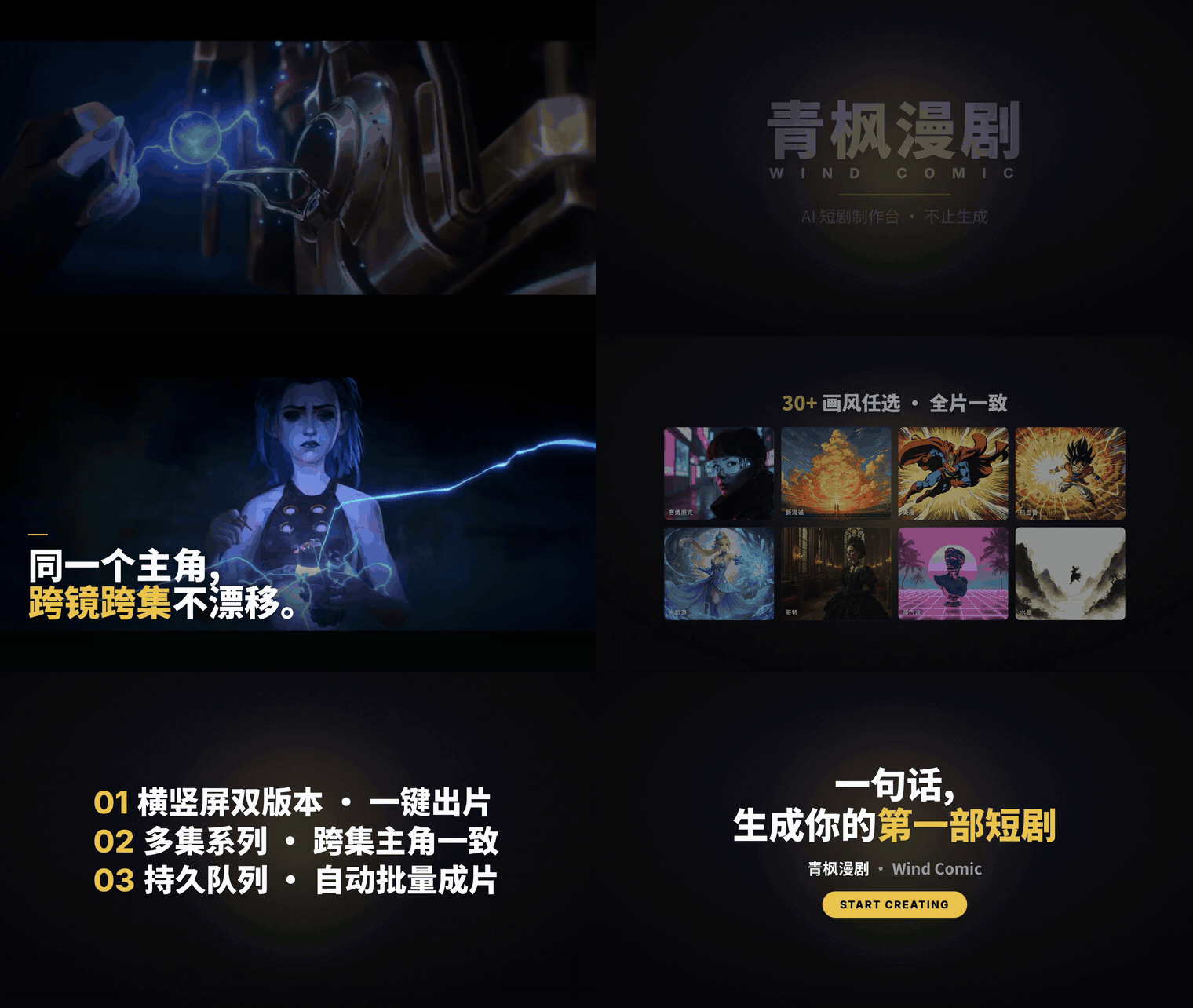
▶ Watch the full 39-second promo — with voiceover & sound
Real cinematic footage woven with motion-graphics · 8 distinct art styles · English narration · scored by the platform's own MiniMax music engine.

|
MiniMax H3 视频生成 API|秘塔科技 秘塔科技提供高性价比的 MiniMax H3 视频生成服务:768P 仅 0.09 元/秒,2K 仅 0.15 元/秒。支持原生 2K、音画同步,API 兼容 OpenAI 协议,同时支持 ComfyUI,无需自行部署 GPU。 🎁 通过 wind-comic专属链接注册,即可领取赠送额度及专属优惠。 MiniMax H3 video-generation API — MetaSota (秘塔科技). ¥0.09/s at 768P, ¥0.15/s at 2K · native 2K with synced audio · OpenAI-compatible API · ComfyUI supported · no GPU to deploy. 🎁 Sign up through the wind-comic link for bonus credits and a partner discount. |
Most "AI video" tools give you a 5-second clip from a one-line prompt. Wind Comic gives you a finished short-form drama — script, character bible, multi-shot storyboards, voice-acted lines, BGM, mouth-synced characters (indicative 2D lip bar out of the box; photorealistic face-level lip-sync via BYO wav2lip/SadTalker/MuseTalk or Kling), and a final mp4 — from the same single line.
It works because it doesn't try to be one giant model. It's an honest multi-agent pipeline where each role (Writer, Director, Producer, Character Designer, Storyboard Artist, Cameo Locker, Lipsync, Editor) is a specialist that hands off with strict consistency contracts. Plus a real-time multiplayer timeline to edit with your team like Figma for film.
   "A reborn CEO confronts his cheating ex-fiancée at her wedding."
                                       │
                                       ▼
   Writer ▶ Director ▶ Style Bible ▶ Char Designer ▶ Scene Designer ▶
   ▶ Storyboard (vision-audited) ▶ Video (multi-engine race) ▶
   ▶ TTS (per-character voice) ▶ Lipsync (Kling/Sync.so/Hailuo) ▶
   ▶ Editor (j-cut/l-cut + BGM per act + CJK subtitles) ▶ final.mp4

   + Real-time collab timeline (Yjs CRDT)
   + Bring-your-own LLM (3 env vars, 0 code change)
   + Plug-in image/video providers (12+ supported)
   + Lip-sync pipeline: viseme track → align score → drift auto-correct → engine render → back into timeline   (v10)
   + Template market: save a hit project → rate / favorite / one-click remix (with its voices)               (v10)
   + Per-project cost attribution + budget guard, four-dimension publish gate                                 (v10)
Three views of the same engine. Open on GitHub to watch them animate — flowing dashes trace live data & control paths, traveling dots are data packets moving through the pipeline.

System architecture — five layers, top to bottom. The Director threads control across the seven pipeline agents (eight roles including the Director); the LLM gateway falls back DeepSeek → MiniMax with zero code change; 12+ media engines plug in behind one router; everything lands on a dual-driver (SQLite ⇄ PostgreSQL) platform.

Sequence — the lifecycle of one idea → film request, time flowing down. Two signature beats: the Vision-Audit retry loop (auto-regenerate any shot scoring < 70) and the multi-engine race (Seedance / Kling / Veo / Vidu — first good clip wins).

Data flow — the artifact refinery. One line of text is refined stage-by-stage (TEXT → JSON → PNG → IMG → MP4); every artifact is persisted to the dual-driver DB + asset store and is independently reusable, so any stage can be re-run in isolation.
🎞️ Diagrams are animated SVG, authored as code in
assets/diagrams/— crisp at any zoom, versioned with the source. (Animation renders on GitHub; the ModelScope mirror shows static PNG.)
Every tool can generate a clip. These three let you direct one — and they compose into a single loop: inspect → locate → retake only what's broken.
Director's console (v12.316–318) — place the actors and the camera on a top-down stage; the exact blocking becomes two things a model can actually use: a precise staging directive appended to the prompt ("Lin Wan at frame left in full shot; Lu Chen right of center in wide shot"), and a layout sketch fed through the existing [STORYBOARD LOCK] channel (layout only — style still comes from the prompt). Shot size and camera angle are derived from the geometry, not typed in by hand, so lens/framing and the written spec can't disagree. A deterministic composition audit reports who is out of frame, who is occluding whom, whether the camera clips an actor — before you spend a cent generating.
Segment retake (v12.315) — hate two seconds of an eight-second shot? Retake those two. The other six are byte-copied (-c copy), not re-encoded, so the part you liked doesn't lose a generation. Shot duration is unchanged by construction, which means the compressed timeline, voice-over delays, subtitle starts and EDL record-ins need no recomputation. Takes are versioned like voice retakes — adopt or roll back.
Frame-by-frame inspection (v12.328–330) — step through a finished shot frame by frame, box the broken stretch, and hand that exact range to segment retake. Frames are extracted with accurate seek (-ss after -i, not the fast keyframe-only seek), and the timestamp under each frame uses the same frame-snapping as the retake planner — so the frame you picked is the frame it cuts at. When the strip is thinned to stay responsive, it says so; frames that fail to decode are reported, not silently skipped.
Also in this range: fonts are self-hosted so builds no longer depend on a network fetch; the director paths finally receive the target language (non-Chinese projects used to get Chinese scripts and rely on a costly after-the-fact re-translation); the in-process rate limiter bounds and evicts its bucket table (the key contained an attacker-supplied email — an unbounded memory vector), and eviction never releases an active block; collaborative comments arriving over Yjs are validated and field-whitelisted, so a peer can no longer overwrite another author's name or text.
Sketch-Lock storyboarding — every shot first renders a B/W composition sketch, then the final frame is generated locked to that composition (toggle at creation time, or per-shot in the Shot Workshop). Camera language finally survives the diffusion lottery.
Emotion-driven camera — shots missing camera movement get one derived from story beats (hook→push-in, chase→handheld, reveal→zoom-in, farewell→pull-out, emotion temperature → push/orbit/crane). Even the Ken Burns degradation follows the intended move.
Engine matrix, honestly — Veo · MiniMax (Hailuo) · Kling (official Beijing API) · HappyHorse 1.1 (Alibaba, v12.272 — joint video+audio in one pass) with a one-line env priority (VIDEO_ENGINE_ORDER=kling,minimax,veo,happyhorse), base64 first-frame channel for local assets, and an honest fallback chain: a failed shot becomes a labeled animatic, never a still image masquerading as video.
The quality loop — ffprobe-powered film health report (aspect/duration/fps/bitrate/audio/degraded shots) per project and per series; batch re-render of degraded shots (2-way concurrent); a season-export health gate so no broken episode sneaks into the compilation; an engine weather bar so you know before you hit generate.
Round-trip storyboards — export the pull sheet as CSV / Markdown / print-ready PDF (with character sheet + health appendix), edit in Excel, import it back — changed visual fields offer one-click re-render of exactly the affected shots.
Writer resilience — truncated or quote-mangled LLM scripts are salvaged (bracket-stack completion + content-quote escaping) instead of being silently replaced by a template. The real 23KB incident dump lives in the test fixtures.
v3 shipped the pipeline. v6 turned it into a production studio; v7–v9 hardened it into a platform; v10 closed the lip-sync, template-market, and cost loops. Reusable characters, a prompt IDE, novel→season auto-splitting with real voiceover, a 60-style gallery, a director's control room, team credit budgets, an industry-grade script audit (Polish Pro, v7.1), a premium design pass (v8.3), a fully-migrated Postgres backend (v9), a lip-sync delivery pipeline + template market + cost observability (v10), and a live API health board — every screen below is a real capture of the running app.

v10 landing — looping cinematic hero, 8 collaborating agents · 7 media engines · 3 consistency guards.
- 🎙️ Voice & lip-sync, end-to-end — per-character voice routing (auto by name + manual pick/audition) → TTS → viseme keyframe track → measured mouth-vs-audio alignment score (Web-Audio) → drift auto-correct → pluggable engine render (wav2lip / SadTalker / MuseTalk, BYO
LIPSYNC_API_URL) → written back into the timeline. One-click whole-film lip-sync with a Vision QC self-heal loop (weak shots auto re-render). - 🧩 Template market — turn a hit project into a reusable template (style + multi-ref elements + pacing + voices), with a preview clip, ★ ratings & ♥ favorites, quality score, and one-click remix that prefills a new project.
- 💴 Cost observability + budget guard — per-project cost attribution by stage (LLM / image / video / TTS / lip-sync), saving hints, and an ok/warn/over budget guard. The publish-readiness gate is now four-dimensional: picture-vs-script · consistency · lip-sync alignability · measured mouth-vs-audio.
 创作工坊 — one line → film: style presets · multi-ref element shelf · character lock · live preview · gold-neon genre gallery |
 模板市场 — preview clips · ★ ratings / ♥ favorites · quality score · one-click remix (carries voices) |
 成片质检 + 配音口型 — four-dimension publish gate · consistency trend · viseme track (animated mouth + measured alignment) · per-shot Vision scores |
 技术监看 · 成本归因 — per-stage cost share (video / image / LLM / TTS / lip-sync) + saving hints |
Every screen above is a real capture of the running v10 app. Design language (v8.3 Taste pass — Plus Jakarta Sans + Phosphor icons, gold machined-bezel cards, spring motion, AI gold-neon genre emblems) carries across all of them.
Notes are consolidated per major version — the full minor-by-minor changelog lives in
VERSIONS.md/ROADMAP.md.
| Major version | What landed |
|---|---|
| v6 · Production studio | Character Studio (reusable cast, multi-view turnaround + 8-field DNA identity lock, cross-project Cameo IP) · Prompt Workbench (@-mention assets + compile-preview + readiness score) · Long-form Intake (novel → chapter-aware episodes, real TTS narration + burned SRT, N-episode parallel) · 60-look Style Gallery · Director Console (4-stage pipeline, stale-detection, single-stage rerun) · Team Workspace (credit pool + RBAC + real invite links) · API Health Board (live gateway status + balance) · top-tier model repointing (veo3.1-pro) + supplement gateway backfilling TTS / Midjourney / Kling. |
| v7 · Platform hardening | Writer/Director on DeepSeek deepseek-v4-pro with a universal MiniMax fallback on any error / out-of-credits / timeout (3-tier LLM health board) · tiered models (deepseek-v4-flash for speed) that cured the reasoning-token instability · Polish Studio Pro — industry script audit: AIGC-readiness score, Save-the-Cat 3-act beat-gap detection, on-the-nose dialogue flags, per-character identity anchors. |
| v8 · AI director station + premium design | Per-shot cinematography console (景别/机位/镜头/运镜/焦点) + continuity & seed lock + emotion/rhythm curves + JSON↔visual parameter linkage, all converging into an 11-tab director station · Taste design pass: Plus Jakarta Sans + Phosphor icons, gold machined-bezel cards, spring motion, an asymmetric bento dashboard, 60 AI-rendered style thumbnails, and AI gold-neon genre icons (18 templates + 5 modes + 8 looks). |
| v9 · Postgres platform + monetization | Full SQLite↔Postgres dual-driver cutover — 17 core tables/clusters migrated to async repos, verified end-to-end on Postgres with transaction commit + rollback atomicity (default stays SQLite, same file, zero split-brain; DB_DRIVER=pg is opt-in) · multi-platform distribution-pack generator (抖音 / 快手 / 视频号 / 小红书 / YouTube Shorts / B站) · real binary AAF export (MS-CFB container, for Avid) alongside EDL / FCPXML · plus quality & consistency depth (publish-readiness gate, rebirth loop, consistency report) and the Kling-style multi-reference + one-click film fusion. |
| v10 · Lip-sync delivery · template market · cost (Stage 16) | Voice & lip-sync end-to-end — per-character voice routing (auto + manual audition), viseme keyframe track, measured mouth-vs-audio alignment + drift auto-correct, pluggable engine render (wav2lip/SadTalker/MuseTalk) plus a zero-config built-in 2D engine that works out of the box (no BYO key), written back into the timeline, one-click whole-film with a Vision QC self-heal loop · Template market — save→rate/favorite→one-click remix (carries voices), preview clips, quality score · Cost observability — per-project stage attribution + budget guard, and a four-dimension publish gate (picture · consistency · lip-sync · measured alignment). 2135 tests green on both drivers. |
| v12.49–v12.80 · Commercial Ad Factory (Stage 22) | 电商/品牌广告工厂全链 — 一句 brief(或贴商品 URL 自动出 brief)→ 竖屏成片:现代写实+photoreal 双硬锚(Director 跑偏古装/3D 的实测病根双修 + plan 确定性净化保险)· 结构化 Hook/CTA 文字卡(ffmpeg drawtext 零乱码,Hook 公式化选句:问句>感叹,批量 Hook 变体 A/B,品牌色可配)· karaoke 词级扫光字幕(对齐 TTS 真实时长,抖音/小红书安全区避让)· BGM sidechain 自动闪避 · 《广告法》合规净化(绝对化用语/医疗红线,全入口覆盖)· 质量三防线+账本(逐镜 VLM 门禁 photoreal/烤字/畸变→定向重生 · 视频瞬时错误同引擎重试 · 坏 mp4 完整性拦截 · 失败镜 Ken Burns 兜底保时长 · quality_report 健康分)· 发布预检(三平台硬指标)· rembg 商用安全抠图(产品跨镜一致)+ Kling Elements 打通 · LLM 网关 429/503 健康感知自动降级。2712 tests green。 |
| v12.82–v12.120 · Ad Factory 深化 + 供给链扩容 | 视频通道扩容(qyt-vidu(Vidu Q3 via 网关 /ent/v2)入链 pri=75 · minimax 轮询超时可调 · Seedream 4.5 图像尾梯队(720x1280 原生竖屏,实测 14s/张))· 素材质量闭环(Pexels B-roll 双层兜底 + 人设感知检索 + 烤字/字幕 VLM 抽查(B-roll 与 AI 镜双向)+ 结果缓存 LRU)· 响度归一 -14 LUFS(实测 -13.62/-1.42 dBTP 命中平台标准)· 成片抽帧封面精选(VLM 打分,零 T2I 额度)+ 发布包封面链(chosen>AnyText>候选)· karaoke 长台词折行+行内缩字(libass 实渲验证)· 英文广告链(语言感知 CTA + 6 条英文合规红线)· 合规词表可扩展(env+JSON)· 导演/编剧自检修正轮入账 + 导演台 HEALTH KPI + 包装车间结构化结果面板 · LLM 健康缓存全端点对齐(拥堵实测:fable-5 断粮 403 → opus→sonnet→OpenRouter→MiniMax 五级无感降级)。2780 tests green。 |
Features that still ship. Director console · novel→season · finished-film station · team workspace · Cinema timeline are refreshed to v10 (live demo data). The style gallery, API health board, Polish Pro audit, and character turnaround are kept as earlier (v6–v8) captures because they show fuller sample output (the full style grid / live balances / a complete Pro audit / a 3-view turnaround sheet).
Every stage at a glance — what's ready, what's gone stale because you changed something upstream, and a one-click rerun that knows exactly which downstream stages it invalidates.

Paste a full novel; Wind Comic splits it into episodes by chapter markers (or by target length), picks a narration mode, and can render a real narration track + burnable subtitles for the whole season in parallel.

Lock a consistent visual identity before you generate. Search, filter by category, and apply any preset straight into the creation workshop.

Live status for every model and gateway: 正常 / 额度用尽 / 配置缺失 / 不可达, with real balance read-out and a "去充值 / 补配置" hint. Keys are never stored or returned.

Paste a draft, hit Pro: deepseek-v4-pro returns a polished script plus a full industry diagnostic — AIGC-pipeline readiness score (e.g. 85/100), style profile, first-3-second hook strength, Save-the-Cat 3-act breakdown with missing beats called out, on-the-nose dialogue lines flagged, and per-character Cameo/Seedance identity anchors so every shot stays on-model.

Every character gets a real 3-view turnaround sheet (front / three-quarter / back) with a locked structured "DNA prompt" — face geometry, skin tone, signature props, color palette, silhouette identity, full body pose — so the same actor reads identically across all 6 shots. The Cameo IP economy lets the same character travel between projects.

One project, eleven tabs of cockpit-grade control: 导演台 · 剧本 · 角色 · 场景 · 分镜 · 连贯性 · 视频 · 镜头工坊 · Cinema 时间线 · 节奏分析 · 成片质检 · 技术监看 · 参数联动 · 评论协作 · 完整播放. The finished film plays right in the workspace with a 90/100 audit badge and one-click mp4 / platform export.

 Credit pool + per-member allocations, RBAC, real invite links. |
 Multi-track timeline; narration audio + subtitles burned in. |
| You are... | What Wind Comic gives you |
|---|---|
| Vertical short-drama creator (霸总 / 重生 / 战神 / 古装) | Trope-aware Writer, hook-first shot 1, reversal density audit, cliffhanger detection, 9:16 default |
| Content marketing team | 1 idea → 30-second polished ad with consistent characters across cuts, real Chinese subtitles burnt in, brand-safe negative prompts |
| Indie filmmaker / video artist | Style Bible locks the visual identity across all shots, McKee-structured story beats, Logic-Pro-style multi-track timeline, real BGM waveform editor |
| Comic / manhua adaptation studio | Script → storyboards in your chosen art style, character consistency via cref+sref+DNA, drag-rearrange shots, regenerate single shots |
| Educator / explainer | Pacing audit warns when content is too flat, conflict-score per shot, suggestions for hooks |
| Open-source builder | Swap any LLM with 3 env vars (OpenAI / Anthropic / DeepSeek / Qwen / Kimi / OpenRouter / Ollama local — all work) |
Director plans the story → Writer drafts dialogue under McKee structure → Style Bible Frame locks the look → Character Designer extracts an 8-dimension DNA signature of each character → Storyboard renders with Vision Audit (auto-regen on <70 score) → Video producer races multiple engines (Minimax / Veo / Kling) → Editor cuts j/l-cut on emotional beats and burns CJK subtitles.
We render one canonical "key art" frame from the Director's plan, then pass it as the first --sref of every subsequent storyboard render. Net effect: all 6 shots feel like they came from the same show, not 6 random Midjourney runs. (Most competitors only carry a 2-frame rolling chain — shot 6 doesn't know what shot 1 looked like.)
Writer prompt detects 短剧/漫剧 genres and switches to vertical canvas + injects proven hook patterns (重生回到 N 年前 · 当街掌掴 + 秘密身份 · 系统提示音突响 · etc). McKee 3-act still backs it; tropes are the surface.
The garbled-Chinese-text-in-AI-video problem solved properly: we strip dialogue text from the video prompt (so the model doesn't try to draw garbled glyphs) + add aggressive negatives (--no text --no chinese --no captions) + post-bake real subtitles with ffmpeg subtitles filter using a system CJK font (PingFang / Noto Sans CJK).
Beyond reference image hacks, we run each character's turnaround sheet through Vision LLM to extract structured features (eye shape / jaw angle / hair style / signature outfit etc.), then inject as natural-language anchor into every shot prompt. Combined with cameo-vision-retry: if a shot's character match scores <75, we auto-regen with boosted cw.
- 3 tracks: shots / BGM / subtitle
- Real BGM waveform decoded via Web Audio API (not procedural)
- Drag-to-retime + edge handles to resize duration
- Auto-snap to neighbors within 0.4s threshold + hard-clamp on overlap
- Real-time multiplayer: Yjs awareness paints other users' cursors live, presence avatars show which tab each collaborator is in, Y.Map locks prevent two people editing the same segment
- Project invites with viewer/commenter/editor role gating
Kling lip-sync API for talking heads, with Sync.so and Hailuo as auto-fallback. The pipeline strips dialogue from the prompt so the model only generates lip motion; we then sync the lips to the TTS audio in post. Real-machine limits: dialogue audio must be ≥ 2 seconds and the source video must be reachable at a public URL; ja/ko/ru currently degrade to no lip-sync (honest skip, surfaced in the engine-weather panel).
After Writer finishes, we score each shot 0-10 on a Chinese-conflict-word dictionary + detect emotional polarity reversals + cliffhanger keywords.
v12.275 turned scoring into diagnosis. An average score hides the difference between a story that builds and one that peaks in shot 1 — [1,2,4,9] and [9,4,2,1] both average 4. So v2 adds four things the average cannot see:
- Conflict-curve shape — least-squares slope + peak position + peak prominence, classified as
escalating/flat/front-loaded/no-climax. - Drag-segment localisation — names the exact shot range (e.g. "shots 3–5") where conflict flatlines, instead of reporting one global number.
- Opening density — the first third is audited separately, because completion rate is decided there.
- Duration rhythm — v1 never looked at
duration; v2 flags both uniform-length monotony and long-take pile-ups.
Every finding points at the shots to change. All pure functions over existing fields — no extra LLM calls, no added cost.
Every text-LLM call (Director / Writer / Vision / Audit) goes through one OpenAI-compatible chat/completions endpoint. Want to swap to DeepSeek-r1 / GPT-4o / Claude (via OpenRouter) / Qwen-Max / local Ollama? Edit 3 lines in .env. Zero code change. See docs/llm-providers.md for the full matrix.
Every feature listed above is in main, type-checked, unit-tested, and visible at /projects/[id] if you npm install && npm run dev right now.
Lineup verified 2026-08-31 (Artificial Analysis arena; 6 parallel web-research lenses + key figures independently re-checked. Full analysis:
docs/COMPETITIVE-GAP-2026-08.md): the top slot changed hands, and a Chinese model took it — T2V-with-audio: Wan 3.0 (1242) → Gemini Omni Flash (1237, down from 1244). New entrant xAI Grok Imagine Video 1.5 (Jun 16): 7 simultaneous visual reference anchors (character + scene + prop + style) plus native audio and voice cloning, $0.08 (480p) / $0.14 (720p) / $0.25/s (1080p) — more reference slots than our current cref+sref pair. Kling 3.0 remains the all-round pick for short drama (native 4K / 60fps / 15s / 6 coherent shots / built-in multilingual dialogue + lip-sync, $0.084–0.112/s); Veo 3.1 (first shipped 2025-10-15; 4K and vertical added 2026-01-13) can reach 60s+ via Scene Extension — but that is stitching; the single-generation ceiling is still 8–10s. It uses its own joint audio-visual generation (Lyria 3 is a separate Google music model, not Veo's audio component), from $0.40/s. Note: Veo 3.1's own T2V+audio Elo is ~1091 — the 1237 on the board belongs to Gemini Omni Flash, a different product. ✅ The Sora 2 API shutdown (2026-09-24) is confirmed by OpenAI — and this project has been guarded since v12.173/207: warn before the date, auto-drop from the model chain after it (falling back to veo/kling), throw only if the chain empties (tests/v12-173-sora-sunset.test.tslocks it). Not an open action item. 🇨🇳 The domestic camp broke through on both shot length and reference count — and two engines we already ship are behind. Seedance 2.5 (7-31) and Wan 3.0 (8-24 GA) both do native 30s single takes; Seedance accepts 50 reference inputs (token-billed, ¥42–70/M tokens), Wan 3.0 runs ¥0.42/s at 720P and converts documents straight to video (PPT/Word/PDF → 30s). Vidu Q3 is the only Chinese model explicitly positioned for short-drama industrialisation (7 reference images with multi-subject locking, 6 cinematic effect packs, lip-sync driving; Turbo 1080p ≈¥0.41/s). PixVerse C1 (4-08) is the most narrowly short-drama-vertical of all (storyboard-grid output + multi-speaker lip-sync).⚠️ Two findings about our own stack, which matter more than any competitor: ①services/minimax.service.ts:240defaults toMiniMax-Hailuo-2.3(nothing overrides it in.env.local, so that is what actually runs) — but 2.3 / 2.3-Fast are marked legacy by the vendor; H3 (V2 API) is the recommended path, and this vendor has pulled an endpoint before with no notice (Music API: 410 + 2153). We list MiniMax H3 as a competitor column in the table below while still calling its previous generation. ② our two Vidu call paths disagree:qyt-vidu.service.tspinsviduq3, whilevidu.service.tssends no model field at all and rides whatever the vendor defaults to — the same disease as Midjourney「no version pinned anywhere, gateway default wins」: when the vendor changes its default our behaviour changes silently, and we cannot reconstruct afterwards which model produced a given shot. Both are queued as v12.402 / v12.403.This round re-checked every high-risk figure with an independent second search, and two claims I had already written into this README were overturned: Veo 3.1 first shipped 2025-10-15 (2026-01-13 was a feature update), its 60s+ is Scene Extension stitching — the single-generation ceiling is still 8–10s, and Lyria 3 is a separate Google music model, not Veo's audio component; and Runway Gen-4.5 has had native audio since 2025-12-11 — the earlier draft called its absence a fatal flaw, which was simply wrong. Elo figures are arena snapshots and move with voting. ⭐ BYO 架构再次接住这波:榜上模型基本都开放 API,填 key 即成为本管线可调度的引擎 —— 竞品越强,本管线越强。
🔴 We overclaimed last round — four "only we have this" claims retracted (verified 2026-09-03). This is not competitors catching up; the claims were too broad to begin with: ① "EDL/AAF export is unique to us" — Descript has had it: Timeline Export covers Premiere XML, FCPXML, Reaper (EDL) and Pro Tools/Logic (AAF). ② "the only MIT, self-hostable end-to-end AI short-drama platform" — false:
EvoLinkAI/ai-short-drama(MIT + Docker + novel→script→storyboard→image→video→voice→film) qualifies too, alongside LocalMiniDrama, Toonflow, huobao-drama and others. ③ "BYO multi-provider registry is unique" — PopShort.AI already ships cross-vendor models (Veo 3.1 / Kling / Seedance / Nano Banana Pro). ④ "no competitor does pacing/reversal auditing" — Volcano Drama publicly claims a multi-agent verification mechanism with 200+ shot strategies optimising conflict, reversal and climax. What survives, stated narrowly: Volcano Drama optimises inline during generation, and Descript exports but has neither pacing audit nor an open licence — so as of 2026-09-03, no single product has all three of「pacing audit hardened into an independent blocking engineering gate + EDL/AAF export + open-source self-hostable for commercial use」. Note this is narrower than last round: "pacing audit" alone no longer holds; it must be "an independent blocking gate". Open-source scale: OpenMontage 54.7k★ (AGPL), ViMax 12.2k★ (MIT), DramaClaw 4.8k★ (Elastic 2.0, not FOSS), BigBanana 1.8k★ (non-commercial), Novella AI 89★ (MIT). Full analysis:docs/COMPETITIVE-GAP-2026-09.md. v12.214→244 双线推进。产品层:GPT Image / Nano Banana(Gemini)接入插件式图像 provider 链(issue #11,社区 @flobo3 提议,OPENAI_IMAGE_ENABLED/GEMINI_API_KEY门控、原生 i2i 接角色一致性契约);多集连续生成补上「剧情记忆」(第 N 集 Writer 注入前几集前情提要 + 承接纪律,对标红果/阅文的 60~100 集连续,此前各集独立成篇)。平台/工程层:六轮独立对抗复检把安全洞从 CRITICAL 到 LOW 全清(SSRF 逐跳重验重定向 + IPv6 全隧道变体 / serve-file 签名能力 URL / WebSocket 鉴权 / 预算护栏),并把反复踩的「改了守卫却没跟到消费方」这个病固化成 CI 入库门禁(npm run gate:consumer,零容忍,上线即抓到 2 个人肉复检漏掉的真 SSRF)。 结论不变:生成层已是红海(竞品在出片/多镜/音频都第一梯队),Wind Comic 护城河收窄到「制作/平台层」——节奏审计、智能剪辑、字幕烧入、协作、自托管、开源、BYO。
| Capability | Veo 3.1 | Kling 3.0 | Seedance 2.5 | Gemini Omni Flash | MiniMax H3 | ViMax (open-source) | Wind Comic |
|---|---|---|---|---|---|---|---|
| Multi-shot story from one prompt | ✅ storyboard mode | ✅ multi-shot native, 30s single take | ✅ 12-agent script→video | ✅ 8-agent script→edit pipeline | |||
| Character consistency across shots | ✅ | ✅ | ✅ up to 50 reference inputs | ✅ 多模态统一 | ✅ reference-to-video | ✅ character extractor agent | ✅ cref + sref + 8-dim DNA + vision retry |
| Style coherence locked | ✅ | ✅ | ✅ | ✅ | ✅ Style Bible Frame | ||
| Native dialogue + SFX audio | ✅ | ✅ 多语对白+口型 | ✅ | ✅ 4 模态原生一体 | ✅ 原生立体声 | ❌ 无配音模块 | ✅ per-character TTS + lip-sync |
| Real CJK subtitles (burned-in) | ❌ | ❌ | ❌ | ❌ | ❌ | ❌ | ✅ libass + open-license CJK font burn |
| Vertical drama tropes | ❌ | ❌ | ❌ | ❌ | ❌ | ❌ | ✅ 12 templates + 9:16 default |
| Real-time multiplayer timeline | ❌ | ❌ | ❌ | ❌ | ❌ | ❌ | ✅ Yjs CRDT + Y.Map locks + cursors |
| Self-hostable | ❌ | ❌ | ❌ | ❌ | ✅ 本地部署 | ✅ Next.js + SQLite/Postgres | |
| BYO LLM (OpenAI / Claude / DeepSeek / local) | ❌ | ❌ | ❌ | ❌(它自己就是模型) | ❌ | ✅ 12+ providers via .env | |
| Open source | ❌ | ❌ | ❌ | ❌ | ✅ MIT | ✅ MIT | |
| Per-shot regenerate with custom prompt | ✅ | ✅ motion brush | ✅ 对话式迭代编辑(招牌能力) | ✅ video-edit 端点 | ✅ + reference image upload | ||
| Pacing / conflict audit | ❌ | ❌ | ❌ | ❌ | ❌ | ❌ | ✅ v2 (v12.275): shot score + reversal detection plus conflict-curve shape (escalating / flat / front-loaded / no-climax), drag-segment localisation to exact shot ranges, opening-density check, and duration-rhythm analysis — every finding names the shots to fix |
| Smart editing (beat-snap + emotion pacing + one-instruction style) | ❌ | ❌ | ❌ | ❌ | ❌ | ✅ beat-snap · emotion pacing · emphasis · transition aesthetics · "fast & hype/slow & lyrical" in one line (BYO LLM) | |
| First+last frame lock (image_tail cut-to-cut coherence) | ❌ | ✅ | ✅ | ✅ (I2V) | ❌ | ✅ Kling FLF wired into main pipeline, per-shot tail-frame picker | |
| Multi-character face cast library (post-build editable) | ❌ | ✅ 主体库 | ✅ 角色管理 | ❌ | ✅ 3-slot cast + cross-shot subject_reference injection | ||
| One-click localization (script + re-voice) | ❌ | ❌ | ❌ | ❌ | ❌ | ✅ 8-lang translate → apply → re-TTS, honest degradation | |
| Royalty-free AI BGM per story | ❌ | ❌ | ❌ | ❌ | ❌ | ❌ | ✅ MiniMax music-2.6, style-prompt → project BGM |
| Per-shot auditable decision log (engine/cost/consistency) | ❌ | ❌ | ❌ | ❌ | ❌ | ❌ | ✅ decision log + cost drill-down + quality score |
| Emotion-aware TTS (mapped to native enum) | ❌ | ❌ | ✅ CN emotion → MiniMax speech-2.8-hd enum, live A/B verified | ||||
| Lip-sync wired into pipeline (auto per dialogue shot) | ✅ | ✅ | ✅ 原生 | ❌ | |||
| Full-app i18n (zh/en/ja/ko/ru, all UI) | ❌(是模型不是 app) | ❌ | ✅ 5-language core UI, ~400 keys (component-level string cleanup ongoing) |
Cells marked
⚠️ = the feature exists but in a limited / locked-down form (e.g. "you can only do this on a paid Pro tier through a UI panel").
本节数据全部来自联网检索(艾媒、DataEye、克劳锐、前瞻、新华网、广电总局公开文件等),含对本项目不利的事实。我们认为写清楚赛道的真实经济结构,比堆一个漂亮的 TAM 更有用。
| 指标 | 数值 | 口径 |
|---|---|---|
| 中国微短剧市场 | 2025 年破 1000 亿元(2024 为 504 亿,+35%) | 全年产值 |
| 2026 预测 | 约 1200 亿元,月活维持 7.18 亿量级 | 多家机构一致预测 |
| AI 漫剧细分 | 2025 年 189.8 亿元,同比 +276%;2030E 破 850 亿 | 艾媒咨询 |
| AI 渗透率 | 2026 Q1 新上线 12.8 万部中约 12.2 万部有 AI 参与(>95%) | AI 已是默认生产方式 |
| 出海 | 2025 产值约 $40 亿,海外 App 双端内购 $20.3 亿(+115%);中国玩家占全球约 80% | ReelShort $4.32 亿 / DramaBox 约 $3.7 亿 |
| 传统真人微短剧 | AI 管线 | |
|---|---|---|
| 单部成本 | 30–150 万元(精品 150–300 万) | 2–30 万元(纯 AI 漫剧 2–10 万) |
| 周期 | 15–30 天 | 1–30 天 |
| 团队 | 40 人以上剧组 | 3–10 人 |
| 每分钟成本 | 约 1 万元 | 100–4000 元 |
综合降本 80–90%。 极端案例《安徽小木匠》制作成本 2900 元、收益约 50 万元(ROI ≈ 170 倍)。
① 制作只占总成本 7.5%,投流占 70–85%。 前瞻网口径:平台广告投放 82.5%、制作 7.5%、演员 5%、剧本 1.5%。这意味着「把制作成本再砍一半」对项目盈亏几乎无影响 —— 任何以「更便宜地出片」为唯一卖点的工具,价值天花板极低。
② 单位经济已经很薄。 CPM 从 2025 下半年约 60 元/千次跌到 2026 年 15–30 元;标准 ROI 仅 1.03–1.07(东南亚出海较优,1.2–1.5)。约 90% 的 AI 短剧公司处于亏损,AI 漫剧爆款率不足 0.1%,头部 5% 项目吞掉 70% 行业利润。
③ 平台正在给「纯 AI 生成」降权。 2026 年抖音/爱奇艺/腾讯视频推出分级分账新政,削减无真人出镜的全 AI 短剧保底资源,转而扶持「真人 + AI 协作」。
- 拉高成品率与质量下限,去够那 <0.1% 的爆款率。 节奏/冲突审计、逐镜 Vision 质检与自动重生、角色一致性(DNA + 嵌入余弦)、发布预检 —— 都是在减少废片,而废片率才是这门生意的真实杀手。
- 能交付进专业剪辑线,支撑平台正在扶持的「真人+AI 协作」。 EDL / FCPXML / 真二进制 AAF(MS-CFB,给 Avid)导出 —— AI 出的素材可以进人类剪辑师的工程,而不是只能整片直出。这是当前全部已查竞品的共同空白。
- 自托管 + 开源 + BYO key,服务 B 端代工与品牌定制。 行业正从 C 端投流转向文旅/品牌定制 B 单(客单价数十万至百万级),这类客户对数据不出私域与成本可控有硬要求 —— 闭源 SaaS 天然做不到。
广电总局《微短剧发展管理办法》2026 年 9 月 1 日施行:
- AI 生成/辅助制作的微短剧,须在每集显著位置标注「AI创作」或「AI辅助制作」,字体不得模糊缩小;
- 视频元数据须嵌入 AI 生成溯源信息;
- 三级分类备案 —— 一/二级须播出前取得省级及以上审核许可,无备案不得发行、不得参评。
本项目当前状态(诚实披露):该办法约束的是内容播出/发行方,不是开源工具本身;本项目不运营内容,故不直接适用。工具侧已提供的手段:v12.222 的抖音直发强标
aigc_info+ 出海打包结构化 AI 声明(未确认即 422)+ 成片角标(AI_WATERMARK=1开启,文本可用AI_WATERMARK_TEXT覆盖为「AI创作」)。尚未提供:视频元数据溯源字段写入。若你要把成片投放到中国大陆平台,请自行开启角标并按平台要求完成备案与标识 —— 合规责任在运营者一侧。
Real puppeteer captures of the running app (node scripts/capture-v12.mjs). 核心迭代:
- 阶段十九 AI 拉片复刻(v11.1.x):拉片五栏真值表(出厂参数,非 AI 看图猜)· 外部视频 ffmpeg 拆条 + BYO Vision 打标 · 替换工作台(「全员换猫」级全局替换)+ 复刻起片(保原片镜头结构/时长)· 复刻保真度对照 · 存为私有模板。
- 项目/资产管理(v11.2.0):我的项目 / 我的资产 删除 + 下架(级联清理 + 属主守卫)。
- 模型雷达(v10.6.3):一键扫描各 API 最新模型 + 同家族自动升级(四护栏 + 回滚)。
- 钩子审计三指标(v10.6.2):开场 3 秒钩子 / 集尾悬念 / BGM 卡点对齐率。
- 阶段二十 A 智能剪辑(v12.0.x,五刀全交付):卡点剪辑(切点吸附音乐拍点)· 情绪节奏曲线(峰值镜 breathe / 动作镜快切)· 侧重强调(关键镜不压 + 沉稳转场)· 转场审美(按镜头关系选转场)· 一句指令调风格(v12.0.4,BYO)——「快节奏燃向」/「慢叙抒情」一句话调 pacing 力度 + 转场软硬,无 key 走规则、配 key LLM 解析自由文本。
- 阶段二十 B 预览音频(v12.1.x):片段预览叠播配音(静音裸片 + 同步配音轨)+ 成片音频体检自愈(ffprobe 缺流补轨)。
- 阶段二十一 角色/资产一致性升级 · 全局资产记忆库 v2(v12.2.x,五刀全交付):对标同构竞品 OiiOii「角色高维特征向量 + 跨场景一致性」——名称归一修 DNA 漏注入 · DNA/场景锚落库(rerun/重启复用、早镜不漏) · 给
global_assets.embedding死列通电(BYO 文本嵌入 + 内存余弦检索) · 建角色入口「相似角色」推荐一键复用(防重复建/跨集漂移) · 身份漂移检测(逐镜视觉 embedding 余弦距离标 outlier 漂移镜)。全程无 key 走确定性地板(精确名+文本匹配),有 key 向量增强,诚实降级。 - 安全加固(v11.1.4):JWT 公开兜底密钥根除(进程级随机密钥,旧泄露值作废)。
| 我的项目 · 删除/下架管理 | 拉片表 + 复刻工作台 |
|---|---|
 |
 |
| 素材库 · 资产管理 | API 健康 · 模型雷达 |
|---|---|
 |
 |
| 钩子审计三指标 | 一句指令调剪辑风格(v12.0.4) |
|---|---|
 |
 |
| 片段预览音频:三态徽章 + 带声试听(v12.1.2) | |
|---|---|
 |
左:带配音(TTS 叠层)+ 带声试听开关 · 右:片段无独立音轨(成片含配乐+配音) |
完整逐版本核心迭代见 VERSIONS.md;阶段计划见 docs/stage18–docs/stage20。
全部由
node scripts/capture-v12-425.mjs对着本机真实数据跑出来。脚本带空壳检测与近重复检测: 页面没渲染出来、或者「点了 tab 但视图没变」的,一律删掉并如实报告 —— 一张截图冒充两张,比少一张更糟。📚 完整 18 张 + 每张的实现逻辑与工作流架构说明:docs/SCREENSHOTS-v12.425.md (单独成文是为了不让首页替访客扛下载量 —— README 引用媒体有 12MB 预算门禁。) v12.426 补记:上面「我的项目」那张(
docs/screenshots/v12/01-my-projects-manage.jpg)已重拍。 旧图里卡片大半是渐变占位 —— 不是没作品,是封面被冻结成了一次失败的快照:流水线末尾抄一份第 1 镜的imageUrl就再不重算,于是出图全挂时的 mock 兜底图被永久写死(30 个项目里 12 个如此,其中 3 个明明各有 11~12 张真分镜还活着)。现改为读时解析,并清掉了 21 个夹具/无素材项目(下架,可一键恢复)。
| 角色转身图 · v12.425 修的就是这里 | 导演台 · 全链路控片 |
|---|---|
 |
 |
立绘原生 896×1152 竖构图,修前被塞进 355×200 横框 + object-cover,裁掉 56%,必须点全屏才看得到完整图。现在框比例跟素材走、填充改 object-contain。 |
四个环节各自可寻址:剧本 / 角色·场景 / 分镜 / 成片,任一环单独「编辑」或「重跑」,并预告重跑的下游影响。 |
| 拉片分析 · 五栏出厂真值 | 分镜规格 · 出厂参数 + 一致性仪表 |
|---|---|
 |
 |
| 每镜给出叙事要素 / 时间 / 镜头语言 / 影像处理 / 声音五栏,且是流水线生成时的真实摄影语言,不是 AI 事后看图反推;可导出 CSV / 剧本册 MD / PDF,也能回灌外部片子做复刻。 | 画幅 / 色彩 / 帧率 / 安全框是工程参数不是滤镜(Scope 2.39:1 · ACES 1.3 · 24fps),真实进入生成 prompt 与导出参数;右侧逐镜一致性打分,低分镜一键跳转重生。 |
All captured by
node scripts/capture-v12-416.mjsagainst real local data (1440×900 @2x, downscaled to 1600px wide). The script has blank-page detection and near-duplicate detection: a screen that failed to render, or one where "the tab was clicked but the view never changed", is deleted and reported honestly — one screenshot masquerading as two is worse than one missing.
Only one project-page shot: clicking the tabs and scrolling the body both leave the view unchanged.This conclusion was wrong and is retracted (v12.425.) The tab bar sits below the fold, so a coordinate click missed it;scrollIntoViewfollowed byel.click()switches tabs fine. See the v12.425 section above for 12 shots taken that way.
Measured performance (local dev server, curl time-to-first-byte): landing 46 ms;
console pages (projects / assets / engine health / usage) 22–38 ms.
Tests: 5294 passing · 0 failing; preflight 10/10; CI all five jobs green.
Below is the foundational v3 pipeline (the v6 studio screens are in the New in v6 section above). Every panel is a real puppeteer capture of the running app (run node scripts/capture-screenshots.mjs / node scripts/capture-v6.mjs to refresh).
The 创作总览 dashboard: 99 projects + 4 case studies + recent activity feed + system status (engines in use, model versions).

Cross-project reusable: 角色 / 场景 / 视频 / 音乐 / 字幕 / 模板 — 1467 assets in this demo project.

Every short film with auto-generated cinematic covers + status badges + quality donut.

The whole pipeline as a live agent flow: Writer / Character Designer / Scene Designer / Storyboard Artist / Video Producer / Editor nodes wired together with progress streaming per node, plus a chat side-rail showing every agent message in real time.

The 剧本 tab: every shot with duration, emotion tag (警觉 / 凝重 / 惊恐 / 暴风的沉着 / 镇定的专注…) and a one-line beat note (从表面到深层警觉 / 从无知到悉知威胁 / 从警戒到遭受袭击 …) so the rhythm of the cut is legible at a glance.

3-track layout (SHOTS / BGM / SUBTITLE), drag-to-retime, double-click subtitles to rewrite, drag edges to resize, real BGM waveform (Web Audio decode), live other-user cursors with name labels, segment lock indicators.

KPI: 平均冲突分 / 反转数 / 通过状态. Per-shot conflict-score bar chart with reversal arrows + emotional polarity icons. Color-coded green (≥7) / amber (4-6) / red (<4). Below: actionable warnings + suggestions.

Project-level + per-shot threaded comments with @-autocomplete and notification bell. Each shot collapses for context.

Per-shot "改 prompt 重生" (regenerate image with custom prompt + reference image upload) and "4K 重渲" (Kling Master 4K re-render, plan-gated).

| What it does | Where it lives | |
|---|---|---|
| Multi-agent pipeline | Director / Writer / Char Designer / Storyboard / Editor — 8 agents | services/hybrid-orchestrator.ts |
| Style Bible Frame | One canonical key-art frame locks visual identity across all shots | lib/style-bible.ts |
| Character DNA | 8-dim vision-extracted character signature + per-shot prompt injection | lib/character-dna.ts |
| Style Vision Audit | Auto-regen any shot scoring <70 on palette/lighting/colorTemp/texture | lib/style-audit.ts |
| Cameo Vision Retry | Auto-regen any shot scoring <75 on character resemblance | services/cameo-retry.ts |
| Pacing Audit | Conflict-score / reversal-detect / cliffhanger per Chinese drama tropes | lib/pacing-audit.ts |
| Drama Tropes | 12 vertical-drama hook templates + 9:16 default + reversal density rules | lib/drama-tropes.ts |
| CJK Subtitle Burner | ffmpeg libass with system CJK font discovery | lib/text-control.ts + services/video-composer.ts |
| Multi-track Timeline | 3 tracks, drag/resize/snap/auto-collide, BGM waveform | components/project/cinema-timeline.tsx + lib/timeline-tracks.ts |
| Real-time collab | Yjs CRDT + WS server + presence + cursors + segment locks | scripts/ws-server.mjs + hooks/use-yjs.ts + hooks/use-segment-locks.ts |
| Project invites | viewer/commenter/editor role + token expiry + revoke | lib/project-share.ts |
| Comments + @mentions | Threaded comments, @-autocomplete, mention notifications | lib/comments.ts + lib/notifications.ts |
| Lipsync | Kling / Sync.so / Hailuo auto-select, fail-safe fallback | services/lipsync.service.ts |
| Plan-gate billing | Per-engine plan checks (Vidu Q3 = enterprise, etc.) | lib/plan-gate.ts |
| API quota tracker | Per-provider failure tracking + dashboard banner | lib/api-usage-tracker.ts |
| 18 project templates | 霸总/重生/穿越/古装/科幻/儿童/纪实/恐怖/喜剧 etc. | lib/story-templates.ts |
| BYO LLM docs | 12-provider config matrix, 0-code swap | docs/llm-providers.md |
| 🆕 Character Studio | Multi-view turnaround + DNA lock + auto-bound voice + bio | lib/character-studio.ts |
| 🆕 Prompt Workbench | @-mention assets, autocomplete, compile-preview, readiness score |
lib/prompt-ide.ts + components/prompt-editor.tsx |
| 🆕 Long-form Intake | Novel→episodes + narration modes + real TTS + season parallel | lib/story-intake.ts + lib/narration-synth.ts + lib/season-orchestrator.ts |
| 🆕 Style Gallery | 60 presets, 5 categories, one-click apply | lib/style-presets.ts + app/dashboard/styles |
| 🆕 Director Console | 4-stage pipeline model + stale detection + single-stage rerun | lib/pipeline-stages.ts + components/director-console.tsx |
| 🆕 Team Workspace | Credit pool + per-member allocations + RBAC + real invites | lib/team-credits.ts + lib/team-invite.ts |
| 🆕 Postgres cutover (v9) | SQLite↔PG dual-driver; all write paths on async repos (project_assets/projects/users/notifications/comments cleared), tx commit+rollback verified, DB_DRIVER=pg opt-in |
lib/db-driver.ts + lib/repos/* + scripts/pg-migrate.ts |
| 🆕 API Health Board | Live model/gateway status + balance + out-of-credits detection | lib/provider-health.ts + app/dashboard/health |
Every model call is provider-pluggable (priority chain + automatic fallback). Creative and high-frequency LLM traffic are split across two model tiers, and MiniMax is always the last-resort fallback on any error / out-of-credits / timeout:
| Capability | Default model (env override) | Supplement / fallback |
|---|---|---|
| Creative LLM (writer / director) | deepseek-v4-pro (OPENAI_CREATIVE_MODEL) + deepseek-v4-flash fast tier for drafts/polish |
MiniMax-M2.7 (LLM_FALLBACK_MODEL) |
| General LLM (planning / validation / Vision-Audit) | claude-sonnet-4-6 (OPENAI_MODEL) |
MiniMax-M2.7 |
| Video | veo3.1-pro (VEO_MODEL) |
veo3.1 · Kling → MiniMax Hailuo (Sora-2 retired — API EOL 2026-09-24) |
| Image | flux.1-kontext-pro (IMAGE_MODEL) |
Midjourney (mj_imagine) · fal FLUX Kontext · local ComfyUI → MiniMax image |
| TTS / voiceover | gpt-4o-mini-tts (VE_TTS_MODEL) |
MiniMax T2A (speech-02-hd) |
| Music / BGM | MiniMax music | (Suno when gateway channel available) |
- Why two LLM tiers: the creative tier (DeepSeek
-pro, a reasoning model) carries writer/director quality work; the general tier (Claudesonnet-4-6) handles high-frequency planning / validation / Vision-Audit; the-flashtier keeps draft-compare & basic polish at sub-second latency. - MiniMax safety net: any primary LLM / video / image failure auto-routes to MiniMax (OpenAI-compatible) — surfaced live on the API Health Board (正常 / 额度用尽 / 配置缺失 / 不可达).
- Swap anything in
.env.local(OPENAI_*/OPENAI_CREATIVE_*/VEO_*/IMAGE_MODEL/VE_TTS_MODEL/MINIMAX_*) — zero code change. Seedocs/llm-providers.md.
docker run -p 3100:3100 -e MOCK_ENGINES=1 -e JWT_SECRET=demo -e NEXTAUTH_SECRET=demo \
  ghcr.io/chrischen667788/wind-comic:latest
Then open http://localhost:3100. No clone, no npm install, no local build.
Prefer compose (also seeds a demo project):
docker compose -f docker-compose.demo.yml up
⚠️ Honest note: demo mode runs the deterministic mock engines (MOCK_ENGINES=1— SVG storyboards, solid-colour clips, sine-wave audio). It demonstrates the pipeline and the product shape, and is not representative of real generation quality. Every artifact is labelled as mock — passing a placeholder off as a finished film is exactly the thing this project keeps hunting down. Add a single API key to switch to real engines.
# 1. clone + install
git clone https://github.com/ChrisChen667788/wind-comic.git
#    in mainland China, clone the AtomGit mirror instead (LFS videos included):
#    git clone https://atomgit.com/ChrisChen667788/wind-comic.git
cd wind-comic
npm install

# 2. configure (3 mandatory lines, see docs/llm-providers.md for swaps)
cp .env.example .env.local
# Edit .env.local:
#   OPENAI_API_KEY=sk-...
#   OPENAI_BASE_URL=https://api.openai.com/v1     # or any compat provider
#   OPENAI_MODEL=gpt-4o                            # or claude-opus-4 via OpenRouter, etc.

# 3. run
npm run dev                # Next.js on :3000
# Optional second terminal for real-time collab:
npm run dev:ws             # Yjs WebSocket server on :1234

# 4. open http://localhost:3000 and create your first short film
Minimum LLM: any model ≥24B parameters that responds in JSON. We've tested gpt-4o, Claude Opus 4, DeepSeek-r1, Qwen-Max, MiniMax-M2, GLM-4.5, Kimi-K2.
Optional engines (graceful fallback when missing):
MINIMAX_API_KEY— image-01 / Hailuo-2.3 video / speech-2.8-hd TTS / music-2.6 BGMKELING_API_KEY— Kling Master 4K + first-last-frame fusion + lip-syncHAPPYHORSE_API_KEY(or reuseVECTORENGINE_API_KEY) — HappyHorse 1.1 (Alibaba). Joint video+audio in a single pass; top-5 on both Artificial Analysis boards. Enable by listing it inVIDEO_ENGINE_ORDER(it is not in the default chain, so adding the key alone changes nothing for existing users). Live-verified 2026-08-07: 1080p h264 + aac, ~170s for a 3s clip. Fixed in v12.295 — we had been sending a field that does not exist. From v12.272 we passedsize: '9:16'; the upstream has nosizeparameter at all, and it silently ignores fields it does not recognise, so every clip came back in the default 16:9. (A deliberately bogussizestill returns HTTP 200 and creates a task — that is how the silent-fallback was proven.) Per Alibaba's own HappyHorse text-to-video reference, the real fields areratio(16:9default,9:16,1:1,4:3,3:4,4:5,5:4,9:21,21:9),resolution(480P/720P/1080P),duration,watermarkandseed. Theusageblock the API returns —{"SR": 1080, "ratio": "16:9"}— is simply an echo of those two, which had been in plain sight all along. Also fixed:watermarkdefaults to true upstream, so every HappyHorse clip carried a bottom-right "Happy Horse" watermark; it is now off by default (HAPPYHORSE_WATERMARK=1restores it). Vertical is no longer gated off, but every finished task still cross-checksusage.ratio, and a mismatch disables that ratio for the rest of the run instead of burning shot after shot. Tune withHAPPYHORSE_RESOLUTION/HAPPYHORSE_SEED;HAPPYHORSE_SIZEis deprecated and ignored.VIDU_API_KEY— Vidu Q3 (long-form 16s clips)VEO_API_KEY— Veo 3.1-fast video fallbackGROK_API_KEY— xAI Grok Imagine 1.5 (T2V/I2V, native audio; BYO — 2026-06 image-to-video #1; auto-preferred when set)JIMENG_AK/JIMENG_SK— ByteDance Seedance 2.0 (火山引擎 CV; multi-ref + native A/V; 2026-06 text-to-video #3; BYO)LTX_API_KEY(orFAL_KEY) — LTX-2.3 (Lightricks open-weight #2 text-to-video; self-hostable viaLTX_BASE_URL; BYO)GEN_CONCURRENCY/GEN_CONCURRENCY_VIDEO·_STORYBOARD·_SCENE— per-stage generation concurrency (default 2, max 8).⚠️ Higher video concurrency is faster but weakens keyframe-chain continuity (shot N pulls shot N-1's last frame) — keep low (1–2) when cross-shot 衔接 matters.SYNCSO_API_KEY/HAILUO_API_KEY— alternative lip-sync providers
We're open to PRs. Two things matter most:
- Don't break the multi-agent contracts. Each agent has explicit input/output shapes — see
types/agents.ts. - Tests gate everything. Vitest 5869/5869 must stay green. Add tests for new lib/service files.
See CONTRIBUTING.md for the repo's contribution guide.
docs/llm-providers.md— Swap LLM provider in 3 env varsdocs/SCREENSHOTS.md— Module-by-module screenshot manifestdocs/MARKETING-en.md·docs/MARKETING-zh.md— Pitch deck copyROADMAP.md— Full sprint-by-sprint changelog (v2.10 → v9.2.0) ·VERSIONS.md— version history tabledocs/COMPETITIVE-GAP-2026-05.md— Honest analysis vs Sora/Kling/Vidu/Higgsfield
MIT. Use it, fork it, build a startup on it. We just ask: if you ship a feature on top, send a PR back.
Wind Comic's own source is MIT. But three npm dependencies ship pre-built binaries under copyleft licenses. This does not affect the MIT status of this repository, and it does not affect you if you simply run or fork the source. It does matter the moment you redistribute a bundle that embeds those binaries (a Docker image, a desktop build, a hosted appliance you hand to a customer):
| Dependency | License | What you must do when redistributing a bundle |
|---|---|---|
ffmpeg-static |
GPL-3.0-or-later | Strongest constraint. Ship the GPL-3 text and a written offer for the corresponding FFmpeg source — or drop the dependency and point FFMPEG_PATH at a system ffmpeg you obtained separately. |
lightningcss (+ platform binaries) |
MPL-2.0 | File-level weak copyleft. Unmodified use/redistribution carries no extra duty; only if you modify its MPL-licensed files must you publish those files. |
@img/sharp-libvips-* |
LGPL-3.0-or-later | Dynamic linking does not infect your code. On redistribution you must let end users replace/relink the library and point them to its source. |
CI enforces this: scripts/license-check.mjs scans the production dependency tree every run and fails the build if a copyleft dependency appears that is not registered in the table above — so a new GPL dependency can never slip in unnoticed.
Wind Comic stands on a lot of excellent open-source work:
- App & UI — Next.js (App Router + Turbopack) · React 19 · Tailwind CSS v4 · Radix UI · Phosphor Icons + Lucide · Framer Motion · React Flow for the agent-workflow DAG
- Realtime & data — Yjs + y-websocket for CRDT real-time collaboration · better-sqlite3 + node-postgres for the dual-driver persistence layer
- Media & export — FFmpeg via fluent-ffmpeg (CJK subtitle burn / audio mux) · pro NLE interchange through CMX3600 EDL · FCP7 XML · AAF (a from-scratch MS-CFB Compound File Binary writer, no third-party lib)
- Methods & algorithms — Robert McKee story structure + Save-the-Cat 3-act beat analysis · CRDT (conflict-free replicated data types) for collaborative editing ·
cref/sref+ 8-dimension character DNA for cross-shot identity consistency - Tooling — TypeScript (strict) · Vitest · Stripe — and every creator whose real-world feedback shaped the pipeline.
Features that exist because someone outside the team took the time to file a good report:
- @flobo3 — #11: proposed GPT Image (
gpt-image-1) and Nano Banana (Gemini Image) as first-class image providers, including the endpoints, the env-var naming, the "reuse the already-configuredOPENAI_API_KEYto lower the barrier" idea, and the observation that Nano Banana's native i2i fits the existing character-consistency contract. Shipped in v12.247–v12.247 essentially as designed. - @MikhailNikolaev44 — #2: reported that selected characters were being ignored on shot regeneration, which uncovered three separate bugs in the reference-image path (v12.132–v12.134), plus the script-language selector request.
- @JSap0914 — #1: fixed broken README links.
Found something? Issues and PRs are genuinely read — several of the pipeline's sharpest fixes started as an outside bug report.
If Wind Comic saved you time, a star helps other creators find it.

Self-collected — GitHub restricted the stargazers API to repo admins and collaborators on 2026-06-30, which broke every third-party star-history service. This chart is generated by scripts/gen-star-history.mjs from this repo's own token and committed daily, so it depends on no outside service. Raw series: assets/star-history.json.
Built with ❤️ by people who believe AI-generated drama should feel like a show, not a tech demo.
⭐ Star us if Wind Comic saved you a week.


