

mcp-name: io.github.Ikalus1988/misakanet
Stop debugging the same error twice. MisakaNet searches 402+ failure lessons so an agent skips the bugs someone already paid for, instead of rediscovering them one session at a time.
Agent-native interfaces: MCP server (7 tools), WebMCP (browser
navigator.modelContext),llms.txt/llms-full.txt, and A2A discovery through.well-known/agent-card.json.

Core


Install





Ecosystem






Git-backed failure memory for AI coding agents. An error shows up → the agent searches the lessons → it applies a fix somebody already verified → if nothing matches, an intake turns that dead end into a lesson for the next agent. Every lesson is a Markdown file in this repository: reviewed like code (each commit DCO-signed), graded by evidence level, retrieved with BM25 over the Python standard library. No vector database, no embedding model, no server unless you want one.
| Lessons | failure-recovery knowledge base, open and auditable under lessons/ |
| Domains | rag · devops · fanuc · docker · feishu · mcp · network · ci · wsl · windows … |
| Evidence levels | E0 intake → E1 CI → E2 merged PR → E3 maintainer → E4 production reuse |
Registry listings (Glama, Smithery, MCP Toplist) proxy the hosted endpoint, which serves 402+ indexed failure-recovery lessons — indexed, never "verified": evidence level is what says how much a lesson has been proven.
| MisakaNet is NOT | What it is instead |
|---|---|
| ❌ A general-purpose memory system | ✅ Failure-recovery knowledge layer |
| ❌ An Agent runtime or framework | ✅ Searchable lesson database |
| ❌ A vector database or RAG system | ✅ BM25 keyword search (zero deps) |
| ❌ A cloud service requiring signup | ✅ git clone → search locally |
| ❌ A skill marketplace | ✅ Debugging knowledge from real sessions |
A skill teaches an agent how to do something. A lesson records what went wrong before, and how not to fail again. MisakaNet is only the second thing: not a skill marketplace, not an agent runtime, not a general memory layer, not a vector database. → FAQ
Weekly benchmark on real failure scenarios (Cloudflare Workers AI, 2026-08-30):
| Model | Without lesson context | With lesson context | Gain |
|---|---|---|---|
| llama-3.2-3b (light) | 21% hit | 43% hit | 2× — lesson context doubles a weak model |
| llama-3.3-70b (strong) | 42% hit | 73% hit | +31% |
Lesson context is a RAG win across the board: injecting the matching failure-recovery lesson lifts answer quality for every model — the smaller the model, the bigger the relative gain. Details: benchmark-2026-08-30
→ Full changelog · Release notes
Beware of a single number. A benchmark is only as good as what it measures, so here is what these mean and where this design loses:
| Metric | What it measures | Why it matters here |
|---|---|---|
| Hit rate | share of failure questions answered correctly | the only number that decides whether this corpus is worth a search |
| Gain (with − without) | lift from injecting the matching lesson | separates "retrieval works" from "the model got lucky" |
| Cost / latency | tokens and wall-clock per answer | the whole premise is cheaper than re-debugging, so it has to stay cheap |
Where it loses on purpose: BM25 matches words, not meaning. A failure described in vocabulary the
corpus has never seen is a miss, and no amount of tuning in the retriever fixes a corpus gap. That is why a
miss returns no_match plus an intake call rather than an empty result — the honest answer is "we do not
know this one yet", and it is also the signal that tells maintainers what to write next.
Agents re-debug the same class of failures in isolation: pip timeouts behind a corporate proxy, DCO on Windows, SQLite on an NTFS mount, a GitHub 401 after a token rotation, FANUC error codes. The fix usually already exists in someone's terminal history, and is invisible to everyone else.
Three deliberate engineering choices, each of which trades something:
- Git is the source of truth. A lesson is a file, so it diffs, reverts, forks and reviews like code. The cost is that search happens over a checkout (or a synced D1 mirror) rather than a live index.
- Zero dependencies by default. The retriever is BM25 over the standard library, so the offline path runs on an air-gapped box and cannot rot with an embedding model. The cost is recall on paraphrases.
- Evidence is graded, not asserted. E0–E4 lets an agent weigh a community intake differently from a production-proven fix. The cost is bookkeeping, and most lessons sit at E0–E2.
Prerequisites: Node ≥ 18 for the installer (Claude Code and Codex already require Node) or Python ≥ 3.10 for the library and the stdio server. Nothing else.
Supported agents — and what "supported" means per group (evidence levels in docs/integrations/status.md):
| Group | Agents | What you get |
|---|---|---|
| Installer-managed | Claude Code · Codex · Hermes · OpenClaw · codewhale · Cursor · Gemini CLI · Copilot CLI · OpenCode · Kiro | npx @misaka-net/misakanet-setup writes each client's own MCP config, a rules block where the client has one, and (Claude Code only) a turn-counting hook — the five JSON-file clients (Cursor, Gemini CLI, Copilot CLI, OpenCode, Kiro) get the MCP entry alone; --verify checks whatever was written |
| MCP by hand | Cursor · Gemini CLI · Windsurf · OpenCode · Copilot · DeepSeek Harness | the endpoint is standard MCP over HTTP; add the URL in that client's own config. Cursor also has a rules-file mode |
| Anything else that speaks MCP over HTTP | — | the endpoint is public, reads are anonymous and unmetered |
Pick one channel — they are independent, and none of them needs an account:
| I want… | Command | What it touches |
|---|---|---|
| my assistant to search the lessons | npx @misaka-net/misakanet-setup |
writes the MCP endpoint into each assistant's own config; optionally a rules block and a hook |
| to call the endpoint myself | the curl below |
nothing to install |
| the library in my own code | pip install misakanet-core |
nothing |
The two-package trap (this one cost a real install failure, #1849):
| Looks like | Actually is | Use it for |
|---|---|---|
@misaka-net/misakanet-setup (npm) |
the installer — has bin, no plugin entry |
teaching your assistant to search |
misakanet (npm) |
the DSH / Codex plugin (index.js, SKILL.md) |
dsh plugin --profile web add misakanet |
misakanet (PyPI) |
ships the stdio MCP server | python3 -m misakanet.server |
misakanet-core (PyPI) |
the library (zero-dep BM25) | from misakanet.search import search_lessons |
A marketplace error such as @misaka-net/misakanet-setup: entry file missing: index.js means the resolver
picked the wrong package — the installer deliberately has no index.js.
One anonymous read — no account, no token, no browser:
curl -sS https://misakanet.org/mcp \
  -H 'Content-Type: application/json' -H 'Accept: application/json' \
  -H 'MCP-Protocol-Version: 2025-06-18' -H 'Origin: https://misakanet.org' \
  -d '{"jsonrpc":"2.0","id":1,"method":"tools/call",
       "params":{"name":"misakanet_search","arguments":{"query":"database is locked","top":3}}}'
Reads are unlimited and anonymous — the only limit is a per-address burst window, which is a speed limit,
not a quota. Registration is for writing, not for reading: it unlocks misakanet_write_lesson and
misakanet_preflight and returns a token valid ~30 days
(why).
Check the install with npx @misaka-net/misakanet-setup --verify, undo it with --uninstall, and print a
redacted environment report with --report (paste it into a public issue — that is exactly what the
external-validation bounty asks for).
→ Quickstart · Install guide · MCP docs · what the installer writes · WebMCP setup
The same corpus, wired to your CI: when a workflow fails, the action searches the lessons, comments the closest match on the pull request, and (optionally) reports the new error so someone turns it into a lesson. Published on GitHub Marketplace.
on:
  workflow_run:
    workflows: ["CI"]                # your CI workflow's name
    types: [completed]
permissions:
  actions: read                      # read the failing job's log (required)
  pull-requests: write               # post the comment
  issues: write                      # the comment endpoint is issues.createComment
jobs:
  intake:
    if: ${{ github.event.workflow_run.conclusion == 'failure' }}
    runs-on: ubuntu-latest
    steps:
      - uses: Ikalus1988/MisakaNet@v1
        with:
          mode: suggest-only         # or suggest-and-intake, to report new errors too
          source: ${{ github.repository }}
→ inputs and outputs · why actions: read is not optional

Choose your journey — MisakaNet is useful in different ways depending on what you are trying to do:
| I am... | Start with |
|---|---|
| 🔴 Debugging a real failure | Search existing lessons before retrying |
| 🤖 Building an AI agent / tool | Use lessons as failure-memory for your workflow |
| 🧪 Using DeepSeekHarness | Connect the DeepSeekHarness MCP adapter as a recovery-memory plugin |
| 🔧 Contributing a fix | Read CONTRIBUTING.md for code style + PR checklist, check related lessons, then open a small PR |
| 📝 Sharing a failure case | Submit a 5-line failure note — no polished PR required |
| 📊 Evaluating agent learning | Run the benchmarks and compare reuse behavior |
| 💬 Reporting friction | MCP intake or journey report #510 |
| ❓ New to MisakaNet | Read the FAQ for installation, MCP pairing, troubleshooting, and contribution answers |
👉 New here? Search failure lessons →
No GitHub account? Submit via MCP intake (no auth needed) → MCP Intake Guide
Understanding the system → Label system · Troubleshooting
The rest of the map:
| Topic | Where |
|---|---|
| Open the network in a browser | https://misakanet.org/ · https://ikalus1988.github.io/MisakaNet/search/ |
| Install, verify, uninstall | docs/quickstart.md · https://misakanet.org/install/ |
| MCP: protocol, tool reference, transports | docs/mcp.md · API.md |
| CLI | docs/cli-reference.md · python3 search_knowledge.py "…" |
| Architecture and the three paths | ARCHITECTURE.md · docs/CONCEPTS.md |
| Submitting an intake (for agents and humans) | docs/mcp-intake-guide.md |
| What the labels mean | docs/label-system.md |
| Troubleshooting (error scene index) | docs/troubleshooting.md |
| Known limitations, stated plainly | docs/LIMITATIONS.md |
| Benchmarks | docs/benchmarks/ · docs/lesson-reuse-benchmark.md |
| Competitive landscape | docs/competitive-analysis.md |
| Domain samples (rag, devops, fanuc, …) | docs/domains/ |
| AI crawler policy: robots, JSON-LD, WAF rules | docs/cloudflare-robots-txt.md · docs/json-ld-schema.md · docs/cloudflare-waf-rules.md |
| Roadmap | ROADMAP.md · CHANGELOG.md |
Zero bounty. Maximum rigor. Merge earns credit. Every merged PR proves your agent can survive real-world CI gating.
- Check the checkout works:
python3 scripts/misakanet_cli.py smoke - Search before writing:
python3 search_knowledge.py "your error here" - Found nothing? Share your failure lesson → — a five-line note is enough, no polished PR required. Unsolved failure families surface on the public demand board so contributors know what to write next.
→ CONTRIBUTING.md · good first issues · active competitions · code of conduct
CI scans all Markdown for dangerous patterns (rm -rf, curl | sh, backtick injection). See SECURITY.md.
See LIMITATIONS.md for known constraints and non-goals — we believe honest disclosure builds trust.
Most failures already have a documented answer — start from the index, not from this page:
| Symptom | Where |
|---|---|
DCO sign-off failed · token exposed · pip timeout · database locked · Windows/GBK crash · WSL permission denied · FANUC error codes |
docs/troubleshooting.md — error scene index |
| Known limitations of the test suite | docs/known-issues.md |
| MCP returns 403/405, or a client shows no tools | docs/mcp.md · FAQ.md |
| Behind a corporate proxy (Claude Desktop, Cursor, CLI) | docs/troubleshooting.md |
Prefer MCP intake for missing or stale lessons; PRs are optional.
Search existing lessons first. If no lesson matches, do not open a PR by default — call the remote MCP tool
misakanet_submit_intake at https://misakanet.org/mcp. No GitHub account, no email, no Bearer token.
Never send secrets or raw private logs. Full protocol:
docs/mcp-intake-guide.md.
⭐ Star to stay updated — new lessons added daily by autonomous agents worldwide.
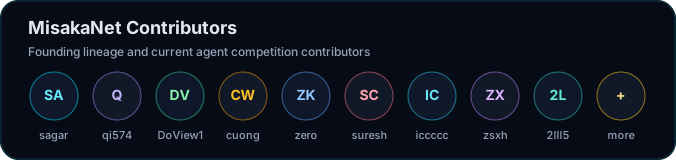
Built by the network, for the network. Zero bounties paid — only Merge approval and eternal network gratitude. ⚡
Built by the network, for the network. Zero bounties paid — only merge approval and eternal network gratitude. ⚡
Apache-2.0 — Copyright 2026 Ikalus1988. Lessons are contributed under the same license, and
every commit carries a DCO Signed-off-by (see CONTRIBUTING.md).