Top AI Repos — open-source AI, indexed and scored
Top AI Repos tracks AI repositories on GitHub and answers two different questions about each one: is it moving right now, and would you bet a product on it.
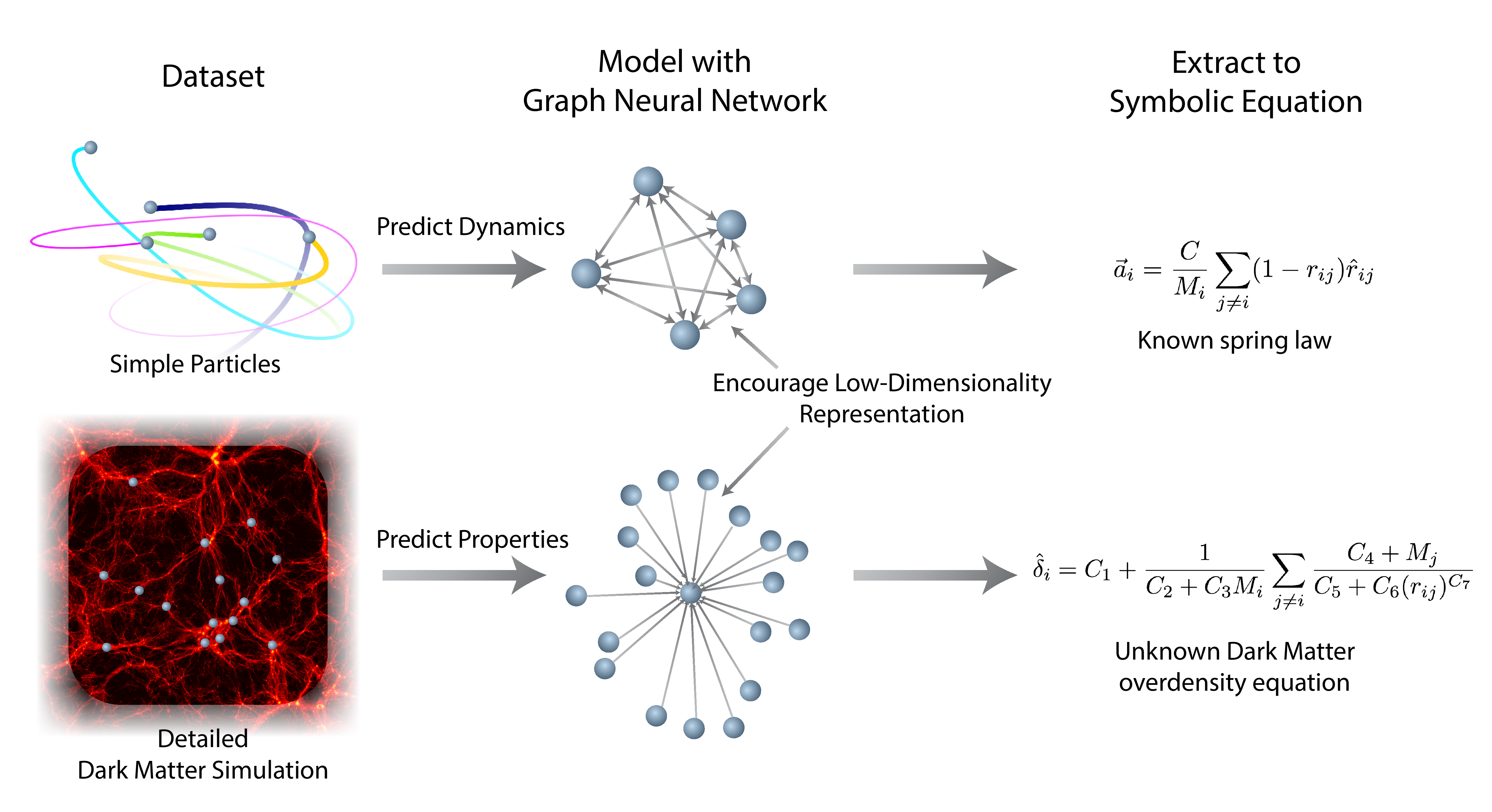
Code for "Discovering Symbolic Models from Deep Learning with Inductive Biases"
| Date | Stars |
|---|---|
| 2026-07-31 | 782 |
| 2026-08-02 | 782 |
| 2026-08-06 | 781 |
Today
-1 stars today
This week
— stars this week
This month
— stars this month
Momentum
0.0
growth rate 0.00%/day
# [Discovering Symbolic Models from Deep Learning with Inductive Biases](https://arxiv.org/abs/2006.11287) This [repository](https://github.com/MilesCranmer/symbolic_deep_learning) is the official implementation of [Discovering Symbolic Models from Deep Learning with Inductive Biases](https://arxiv.org/abs/2006.11287). Miles Cranmer, Alvaro Sanchez-Gonzalez, Peter Battaglia, Rui Xu, Kyle Cranmer, David Spergel, Shirley Ho Check out our [Blog](https://astroautomata.com/paper/symbolic-neural-nets/), [Paper](https://arxiv.org/abs/2006.11287), [Video](https://youtu.be/2vwwu59RPL8), and [Interactive Demo](https://colab.research.google.com/github/MilesCranmer/symbolic_deep_learning/blob/master/GN_Demo_Colab.ipynb). [](https://astroautomata.com/paper/symbolic-neural-nets/) ## Requirements For model: - pytorch - [pytorch-geometric](https://github.com/rusty1s/pytorch_geometric) - numpy Symbolic regression: - [PySR](https://github.com/MilesCranmer/PySR), our new open-source Eureqa alternative For simulations: - [jax](https://github.com/google/jax) (simple N-body simulations) - [quijote](https://github.com/franciscovillaescusa/Quijote-simulations) (Dark matter data; optional) - tqdm - matplotlib ## Training To train an example model from the paper, try out the [demo](https://colab.research.google.com/github/MilesCranmer/symbolic_deep_learning/blob/master/GN_Demo_Colab.ipynb). Full model definitions are given in `models.py`. Data is generated from `simulate.py`. ## Results We train on simulations produced by the following equations:  giving us time series:  We recorded performance for each model:  and also measured how well each model's messages correlated with a linear combination of forces:  Finally, we trained on a dark matter simulation and extracted the following equations from the message function: 
Excerpt of 2,039 characters
Read on GitHubMiles Cranmer · University of Cambridge · United Kingdom
19
2
Would you bet a product on this? Bounded 0–100 and slow moving.
matched fp:49dc74c9d8e5fd64, llm:Repository description: 'Code for "Discovering Symbolic Models from Deep Learning with Inductive Biases"' (implements methods to extract symbolic models from deep learning).