

This is the repo for our paper: HaluEval: A Large-Scale Hallucination Evaluation Benchmark for Large Language Models. The repo contains:
- The 35K data used for evaluating the LLM.
- The code for generating the data.
- The code for evaluating the model.
- The code for analyzing the model.
HaluEval includes 5,000 general user queries with ChatGPT responses and 30,000 task-specific examples from three tasks, i.e., question answering, knowledge-grounded dialogue, and text summarization.
For general user queries, we adopt the 52K instruction tuning dataset from Alpaca. To further screen user queries where LLMs are most likely to produce hallucinations, we use ChatGPT to sample three responses for each query and finally retain the queries with low-similarity responses for human labeling.
Furthermore, for the task-specific examples in HaluEval, we design an automatic approach to generate hallucinated samples. First, based on existing task datasets (e.g., HotpotQA) as seed data, we design task-specific instructions for ChatGPT to generate hallucinated samples in two methods, i.e., one-pass and conversational. Second, to select the most plausible and difficult hallucinated sample for LLMs evaluation, we elaborate the filtering instruction enhanced by ground-truth examples and leverage ChatGPT for sample selection.
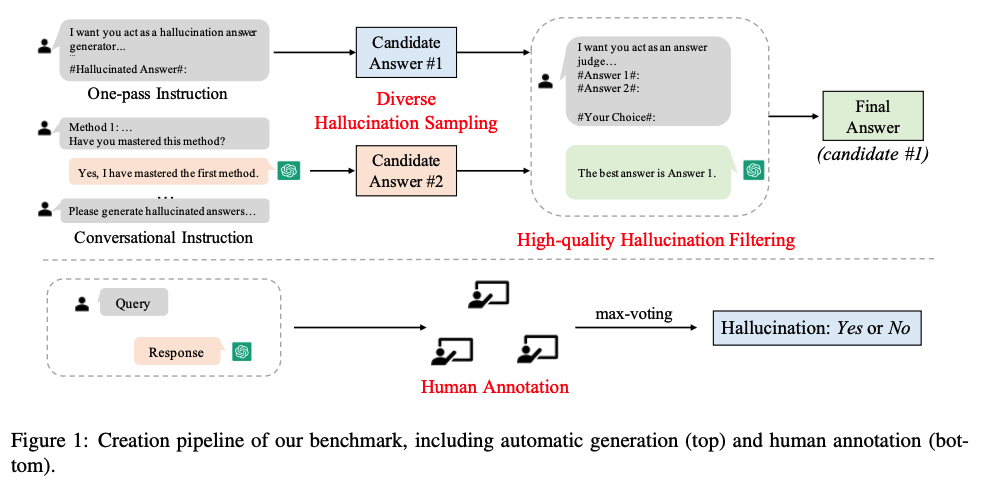
The directory data contains 35K generated and human-annotated hallucinated samples we used in our experiments.
There are four JSON files as follows:
qa_data.json: 10K hallucinated samples for QA based on HotpotQA as seed data. For each sample dictionary, the fieldsknowledge,question, andright_answerrefer to the knowledge from Wikipedia, question text, and ground-truth answer collected from HotpotQA. The fieldhallucinated_answeris the generated hallucinated answer correspondingly.dialogue_data.json: 10K hallucinated samples for dialogue based on OpenDialKG as seed data. For each sample dictionary, the fieldsknowledge,dialogue_history, andright_responserefer to the knowledge from Wikipedia, dialogue history, and ground-truth response collected from OpenDialKG. The fieldhallucinated_responseis the generated hallucinated response correspondingly.summarization_data.json: 10K hallucinated samples for summarization based on CNN/Daily Mail as seed data. For each sample dictionary, the fieldsdocumentandright_summaryrefer to the document and ground-truth summary collected from CNN/Daily Mail. The fieldhallucinated_summaryis the generated hallucinated summary correspondingly.general_data.json: 5K human-annotated samples for ChatGPT responses to general user queries from Alpaca. For each sample dictionary, the fieldsuser_query,chatgpt_response, andhallucination_labelrefer to the posed user query, ChatGPT response, and hallucination label (Yes/No) annotated by humans.
Based on these data, you can evaluate the ability of LLMs to recognize hallucinations and analyze what type of contents/topics LLMs tend to hallucinate (or fail to recognize the contained hallucination).
We executed the data generation pipeline via ChatGPT according to the following steps:
- First, we download the training sets of HotpotQA, OpenDialKG, and CNN/Daily Mail.
cd generation
wget http://curtis.ml.cmu.edu/datasets/hotpot/hotpot_train_v1.1.json
wget https://raw.githubusercontent.com/facebookresearch/opendialkg/main/data/opendialkg.csv
wget https://huggingface.co/datasets/ccdv/cnn_dailymail/blob/main/cnn_stories.tgz
- Second, we sample 10K samples and generate their hallucinated counterparts by setting the task
and sampling strategy.
seed_data: the downloaded training sets of HotpotQA, OpenDialKG, and CNN/Daily Mail.task: sampled tasks, i.e.,qa,dialogue, orsummarization.strategy: sampling strategy, i.e.,one-turnormulti-turn. (one-pass and conversational in our paper)
python generate.py --seed_data hotpot_train_v1.1.json --task qa --strategy one-turn
- Finally, we select the most plausible and difficult hallucinated sample from these two sampling methods.
The final selected samples will be stored in the
datadirectory.task: filtered task, i.e.,qa,dialogue, orsummarization.
python filtering.py --task qa
Users can use our provided instructions and codes on their own datasets to generate hallucinated samples.
In evaluation, we randomly sample a ground-truth or a hallucinated output for each data. For example, if the text is a hallucinated answer, the LLM should recognize the hallucination and output "Yes", which means the text contains hallucinations. If the text is a ground-truth answer, the LLM should output "No" indicating that there is no hallucination.
task: evaluated task, i.e.,qa,dialogue, orsummarization.model: evaluated model, e.g., ChatGPT (gpt-3.5-turbo), GPT-3 (davinci).
cd evaluation
python evaluate.py --task qa --model gpt-3.5-turbo
Based on the samples that LLMs succeed or fail to recognize, we can analyze the topics of these samples using LDA.
task: analyzed task, i.e.,qa,dialogue, orsummarization.result: the file of recognition results at the evaluation stage.category:all(all task samples),failed(task samples that LLMs fail to recognize hallucinations)
cd analysis
python analyze.py --task qa --result ../evaluation/qa/qa_gpt-3.5-turbo_result.json --category all
HaluEval uses MIT License.
Please cite the repo if you use the data or code in this repo.
@misc{HaluEval,
  author = {Junyi Li and Xiaoxue Cheng and Wayne Xin Zhao and Jian-Yun Nie and Ji-Rong Wen },
  title = {HaluEval: A Large-Scale Hallucination Evaluation Benchmark for Large Language Models},
  year = {2023},
  journal={arXiv preprint arXiv:2305.11747},
  url={https://arxiv.org/abs/2305.11747}
}


