










Schedule search the way an operating system schedules processes: compile an open-domain question into a normalized coverage map, dispatch its empty cells to pipelined-parallel sub-agents, write every piece of evidence — with its source — into a shared evidence graph, and synthesize a citation-grounded answer from search state — state that lives in the system, not in conversation history.


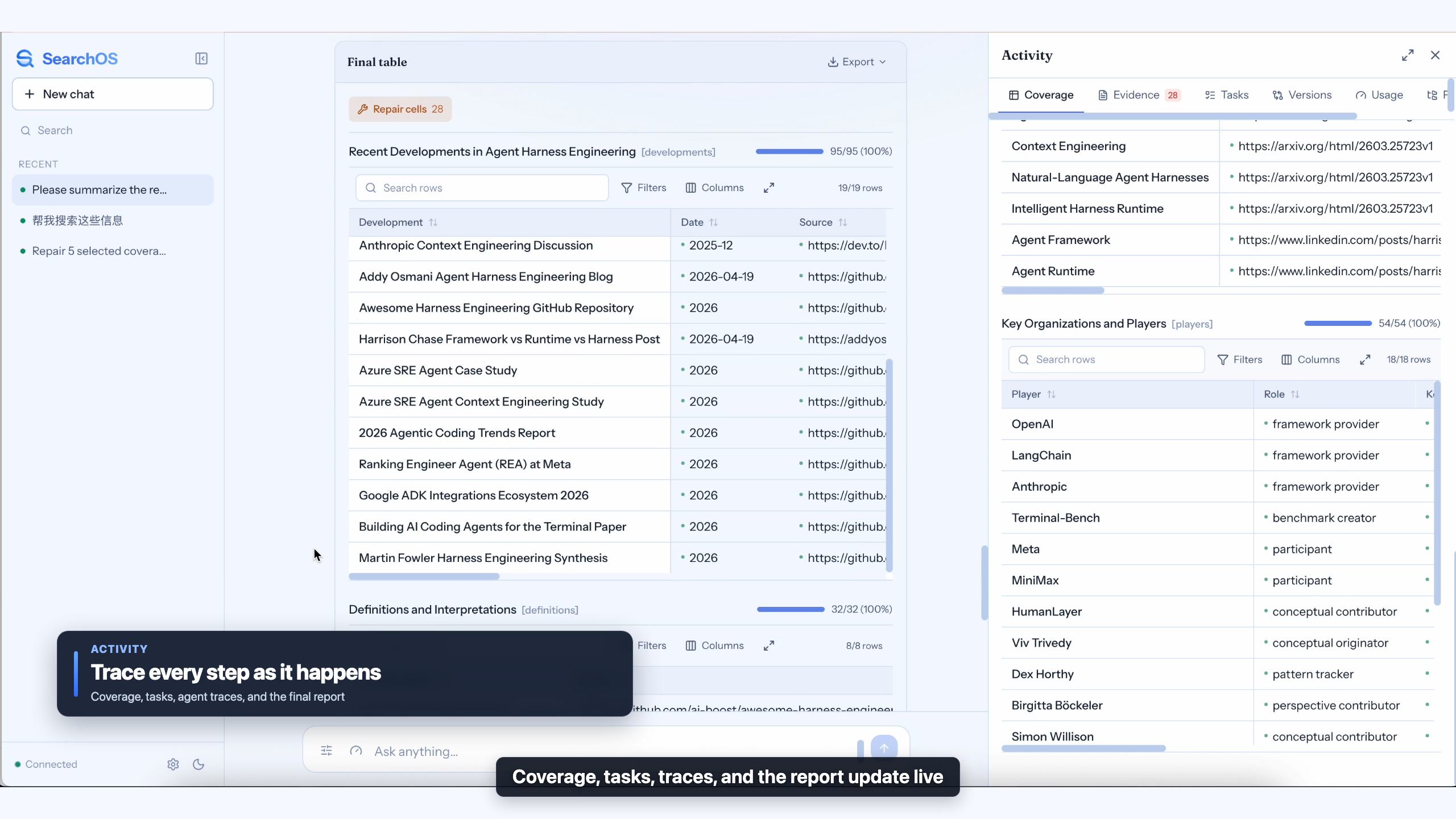
🎬 Full product walkthrough (English)
▶️ Quick run:./install.sh source .venv/bin/activate searchos "Top-5 universities per subject in the 2025 QS rankings, with application deadlines"
install.shprepares the Python environment, bundled Access Skill dependencies, Chromium, and the Web frontend. The first run then launches a setup wizard: pick a model provider (vendor coding plans / pay-as-you-go APIs / local deployment), paste an API key, and you're up. Runsearchoswith no query for the full-screen TUI to watch task dispatch, tool streams, and the coverage map grow in real time. You can also run./web/start.shto bring up the REST/WS API (:8000) + web frontend (:3000) and launch searches from the browser with a live agent wall and coverage map.
- 2026-07-17 — SearchOS-V1 is now on arXiv. Read the paper on arXiv or Hugging Face. 📄
- 2026-07-11 — Start faster. Search wider. See every step. A new one-command installer gets SearchOS running; parallel Explore waves scout the web in batches, while live progress and evidence grouped by entity make every discovery easier to follow. Skills now run in hardened, isolated workers. ⚡
- 2026-07-10 — A whole new way to research. Draw the structure of your question. SearchOS turns it into citation-backed research you can explore, refine, and export. 🧩
- 2026-07-09 — Pick up exactly where you left off. Every session returns with its conversation, progress, evidence, and live activity intact. ⏪
- 2026-07-08 — Everything in one place. Models, providers, search, skills, and budgets now come together in one beautifully simple control center. ⚙️
- 2026-07-07 — SearchOS is now open source. Multi-agent search, structured research, TUI, and Web UI. All together. Ready for everyone. 🚀
- 🗂️ Search state as a system asset — SOCM (Search-Oriented Context Management) keeps the task queue, evidence graph, and coverage map in one persistent state shared by all agents: snapshot, restore, replay — nothing drowns in conversation history.
- 🧩 Coverage-map-driven, recall-first — the question becomes normalized entity × attribute tables; dispatch keeps targeting empty cells until every one holds a sourced value.
- ⚡ Pipelined-parallel sub-agents — search → open → find stages overlap across agents; wall-clock approaches the slowest single chain, not a serial sum.
- 🔗 Every cell carries a citation — extraction middleware writes (entity, attribute, value, source) into the evidence graph; every answer traces back to its source.
- 🛡️ Sensor safety net — five kinds of loop / stall detection on every tool call: remind first, re-dispatch from a new angle if it persists.
- 🧰 Skills + multi-provider out of the box — access skills crack anti-bot / login-walled sites, strategy skills handle rankings / multi-hop / disambiguation;
SF_PROVIDERconnects any vendor in one line.
📊 Leads on all headline F1 metrics on WideSearch / GISA, including Set · F1 +13.4 over the next-best baseline on enumeration questions (see Evaluation).
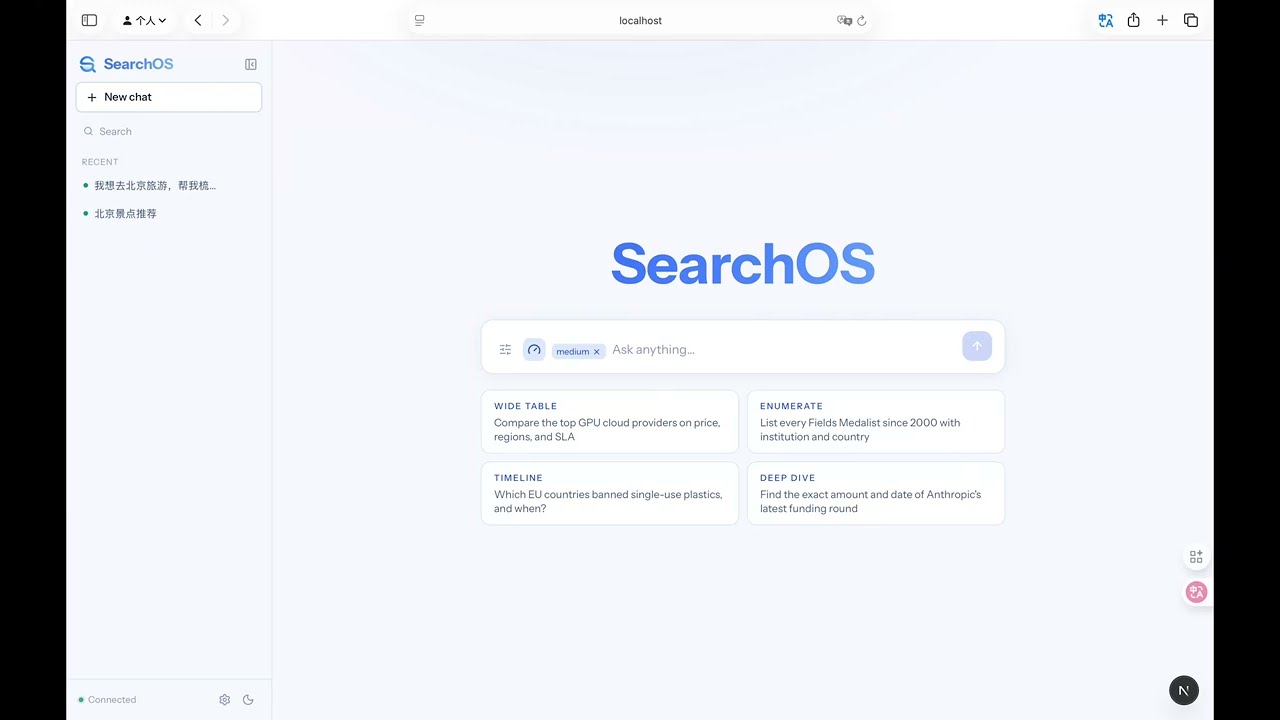
|
|
|
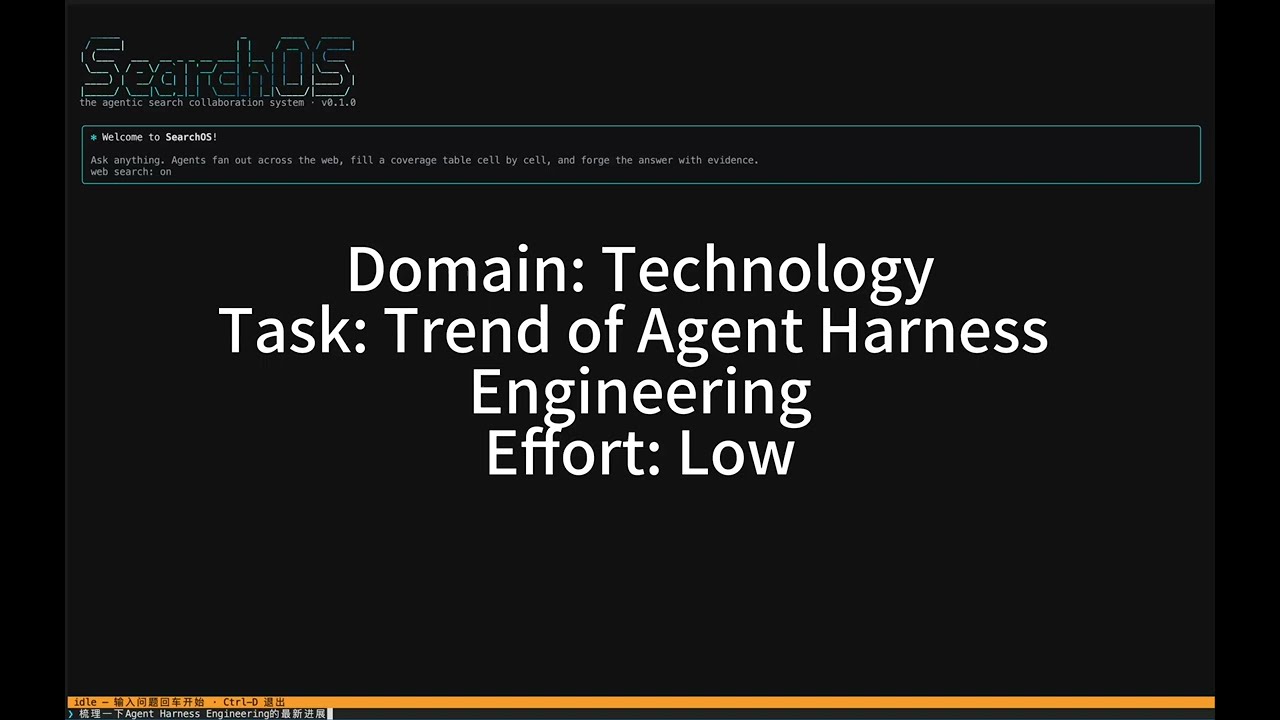
|
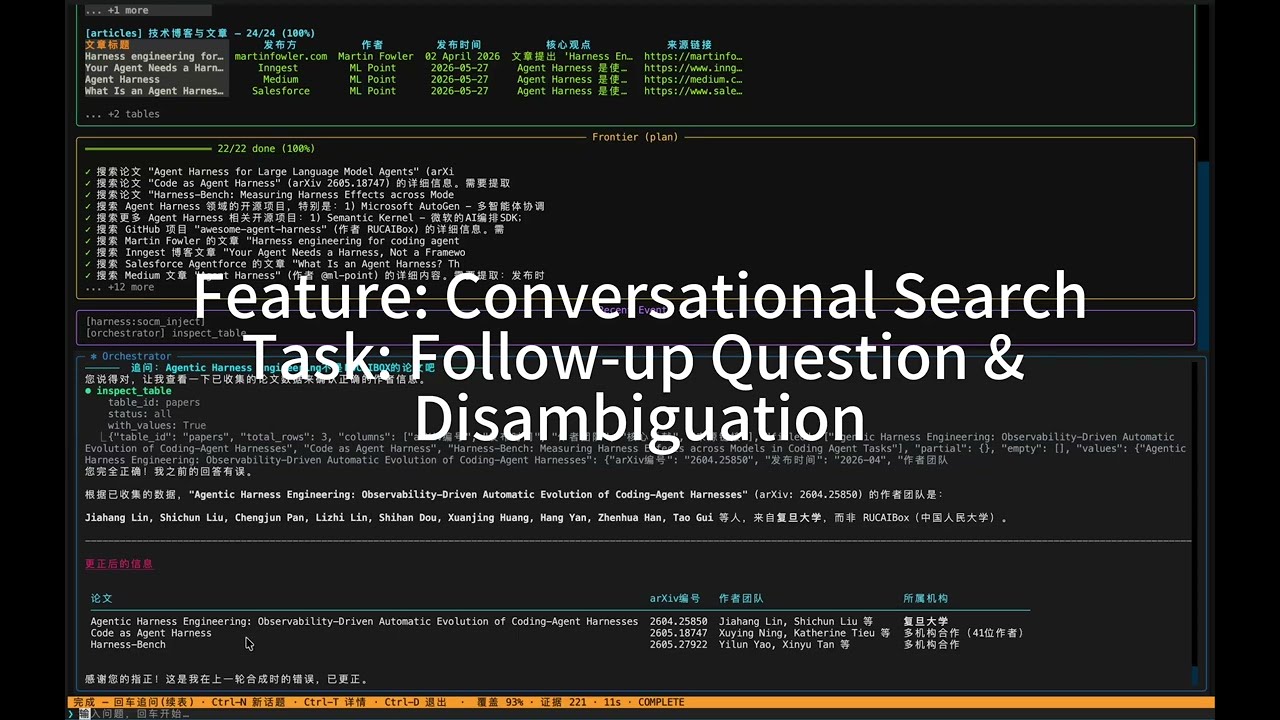
|
|
Click a cover to watch on YouTube (more demos coming)
Pointing a general-purpose agent or deep-search agent at long-horizon search tasks commonly produces these failure modes:
- Opaque process — intermediate search results drown in dozens of turns of conversation history; facts get lost after context compression; mid-run you can neither see progress nor resume or replay.
- Easy to loop — no memory of what has already been checked: the same query gets re-issued with different phrasing, and the same entity's attributes are searched again in different subtasks.
- Blurred roles — sub-agents must search, read, remember, and summarize all at once; on long tasks something always slips: extracted fields use inconsistent conventions, sources get dropped.
- Can't get in, can't search well — anti-bot walls, login gates, and deep directories keep hard sites unreachable; ranking, multi-hop, and disambiguation questions aren't solved by simply searching more.
SearchOS answers each of the four failures with a mechanism-level fix:
- Search state lives in the system, not in conversation history — SOCM keeps the task queue, evidence graph, and coverage map in one shared persistent state (
search_state.json): snapshot, restore, replay at any time; sub-agents run on a three-layer context (SOCM snapshot → episodic summaries → recent working memory) instead of full history, keeping a stable prompt-cache-friendly prefix. - Entity-centric modeling + loop-breaking sensors — a normalized multi-table schema (primary keys + attributes, with foreign keys) means each fact is fetched once and dispatch always targets empty cells; LoopSensor runs five loop checks on every tool call — remind first, mark
loopedand re-dispatch from a different angle if it persists. - Search and extraction are separated — sub-agents just find the right pages; on every page open, a judge model extracts (entity, attribute, value, source, confidence) into the evidence graph, with unit normalization and excerpts anchored to the original text — consistent conventions, traceable sources.
- Role-aligned three-layer skill system for open-domain information seeking — orchestrates methodology, search strategies, and site-level executable access skills in one system (details in Skill system).
User query
   │
   ▼
┌─────────────────────────── Orchestrator (sole decision maker) ───────────────────┐
│   Explore scouting → create_schema builds the coverage map → enqueue_tasks       │
│   dispatch → check_agents polling → assess/adjust → enough coverage or budget    │
│   exhausted → synthesize                                                         │
└──────┬──────────────────────────┬─────────────────────────────┬──────────────────┘
       ▼                          ▼                             ▼
  explore_agent              search_agent × N              writer_agent
 (query typing / hub pages / (searches the web per         (consumes SOCM, writes
  candidate entities /        subtask, never writes         cited sections)
  search plan)                state directly)
       │                          │                             │
       └────────────┬─────────────┴─────────────────────────────┘
                    ▼
      Three middleware layers: Context → Sensor → Extraction
     (prompt assembly / budget & loop monitoring / judge-based auto extraction)
                    │
                    ▼
┌──────────── SOCM · Search-Oriented Context Management (shared search state) ────┐
│  Frontier Memory   task queue: priority + blocked_by DAG, three task types in   │
│                    one shared pool                                              │
│  Evidence Graph    findings / sources / confidence, support-conflict edges      │
│  Coverage Map      entity × attribute, multi-table + foreign keys, per-column   │
│                    types / formats / validation                                 │
│  Strategy Memory   strategy & failure memory · Writer Outline · Budget          │
└─────────────────────────────────────────────────────────────────────────────────┘
A session loops through six steps:
- Explore — a scout goes first: classifies the query type, locates hub pages, produces candidate entities and a search plan; it does not extract attribute values.
- Schema — the Orchestrator builds a normalized coverage map by entity type (multiple tables + relations); every entity Explore found is seated as a seed row.
- Dispatch — gaps are split into self-contained natural-language subtasks and dispatched to search agents in parallel by priority and dependency.
- Extract — after every page open, the Extraction middleware automatically extracts (entity, attribute, value, source, confidence) into the evidence graph and lights up the coverage map.
- Assess — subtasks are polled and harvested: new entities join the table, bad sources are blacklisted, conflicts go to arbitration, empty cells get targeted follow-ups.
- Synthesize — once the coverage self-check passes, the answer is joined out of SOCM in the user's requested format, citation by citation.
Every cell carries a back-anchored source number, with the sources listed at the end — this is what "citation-grounded relational schema completion" looks like in the final product (excerpt from a real run; the query, in Chinese, was survey Hong Kong's popular insurance products in recent years):
### Major insurers in Hong Kong
| Company     | English name   | 2024 APE rank | 2023 premiums  |
|-------------|----------------|---------------|----------------|
| 友邦保险     | AIA [6]        | #1 [6]        | HK$87.1B [6]   |
| 保诚         | Prudential [6] | #2 [6]        | HK$65.3B [6]   |
| 汇丰保险     | HSBC Life [6]  | #3 [6]        | HK$55.5B [6]   |
| 宏利         | Manulife [6]   | #4 [6]        | HK$49.8B [6]   |

### Sources
[6] https://www.ia.org.hk/tc/infocenter/press_releases/20250425.html, https://inews.hket.com/…
The full artifact (a replayable directory with the trajectory, page cache, and SOCM state) lives under searchos_workspace/<timestamp>/.
Requires Python ≥ 3.11:
./install.sh                # recommended: Python env + Access Skills + Chromium + Web frontend
source .venv/bin/activate

pip install -e .            # manual: core CLI/TUI and Web API dependencies
pip install -e ".[access]"  # manual: bundled Access Skill executors
pip install -e ".[eval]"    # manual: evaluation dependencies
pip install -e ".[all]"     # manual: all optional runtime dependencies
The full installer also requires Node.js ≥ 20.9. Use ./install.sh --core to skip Access Skill and browser runtimes, --no-web to skip frontend dependencies, or --all --dev for a complete development environment. See the installation guide.
The first run launches a setup wizard automatically: when no usable model configuration is detected, searchos walks you through picking a provider and entering an API key, then writes .env (re-run anytime with searchos --setup). The Web Settings page and TUI commands /model, /search, and /config write to the same web_settings.json overlay, so CLI, TUI, and Web runs share one configuration.
You can also configure secrets manually: copy .env.example to .env and add only the API keys you use. Choose providers, models, search backends, and other runtime settings through the setup wizard, Web Settings, or TUI; those choices are stored in web_settings.json.
ZHIPU_API_KEY=xxx             # example model-provider key
SERPER_API_KEY=xxx            # example search-provider key
JINA_API_KEY=xxx              # optional: higher Jina fetching quota
All presets (each vendor's endpoints, model IDs, how to get keys, and known quirks) are in docs/providers.md. Advanced environment-only configuration through SF_PROVIDER and other SF_* overrides remains supported and is documented there.
All configuration is centralized in settings.py; SF_-prefixed environment variables override it, with __ separating nested fields (partial overrides deep-merge with defaults, changing only the fields you set). Models are bound by role (11 roles → model profiles), which makes provider mixing, rate control, ablations, and cost reduction straightforward:
| Common settings | Description |
|---|---|
SF_MODEL / SF_FAST_MODEL |
Override the preset's main / lightweight-tier model |
SF_API_BASE |
Override the endpoint (e.g. switch to the international domain) |
SF_SEARCH_PROVIDER |
Search backend: serper | tavily | ragflow (inferred from available keys if unset) |
SF_BROWSER_BACKEND |
Fetch backend: jina | aiohttp | crawl4ai | search_engine |
SF_ROLES__JUDGE=main |
Rebind a single role's model profile (advanced / ablation) |
SF_PROFILES__MAIN__TEMPERATURE=0.3 |
Field-level override on one profile (advanced / ablation) |
SF_PROFILES__MAIN__RPM=60 / ...__TPM=100000 |
Per-profile sliding-window request/token limits; 0 disables a limit |
SF_MAX_PARALLEL_AGENTS |
Sub-agent concurrency cap (default 8) |
SF_ENABLE_EXPLORE_BATCH / SF_EXPLORE_MIN_WAVES / SF_EXPLORE_MAX_WAVES |
Parallel Explore mode and adaptive wave bounds (default 2–3) |
SF_ENABLE_EXPLORE / SF_ENABLE_SKILLS |
Ablation switches: disable Explore / disable Skills |
SF_SKIP_SYNTHESIS |
Evaluation mode: skip synthesis and export the table straight from the coverage map |
| Command | What it does |
|---|---|
python -m searchos "<query>" |
Single query; results land in searchos_workspace/<timestamp>/output/report.md |
python -m searchos |
Full-screen Textual TUI: live panels, mid-run steering, multi-turn follow-ups, /skill skill management |
python -m eval.run --benchmark widesearch --range 1-50 |
Run evaluations (see the next section) |
python -m searchos opens the full-screen interface: a live dashboard on top (task dispatch, sub-agent status, coverage map growth) and the tool stream below. One input box routes by timing:
| When | What typing natural language does |
|---|---|
| Idle | Starts a new search run |
| Mid-run | Live steering — your text is injected into the running Orchestrator immediately, without interrupting sub-agents; use it to add constraints ("2024 data only"), correct course, or point at good sources |
| After a run | Multi-turn follow-up — reuses the previous round's coverage map and evidence: if the answer is already in the table it is answered directly (no new search); otherwise the existing table is extended incrementally, never rebuilt from scratch |
Slash commands work at any time (including mid-run):
| Command | Alias / shortcut | What it does |
|---|---|---|
/new |
/clear · Ctrl-N |
New topic: clears conversation history and the coverage map; the next question starts from a fresh workspace |
/resume [session-id] |
/load |
Restore a previous session with its conversation, trajectory, coverage, and evidence; omit the id to open the picker |
/effort [low|medium|high|max] |
— | Effort tier: adjusts iteration cap, concurrency, per-agent search budget, wall-clock limit, and skill-routing top-k in one go; with no argument it opens an interactive picker; mid-run changes take effect next round |
/skill |
— | Skill management: no argument opens a grouped multi-select dialog; subcommands list, only <names…> (whitelist, fuzzy prefix match), on / off <names…>, all (reset to router control) for fine-grained control |
/model |
— | Open shared model settings: provider connections, model cards, role bindings, and per-profile limits |
/search [auto|serper|tavily|ragflow] |
— | Inspect or switch the shared search backend |
/config [key value] |
/set |
Open the shared settings panel or quickly change supported run defaults |
/verbose |
/detail · Ctrl-T |
Toggle compact / detailed tool stream |
/stop |
/cancel · Esc |
Interrupt the current run (Esc exits the program when idle) |
/help |
/? |
Command help |
/quit |
/exit · Ctrl-D |
Exit SearchOS |
The four /effort budget tiers at a glance (these modify global settings and take effect immediately for the current session; parallel sub-agents stay fixed at 8 across tiers):
| Tier | Orchestrator iterations | Searches per agent | Wall-clock cap | Routing top-k |
|---|---|---|---|---|
low |
25 | 10 | 10 min | 20 |
medium (default) |
50 | 20 | 30 min | 40 |
high |
100 | 35 | 60 min | 60 |
max |
150 | 50 | 120 min | 80 |
Three categories of skills, all under searchos/skills/library/:
| Category | Count | Description |
|---|---|---|
| access | 248 | Site-level data access, named by domain (e.g. en_wikipedia_org); auto-routed on URL match, or invoked proactively by sub-agents as typed tools |
| strategy | 40+ | Reasoning methodology: ranking_top_n, entity_disambiguation, multi_hop_bridge…, optionally with anti-pattern checklists |
| orchestrator | a few | Orchestration-level methodology, injected wholesale as a playbook |
At runtime an LLM router pre-filters the access catalog to a query-relevant top-k (fail-open); each dispatched sub-agent carries at most 3 skills; pages that match no access skill fall back to the generic extraction middleware.
SEARCHOS_SKILL_ONLY=en_wikipedia_org,ranking_top_n   # whitelist
SEARCHOS_SKILL_LAYERS_DISABLED=access                # disable by layer
SEARCHOS_SKILLS_DISABLED=1                           # disable all
After a session, high-frequency domains can optionally be mined and baked into new access skills for later runs. Enable this under Settings → Skills or TUI /config; generation uses the configured skill_evolver role. The legacy SF_ENABLE_ACCESS_SKILL_GENERATION variable remains migration-only.
On WideSearch (wide-table retrieval) and GISA (open-domain information seeking), compared against 2 single-agent baselines (ReAct / Plan-and-Solve) and 3 multi-agent systems (Table-as-Search / A-MapReduce / Web2BigTable). All scores are max@3 (best of three runs per case, ×100); bold marks the best in each row. Item scores cells independently; Row requires a fully correct row.
| Benchmark | Metric | ReAct | Plan-and-Solve | Table-as-Search | A-MapReduce | Web2BigTable | SearchOS |
|---|---|---|---|---|---|---|---|
| WideSearch | Item · Precision | 82.9 | 83.8 | 82.4 | 83.1 | 78.3 | 83.9 |
| Item · Recall | 70.2 | 72.9 | 73.5 | 74.2 | 73.4 | 79.7 | |
| Item · F1 | 72.9 | 75.2 | 75.4 | 76.0 | 73.8 | 80.3 | |
| Row · Precision | 58.0 | 58.7 | 57.1 | 56.9 | 57.5 | 59.0 | |
| Row · Recall | 48.8 | 50.2 | 51.6 | 49.8 | 54.0 | 55.8 | |
| Row · F1 | 50.9 | 52.2 | 52.7 | 51.4 | 54.5 | 56.5 | |
| GISA | Table · Item · F1 | 74.8 | 71.2 | 73.4 | 72.5 | 68.1 | 76.9 |
| Table · Row · F1 | 58.1 | 50.7 | 54.1 | 52.1 | 45.3 | 59.7 | |
| Set · F1 | 61.6 | 63.1 | 60.9 | 62.5 | 56.7 | 76.5 | |
| List · F1 | 67.1 | 53.8 | 54.2 | 57.4 | 65.5 | 68.1 | |
| Item · EM | 0.0 | 16.7 | 16.7 | 33.3 | 50.0 | 50.0 |
SearchOS leads on all F1 metrics across both benchmarks, with gains driven primarily by recall — coverage-map-driven dispatch keeps filling empty cells until every schema cell has a sourced value; on enumerating complete sets, Set · F1 beats the next-best baseline by +13.4.
SearchOS is under active development. The roadmap below highlights our current priorities and may evolve as the project and research progress.
- SearchOS-V1 Technical Report — Released on arXiv, covering the system design, hierarchical skill architecture, evaluation methodology, and reproducible results.
- Automated Skill Generation Pipeline — Develop an end-to-end pipeline for discovering, generating, validating, and maintaining reusable search skills. More details will be presented in follow-up research.
- Multimodal Search — Extend search and evidence grounding beyond text to images, charts, audio, and video.
- Broader Data-Source Support — Add more integrations for academic, enterprise, and domain-specific information sources.
This roadmap reflects current priorities rather than fixed release commitments. Suggestions and contributions are welcome through GitHub Issues.
searchos/
├── agents/        Orchestrator plus Explore, Search, and optional Writer agent definitions
├── harness/       SearchSession, Context/Sensor/Evidence Intake middleware, repair planning, synthesis, telemetry
├── socm/          Shared search state: Frontier / Evidence Graph / Coverage Map / Strategy
├── tools/         Tools grouped by role: schema, tasks, writer, simple_browser …
├── skills/        Contracts/manifests, routing, isolated runtime, creation/evolution workflows, skill library
├── tui/           Textual interface: live dashboard, resume, settings, Skills, follow-ups, steering
├── config/        providers, model cards/roles, rate limits, effort presets, env + shared settings overlay
└── cli.py         `searchos` / `python -m searchos` entry point

web/api/           FastAPI REST/WS service: runs, history/assets, snapshots/branching, repair, settings, Skill jobs
web/frontend/      Next.js research workspace: composer, live run, evidence, versions, usage, history library

eval/              Evaluation framework: run.py entry, runner, benchmarks, scorers, reformat
datasets/          Bundled WideSearch and GISA benchmark data
eval_results/      Evaluation output (one directory per case, with a fully replayable session)
searchos_workspace/ Session workspaces for interactive runs (timestamped directories)
Yuyao Zhang1,2,*,‡ · Junjie Gao2,* · Zhengxian Wu2 · Jiaming Fan2 · Jin Zhang2 · Shihan Ma2 · Yao Yao2 · Weiran Qi2 · Guiyu Ma2 · Xingzhong Xu2 · Kai Yang2 · Ji-Rong Wen1 · Zhicheng Dou1,†
1 Renmin University of China · 2 Ant Group
SearchOS was developed through the joint efforts of the authors and contributors listed above. We thank Ant Insurance for its strong support throughout the project.
If SearchOS helps your research, please cite our paper:
@article{zhang2026searchos,
  title={SearchOS-V1: Towards Robust Open-Domain Information-Seeking Agent Collaboration},
  author={Zhang, Yuyao and Gao, Junjie and Wu, Zhengxian and Fan, Jiaming and Zhang, Jin and Ma, Shihan and Yao, Yao and Qi, Weiran and Jin, Chuyan and Ma, Guiyu and others},
  journal={arXiv preprint arXiv:2607.15257},
  year={2026}
}MIT — see LICENSE. Additional terms about source-code comments are described in LEGAL.md.