
Top AI Repos — open-source AI, indexed and scored
Top AI Repos tracks AI repositories on GitHub and answers two different questions about each one: is it moving right now, and would you bet a product on it.
Top AI Repos tracks AI repositories on GitHub and answers two different questions about each one: is it moving right now, and would you bet a product on it.

fit piecewise linear data for a specified number of line segments
| Date | Stars |
|---|---|
| 2026-07-30 | 350 |
| 2026-08-10 | 352 |
| 2026-09-11 | 353 |
| 2026-09-18 | 354 |
| 2026-10-07 | 355 |
| 2026-10-13 | 355 |
| 2026-10-15 | 355 |
| 2026-10-22 | 356 |
| 2026-10-23 | 356 |
| 2026-11-04 | 356 |
Today
— stars today
This week
— stars this week
This month
+2 stars this month
Momentum
35.0
growth rate 0.00%/day
# About A library for fitting continuous piecewise linear functions to data. Just specify the number of line segments you desire and provide the data.   [](https://codecov.io/gh/cjekel/piecewise_linear_fit_py)  [](https://anaconda.org/conda-forge/pwlf) Check out the [documentation](https://jekel.me/piecewise_linear_fit_py)! Read the [blog post](http://jekel.me/2017/Fit-a-piecewise-linear-function-to-data/). 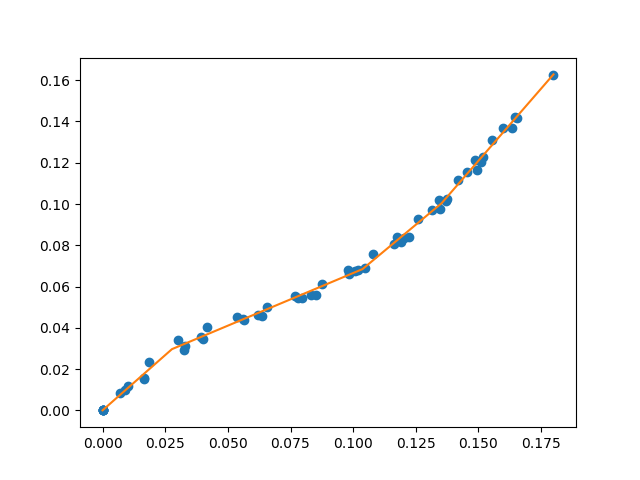 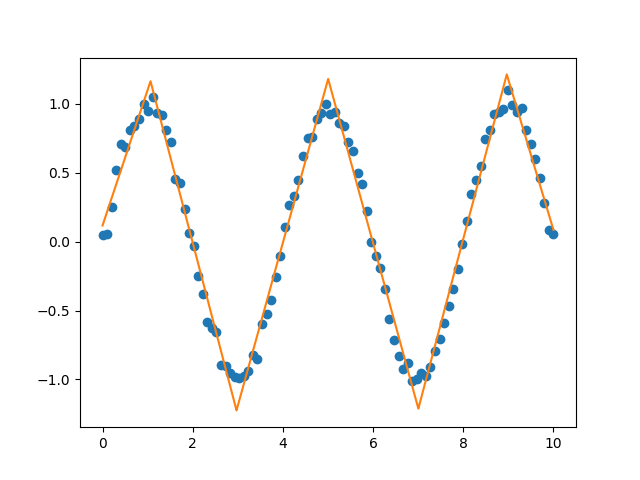 Now you can perform segmented constant fitting and piecewise polynomials! 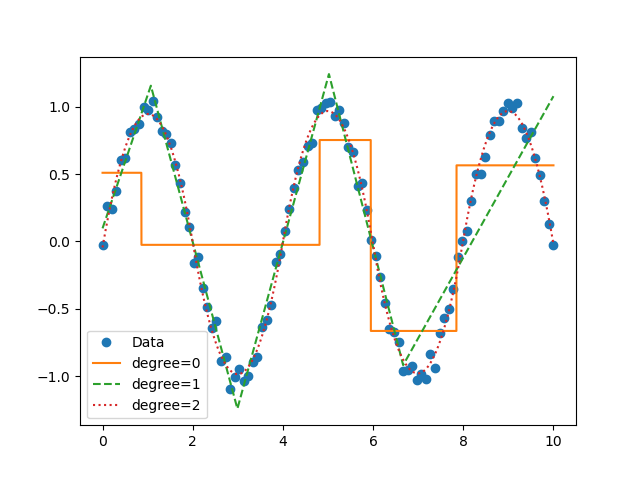 # Features For a specified number of line segments, you can determine (and predict from) the optimal continuous piecewise linear function f(x). See [this example](https://github.com/cjekel/piecewise_linear_fit_py/blob/master/examples/fitForSpecifiedNumberOfLineSegments.py). You can fit and predict a continuous piecewise linear function f(x) if you know the specific x locations where the line segments terminate. See [this example](https://github.com/cjekel/piecewise_linear_fit_py/blob/master/examples/fitWithKnownLineSegmentLocations.py). If you want to pass different keywords for the SciPy differential evolution algorithm see [this example](https://github.com/cjekel/piecewise_linear_fit_py/blob/master/examples/fitForSpecifiedNumberOfLineSegments_passDiffEvoKeywords.py). You can use a different optimization algorithm to find the optimal location for line segments by using the objective function that minimizes the sum of square of residuals. See [this example](https://github.com/cjekel/piecewise_linear_fit_py/blob/master/examples/useCustomOptimizationRoutine.py). Instead of using differential evolution, you can now use a multi-start gradient optimization with fitfast() function. You can specify the number of starting points to use. The default is 2. This means that a latin hyper cube sampling (space filling DOE) of 2 is used to run 2 L-BFGS-B optimizations. See [this example](https://github.com/cjekel/piecewise_linear_fit_py/blob/master/examples/sineWave_time_compare.py) which runs fit() function, then runs the fitfast() to compare the runtime differences! # Installation ## Python Package Index (PyPI) You can now install with pip. ``` python -m pip install pwlf ``` ## Conda If you have conda, you can also install from conda-forge. ``` conda install -c conda-forge pwlf ``` ## From source Or clone the repo ``` git clone https://github.com/cjekel/piecewise_linear_fit_py.git ``` then install with pip ``` python -m pip install ./piecewise_linear_fit_py ``` # How it works This [paper](https://github.com/cjekel/piecewise_linear_fit_py/raw/master/paper/pwlf_Jekel_Venter_v2.pdf) explains how this library works in detail. This is based on a formulation of a piecewise linear least squares fit, where the user must specify the location of break points. See [this post](http://jekel.me/2018/Continous-piecewise-linear-regression/) which goes through the derivation of a least squares regression problem if the break point locations are known. Alternatively check out [Golovchenko (2004)](http://golovchenko.org/docs/ContinuousPiecewiseLinearFit.pdf). Global optimization is used to find the best location for the user d
Excerpt of 5,181 characters
Read on GitHubWould you bet a product on this? Bounded 0–100 and slow moving.
matched fp:2738fdd139399d0b, topic:tensorflow