
Top AI Repos — open-source AI, indexed and scored
Top AI Repos tracks AI repositories on GitHub and answers two different questions about each one: is it moving right now, and would you bet a product on it.
Top AI Repos tracks AI repositories on GitHub and answers two different questions about each one: is it moving right now, and would you bet a product on it.

A tool-use-focused LLM plugin for neovim.
| Date | Stars |
|---|---|
| 2026-07-31 | 460 |
| 2026-08-04 | 460 |
| 2026-08-06 | 460 |
Today
— stars today
This week
— stars this week
This month
— stars this month
Momentum
0.0
growth rate 0.00%/day
# magenta.nvim ``` ___ ___ /' __` __`\ /\ \/\ \/\ \ \ \_\ \_\ \_\ \/_/\/_/\/_/ magenta is for agentic flow ``` Magenta provides transparent tools to empower AI workflows in neovim. It allows fluid shifting of control between the developer and the AI, from AI automation and agent-led feature planning and development. Developed by [dlants.me](https://dlants.me?ref=magenta.nvim): I was tempted by other editors due to lack of high-quality agentic coding support in neovim. I missed neovim a lot, though, so I decided to go back and implement my own. I now happily code in neovim using magenta, and find that it's just as good as cursor, windsurf, ampcode & claude code. I sometimes write about AI, neovim and magenta specifically: - [With AI, you barely need a frontend framework](https://dlants.me/vamp.html?ref=magenta.nvim) - [How does AI change software engineering?](https://dlants.me/ai-se.html?ref=magenta.nvim) - [Why I don't think AGI is imminent](https://dlants.me/agi-not-imminent.html?ref=magenta.nvim) - [AI whiplash, and neovim in the age of AI](https://dlants.me/ai-whiplash.html?ref=magenta.nvim) - [AI is not mid](https://dlants.me/ai-mid.html?ref=magenta.nvim) 🔍 **Also check out [pkb](https://github.com/dlants/pkb)**: A CLI for building a local knowledge base with LLM-based context augmentation and embeddings for semantic search. Can be used as a claude skill. **Note**: I mostly develop using the Anthropic provider, so Claude Opus is recommended. I decided to drop support for other providers for now, since I am more interested in exploring the features space. If another provider becomes significantly better or cheaper, I'll probably add it. 📖 **Documentation**: Run `:help magenta.nvim` or ask magenta for complete documentation. ## Demos  [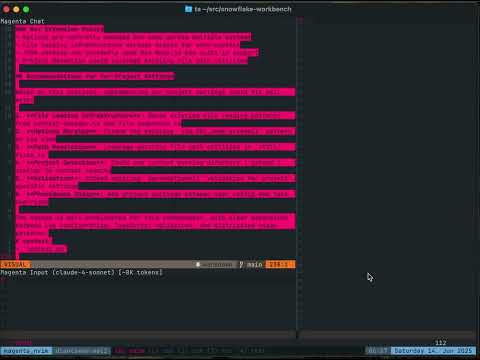](https://www.youtube.com/watch?v=W_YctNT20NQ) # Why would I use this instead of claude code / another cli agent harness? It's neovim, baby! Use your muscle memory to browse agent output, gather context, and edit your prompt. Jump into a buffer to fix errors or redirect the agent — the diff of your edits will be sent to the agent in the next message. Magenta is fully transparent: you see everything the agent sees — prompts, reminders, tool descriptions — and can customize all of it. Edits use [EDL](https://github.com/dlants/magenta.nvim/blob/main/node/core/src/tools/edl-description.md), a purpose-built DSL that's far more token-efficient than claude code's str_replace. The useful parts of claude code (context management, sub-agents, skills, custom agents) are all present, so you won't miss anything. And also apparently the code quality is a lot better? # Why would I use this instead of other neovim AI plugins? I haven't actually used other neovim AI plugins in a while, so take this with a grain of salt. My feeling is that magenta provides a richer set of features, nicer UI and more customizability than other plugins. Using a typescript core means we can leverage the anthropic sdk and libraries like anthropic's sandbox-runtime, which greatly speeds up development. The distinguishing features: - **Edit Description Language (EDL)**: A [small DSL](https://github.com/dlants/magenta.nvim/blob/main/node/core/src/tools/edl-description.md) that's more expressive than string match/replace and often uses far fewer tokens to express edits, since it doesn't have to accurately re-type large swaths of text when making large edits. - **OS-level sandboxing**: By default we use anthropic's sandbox-runtime to run the agent in an OS sandbox (seatbelt on macOS, bubblewrap on Linux) with configurable filesystem and network policies. Fewer operations require manual approval, leading to less alert fatigue. - **Docker sub-agents**: Spawn isolated agents in Docker containers for parallel, unsupervised work. - **Per-thre
Excerpt of 16,732 characters
Read on GitHubWould you bet a product on this? Bounded 0–100 and slow moving.
matched fp:ed51202e48c871ca, desc:tool use