




fairchem is the FAIR Chemistry's centralized repository of all its data, models,
demos, and application efforts for materials science and quantum chemistry.
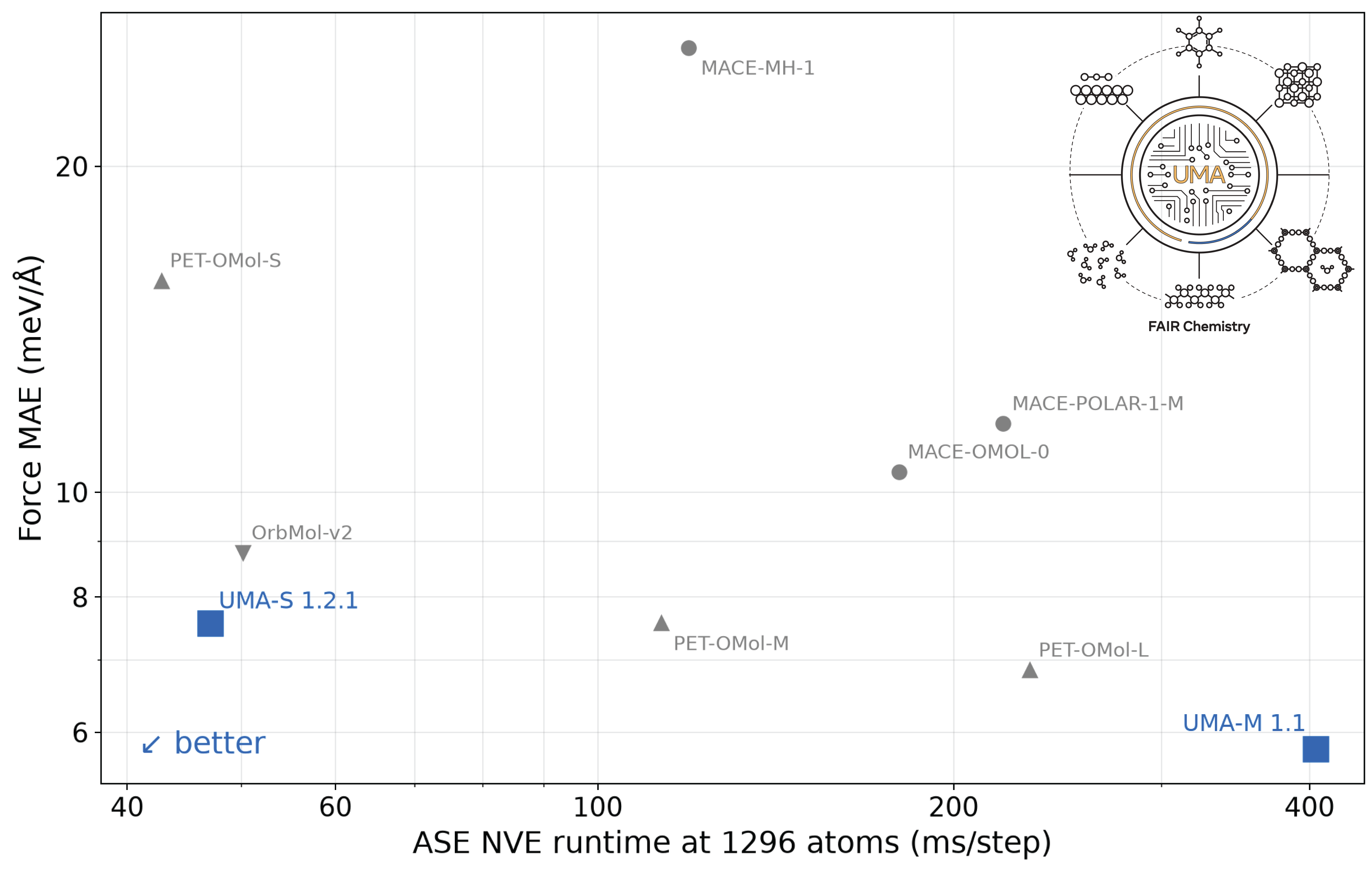
The vertical axis is force MAE (meV/Å) on the public OMol25 validation set; the horizontal axis is mean runtime (ms/step) for an ASE NVE step on a water system using an NVIDIA H200. See the benchmark details and reproduction scripts for the full setup.
For more OMol model accuracy benchmarks, you can also see the FAIR Chemistry leaderboard.
Please use this logo for references to UMA!
September 2026 - Read our new paper on
quantum-accurate atomistic modeling of enzyme catalysis using a machine-learned potential. Also, UMA inference is now much faster with
fairchem-core 2.22.0.

June 2026 - UMA playground released, try the interactive educational demo here yourself!

March 2026 - UMA-1.2 released! ~50% faster, ~40% more accurate on Open Molecules test set, and expanded data coverage for catalysts (oxides and interfaces), molecules, and polymers!
Oct 2025 - check out our seamless Multi-node, Multi-GPU and LAMMPs interfaces to run large scale dynamics!
June 2025 - UMA/OMol first released! Read about the UMA model and OMol25 dataset release.
UMA models and legacy inorganic bulk models trained using OMat24 are trained with DFT and DFT+U total energy labels. These are not compatible with Materials Project calculations. If you are using UMA or models trained on OMat24 only for such calculations, you can find a OMat24 specific calculations of reference unary compounds and MP2020-style anion and GGA/GGA+U mixing corrections in the OMat24 Hugging Face repo. Do not use MP2020 corrections or use the MP references compounds when using OMat24-trained models. Additional care must be taken when computing energy differences, such as formation and energy above hull and comparing with calculations in the Materials Project since DFT pseudopotentials are different and magnetic ground states may differ as well.
Although not required, we highly recommend installing using a package manager and virtualenv such as uv, it is much faster and better at resolving dependencies than standalone pip.
Install fairchem-core using pip
pip install fairchem-coreIf you want to contribute or make modifications to the code, clone the repo and install in edit mode
git clone [email protected]:facebookresearch/fairchem.git

pip install -e fairchem/packages/fairchem-core[dev]The easiest way to use pretrained models is via the ASE FAIRChemCalculator.
A single uma model can be used for a wide range of applications in chemistry and materials science by picking the
appropriate task name for domain specific prediction.
Make sure you have a Hugging Face account, have already applied for model access to the UMA model repository, and have logged in to Hugging Face using an access token. You can use the following to save an auth token,
huggingface-cli loginModels are referenced by their name, below are the currently supported models:
| Model Name | Description |
|---|---|
| uma-s-1p2p1 | Latest version of the UMA small model, fastest of the UMA models while still SOTA on most benchmarks (6.6M/290M active/total params) |
| uma-m-1p1 | Best in class UMA model across all metrics, but slower and more memory intensive than uma-s (50M/1.4B active/total params) |
- oc20: use this for catalysis
- oc22: use this for oxide catalysis (1p2 only)
- oc25: use this for (electro)catalysis (1p2 only)
- omat: use this for inorganic materials
- omol: use this for molecules+polymers
- odac: use this for MOFs
- omc: use this for molecular crystals
from ase.build import fcc100, add_adsorbate, molecule
from ase.optimize import LBFGS
from fairchem.core import pretrained_mlip, FAIRChemCalculator

predictor = pretrained_mlip.get_predict_unit("uma-s-1p2p1", device="cuda")
calc = FAIRChemCalculator(predictor, task_name="oc20")

# Set up your system as an ASE atoms object
slab = fcc100("Cu", (3, 3, 3), vacuum=8, periodic=True)
adsorbate = molecule("CO")
add_adsorbate(slab, adsorbate, 2.0, "bridge")

slab.calc = calc

# Set up LBFGS dynamics object
opt = LBFGS(slab)
opt.run(0.05, 100)from ase.build import bulk
from ase.optimize import FIRE
from ase.filters import FrechetCellFilter
from fairchem.core import pretrained_mlip, FAIRChemCalculator
predictor = pretrained_mlip.get_predict_unit("uma-s-1p2p1", device="cuda")
calc = FAIRChemCalculator(predictor, task_name="omat")
atoms = bulk("Fe")
atoms.calc = calc
opt = FIRE(FrechetCellFilter(atoms))
opt.run(0.05, 100)Note: pretrained_mlip.get_predict_unit() currently uses a seed to set the global state of the numpy RNG. In order to obtain different trajectories for different runs of the following code, we have to set a random seed as shown below:
import numpy as np
from ase import units
from ase.io import Trajectory
from ase.md.langevin import Langevin
from ase.build import molecule
from fairchem.core import pretrained_mlip, FAIRChemCalculator

seed = np.random.randint(0, np.iinfo(np.int32).max, dtype=int)
# we recommend using turbo mode for MD to get the best speed
predictor = pretrained_mlip.get_predict_unit(
    "uma-s-1p2p1", device="cuda", seed=seed, inference_settings="turbo"
)
calc = FAIRChemCalculator(predictor, task_name="omol")

atoms = molecule("H2O")
atoms.calc = calc

dyn = Langevin(
    atoms,
    timestep=0.1 * units.fs,
    temperature_K=400,
    friction=0.001 / units.fs,
)
trajectory = Trajectory("my_md.traj", "w", atoms)
dyn.attach(trajectory.write, interval=1)
dyn.run(steps=1000)from ase.build import molecule
from fairchem.core import pretrained_mlip, FAIRChemCalculator
predictor = pretrained_mlip.get_predict_unit("uma-s-1p2p1", device="cuda")
# singlet CH2
singlet = molecule("CH2_s1A1d")
singlet.info.update({"spin": 1, "charge": 0})
singlet.calc = FAIRChemCalculator(predictor, task_name="omol")
# triplet CH2
triplet = molecule("CH2_s3B1d")
triplet.info.update({"spin": 3, "charge": 0})
triplet.calc = FAIRChemCalculator(predictor, task_name="omol")
triplet.get_potential_energy() - singlet.get_potential_energy()If you have multiple gpus (or multiple nodes), we handle all the parallelism for you under the hood by a single flag (workers=N). This is also compatible with LAMMPs to perform large scale MD. See our docs for more details. This requires the Ray package to be installed and comes with the extras bundle.
pip install fairchem-core[extras]
import time

import numpy as np
from ase import units
from ase.md.langevin import Langevin
from fairchem.core import pretrained_mlip, FAIRChemCalculator

from fairchem.core.datasets.common_structures import get_fcc_crystal_by_num_atoms

seed = np.random.randint(0, np.iinfo(np.int32).max, dtype=int)
predictor = pretrained_mlip.get_predict_unit(
    "uma-s-1p2p1",
    inference_settings="turbo",
    device="cuda",
    workers=8,
    seed=seed,
)
calc = FAIRChemCalculator(predictor, task_name="omat")

atoms = get_fcc_crystal_by_num_atoms(8000)
atoms.calc = calc

dyn = Langevin(
    atoms,
    timestep=0.1 * units.fs,
    temperature_K=400,
    friction=0.001 / units.fs,
)
# warmup 10 steps
dyn.run(steps=10)
start_time = time.time()
dyn.attach(
    lambda: print(
        f"Step: {dyn.get_number_of_steps()}, E: {atoms.get_potential_energy():.3f} eV, "
        f"QPS: {dyn.get_number_of_steps()/(time.time()-start_time):.2f}"
    ),
    interval=1,
)
dyn.run(steps=1000)fairchem is available under a MIT License. Models/checkpoint licenses vary by application area.


