

This repo implements the training and testing of deep regression neural networks for "Sparse-to-Dense: Depth Prediction from Sparse Depth Samples and a Single Image" by Fangchang Ma and Sertac Karaman at MIT. A video demonstration is available on YouTube. This repo offers the original implementation of the paper in Torch. The PyTorch version can be found here.

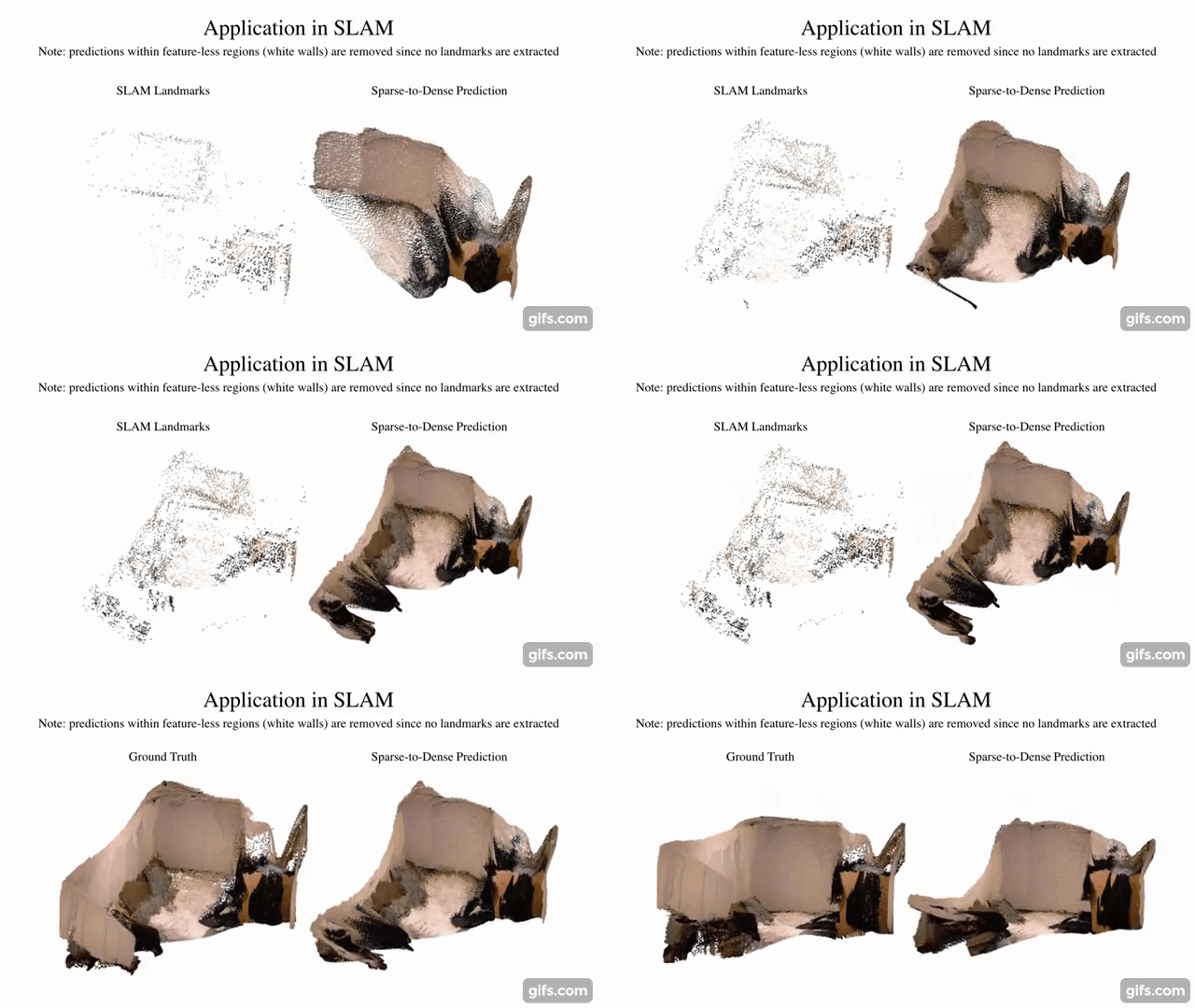
This repo can be used for training and testing of
- RGB (or grayscale image) based depth prediction
- sparse depth based depth prediction
- RGBd (i.e., both RGB and sparse depth) based depth prediction
See the installation instructions for a step-by-step guide.
- Install Torch on a machine with CUDA GPU.
- Install cuDNN(v4 or above) and the Torch cuDNN bindings
- If you already have both Torch and cuDNN installed, update packages and install dependencies.
 luarocks install nn
 luarocks install cunn
 luarocks install cudnn
 luarocks install optnet
- Install the HDF5 format libraries. Files in our pre-processed datasets are in HDF5 formats.
 sudo apt-get update
 sudo apt-get install -y libhdf5-serial-dev hdf5-tools
 git clone https://github.com/davek44/torch-hdf5.git
 cd torch-hdf5
 luarocks make
 cd ..
- Download the preprocessed NYU Depth V2 and/or KITTI datasets in HDF5 formats and place them under the
datafolder. The downloading process might take an hour or so. The NYU dataset requires 32G of storage space, and KITTI requires 81G.cd data wget http://datasets.lids.mit.edu/sparse-to-dense/data/kitti.tar.gz tar -xvf kitti.tar.gz && rm -f kitti.tar.gz wget http://datasets.lids.mit.edu/sparse-to-dense/data/nyudepthv2.tar.gz tar -xvf nyudepthv2.tar.gz && rm -f nyudepthv2.tar.gz cd ..
- Download the networks pretrained on ImageNet datasets. In particular, use ResNet-50 for the NYU Depth V2 dataset, and ResNet-18 for the KITTI dataset. Place them under the
pretrainedfolder.cd pretrained wget https://d2j0dndfm35trm.cloudfront.net/resnet-50.t7 wget https://d2j0dndfm35trm.cloudfront.net/resnet-18.t7 cd ..
The training scripts come with several options, which can be listed with the --help flag.
th main.lua --helpTo run the training, simply run main.lua. By default, the script runs the RGB-based prediction network on NYU-Depth-V2 with 1 GPU and 2 data-loader threads without using pretrained weights.
th main.lua To train networks with different datasets, input modalities, loss functions, and components, see the example below:
th main.lua -dataset kitti -inputType rgbd -nSample 100 -criterion l1 -encoderType conv -decoderType upproj -pretrain trueTraining results will be saved under the results folder.
| Parameter | Options | Remarks |
|---|---|---|
| datasets | nyudepthv2, kitti | |
| inputType | rgb, rgbd, d, g, gd | d:sparse depth only; g: grayscale |
| nSample | non-negative integer (0 for rgb and g) | |
| criterion | l1, l2, berhu | |
| pretrain | false, true | |
| rep | linear, log, inverse | representation of input depth |
| encoderType | conv, depthsep, channeldrop | depthsep: depthwise separable convolution |
| decoderType | upproj, upconv, deconv2, deconv3 | deconv_n: transposed convolution with kernel size n-by-n |
To test the performance of a trained model, simply run main.lua with the -testOnly true option, along with other model options. For instance,
th main.lua -testOnly true -dataset kitti -inputType rgbd -nSample 100 -criterion l1 -encoderType conv -decoderType upproj -pretrain trueDownload our trained models at http://datasets.lids.mit.edu/sparse-to-dense/results/ to the results folder. For instance,
cd results
wget -r -np -nH --cut-dirs=2 --reject "index.html*" http://datasets.lids.mit.edu/sparse-to-dense/results/nyudepthv2.input=rgbd.nsample=200.rep=linear.encoder=conv.decoder=upproj.criterion=l1.lr=0.01.bs=16.pretrained=true/
cd ..
More trained models will be released.
-
Error metrics on NYU Depth v2:
RGB rms rel delta1 delta2 delta3 Roy & Todorovic (CVPR 2016) 0.744 0.187 - - - Eigen & Fergus (ICCV 2015) 0.641 0.158 76.9 95.0 98.8 Laina et al (3DV 2016) 0.573 0.127 81.1 95.3 98.8 Ours-RGB 0.514 0.143 81.0 95.9 98.9 RGBd-#samples rms rel delta1 delta2 delta3 Liao et al (ICRA 2017)-225 0.442 0.104 87.8 96.4 98.9 Ours-20 0.351 0.078 92.8 98.4 99.6 Ours-50 0.281 0.059 95.5 99.0 99.7 Ours-200 0.230 0.044 97.1 99.4 99.8 -
Error metrics on KITTI dataset:
RGB rms rel delta1 delta2 delta3 Make3D 8.734 0.280 60.1 82.0 92.6 Mancini et al (IROS 2016) 7.508 - 31.8 61.7 81.3 Eigen et al (NIPS 2014) 7.156 0.190 69.2 89.9 96.7 Ours-RGB 6.266 0.208 59.1 90.0 96.2 RGBd-#samples rms rel delta1 delta2 delta3 Cadena et al (RSS 2016)-650 7.14 0.179 70.9 88.8 95.6 Ours-50 4.884 0.109 87.1 95.2 97.9 Liao et al (ICRA 2017)-225 4.50 0.113 87.4 96.0 98.4 Ours-100 4.303 0.095 90.0 96.3 98.3 Ours-200 3.851 0.083 91.9 97.0 98.6 Ours-500 3.378 0.073 93.5 97.6 98.9 Note: our networks are trained on the KITTI odometry dataset, using only sparse labels from laser measurements.


If you use our code or method in your work, please consider citing the following:
@article{Ma2017SparseToDense,
	title={Sparse-to-Dense: Depth Prediction from Sparse Depth Samples and a Single Image},
	author={Ma, Fangchang and Karaman, Sertac},
	booktitle={ICRA},
	year={2018}
}
@article{ma2018self,
	title={Self-supervised Sparse-to-Dense: Self-supervised Depth Completion from LiDAR and Monocular Camera},
	author={Ma, Fangchang and Cavalheiro, Guilherme Venturelli and Karaman, Sertac},
	journal={arXiv preprint arXiv:1807.00275},
	year={2018}
}
Please direct any questions to Fangchang Ma at [email protected].