

The open-source agent system that writes research papers with verified citations.
OpenDraft drafts research papers, literature reviews and thesis chapters from one topic, and keeps a citation only if at least two of Crossref, OpenAlex and Semantic Scholar hold its DOI. An open-source alternative to Jenni and ThesisAI: MIT licensed, runs on your own model key.
Website: opendraft.xyz · Docs · Sample PDF · Hosted version (OpenPaper)




Use OpenDraft as a skill in your own agent (Claude, ChatGPT), free → getedge.cc/skills/autonomous-research
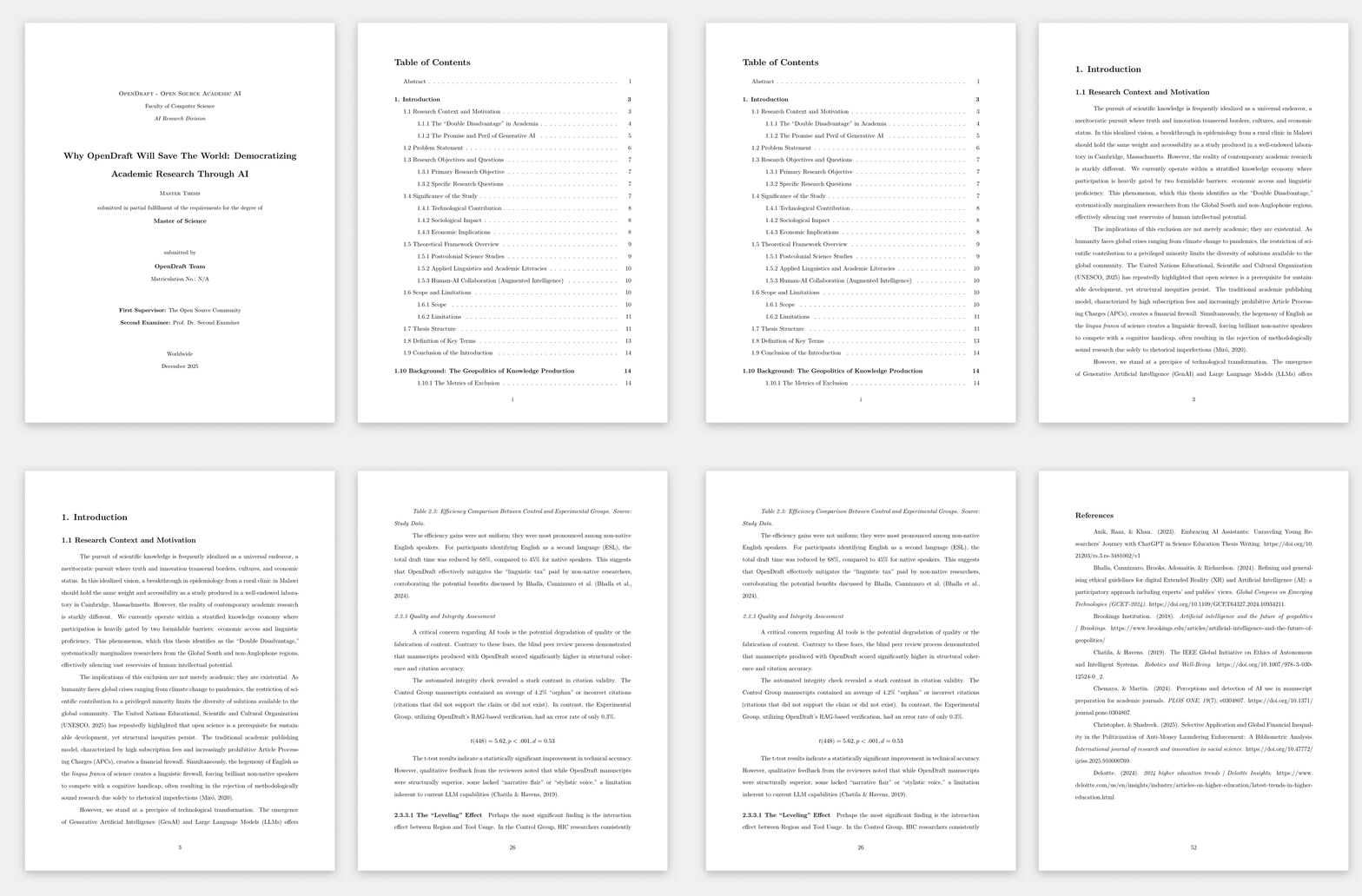
Real output: pages from the sample draft (60 pages, 40+ citations).
- Talukder et al. (2026), Discourse2Draft: an AI-powered structured document writing tool, Frontiers in Artificial Intelligence. Peer-reviewed NIH paper, next to Stanford's STORM (comparison).
- Kong et al. (2026), AI for Auto-Research: Roadmap & User Guide, arXiv:2605.18661. NUS survey of research agents.
24k+ downloads: 20,289 on PyPI (pepy.tech) and 4,200 on npm, as of November 2026.
Requires Python 3.10+ and a Gemini API key (Claude and OpenAI also work).
pip install opendraft
opendraft setup                      # enter your Gemini API key
opendraft "Remote work and team productivity"| Command | What it does |
|---|---|
opendraft |
Interactive mode |
opendraft "Topic" --level phd --lang de |
Draft at a level (research_paper, bachelor, master, phd) and language |
opendraft "Topic" --expose |
Outline and sources only, faster |
opendraft revise ./output "make the intro longer" |
Revise a draft |
opendraft tldr paper.pdf |
5-bullet summary of any paper |
In Claude Code, Codex or any agent that reads skills:
npx skills add federicodeponte/opendraft --skill autonomous-researchThen ask: Write a paper on <topic>. The skill lives in skills/autonomous-research/; it runs inside your agent and does not call this Python engine.
git clone https://github.com/federicodeponte/opendraft.git
cd opendraft
pip install -e ./engine
cp .env.example engine/.env          # add your key
opendraft "Your topic"| Variable | Required | Purpose |
|---|---|---|
GOOGLE_API_KEY |
One key required | Gemini (default provider) |
ANTHROPIC_API_KEY / OPENAI_API_KEY |
Optional | Claude or OpenAI, with AI_PROVIDER=claude or openai |
ENABLE_SEMANTIC_SCHOLAR |
Optional | Set false if Semantic Scholar rate-limits you |
All settings are listed in .env.example.
19 agents work in six phases: research, structure, compose, validate, refine, enhance. A source stays only if at least two of Crossref, OpenAlex and Semantic Scholar hold its DOI. That proves the work exists, not that every claim about it is right, so a second check judges whether each source fits its claim. Details: citation verification · pipeline · methodology.
What is OpenDraft? An open-source agent system that researches and writes papers with verified citations. MIT licensed.
Is OpenDraft free? Yes. You pay only your model provider, about $0.35 to $3 per draft.
How are citations verified? A source stays only if at least two of Crossref, OpenAlex and Semantic Scholar hold its DOI. That proves it exists, not that every claim about it is right.
How long does a draft take, and in what formats? Usually 10 to 20 minutes. Export to PDF, Word and LaTeX.
Who has cited OpenDraft? A peer-reviewed NIH paper (Talukder et al., 2026), next to Stanford's STORM, and the NUS survey AI for Auto-Research (Kong et al., 2026).
Are the drafts ready to submit? No. They are starting points: review and edit before use, and follow your institution's policy on disclosure.
Issues and pull requests are welcome. See CONTRIBUTING.md, ask in Discussions, and read the changelog.
MIT, see LICENSE. To cite OpenDraft, use CITATION.cff ("Cite this repository" on GitHub).


