


Overview | Setup | Colabs | Usage | Extended Usage
Core Contributors: Xingyou Song, Yash Akhauri, Jiyoun Ha, Bryan Lewandowski
RegressLM is a library for sequence-to-sequence numeric prediction, applicable to tokenizable inputs (e.g. strings, images) and allows pretraining and fine-tuning over multiple tasks.
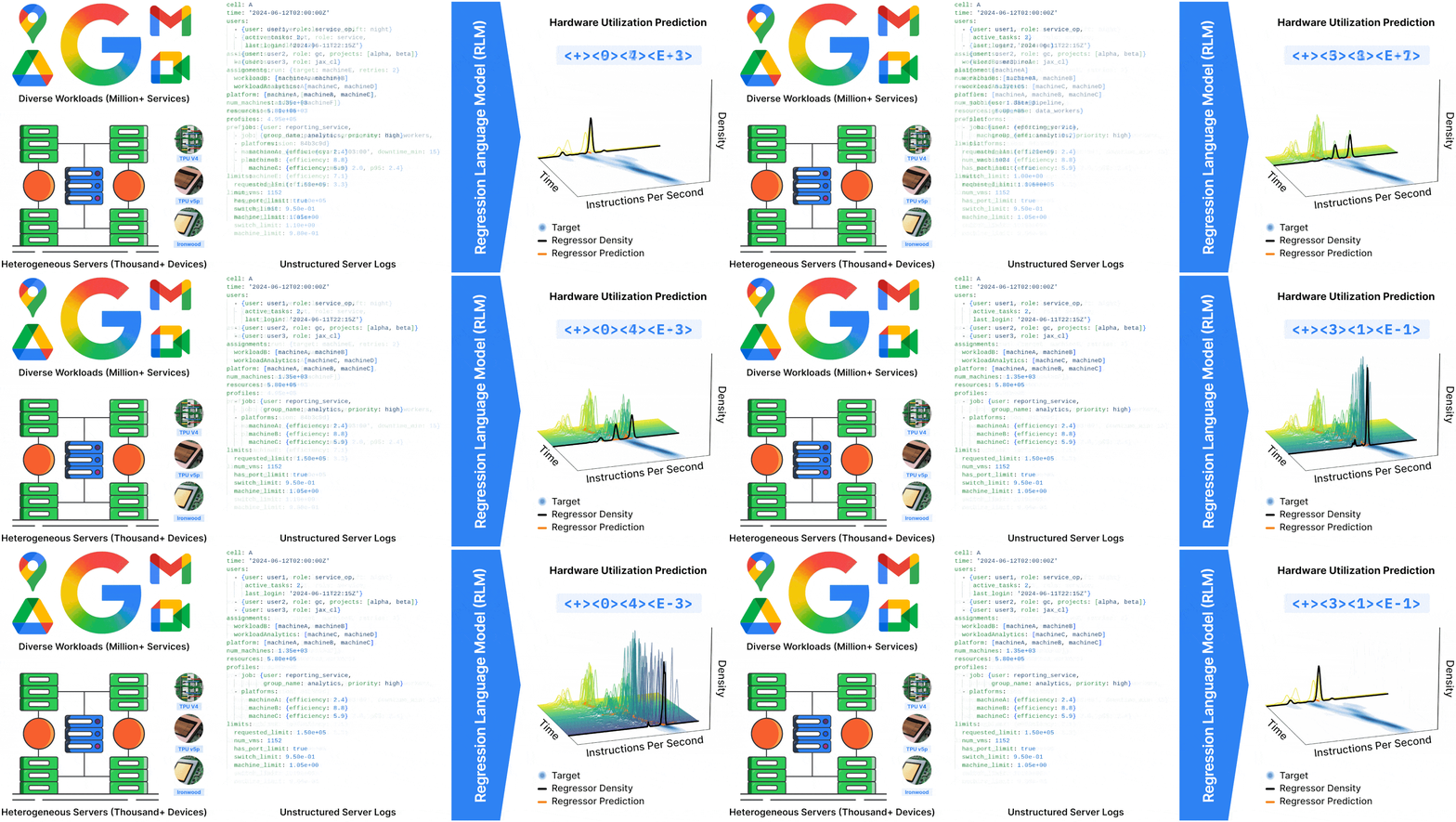
Example Application: Directly predicting performance metrics from unstructured, textually represented system states from Google's massive compute clusters.
Get started by installing the core libraries (dependencies):
pip install -e .
To run e.g. T5Gemma variants and LoRA fine-tuning, install additional libraries:
pip install ".[extras]"
Installation should take less than a minute.
Supported Platforms: Requires Python 3.10+. Linux (e.g. Ubuntu) strongly preferred for deep learning.
Example Colabs for getting started and demonstrating flagship results:
- Synthetic Density Training:
- Triton GPU Kernel Latency Prediction:
- Kaggle Experiment Outcome Prediction:

There are two main stages: inference and pretraining (optional but recommended).
The intended use-case is to import a RegressLM class, which can decode floating-point predictions from a given input, and also fine-tune against new data.
from regress_lm import core
from regress_lm import rlm

# Create RegressLM from scratch. Optionally, use `from_t5gemma_encoder`.
reg_lm = rlm.RegressLM.from_scratch(max_input_len=2048)

# Example (x,y) pairs, which can be fine-tuned against.
examples = [core.Example(x='hello', y=0.3), core.Example(x='world', y=-0.3)]
reg_lm.fine_tune(examples)

# Query inputs.
query1, query2 = core.ExampleInput(x='hi'), core.ExampleInput(x='bye')
samples1, samples2 = reg_lm.sample([query1, query2], num_samples=128)To produce better initial checkpoints for transfer learning, we recommend the user pretrains over large amounts of their own training data. Example pseudocode with PyTorch:
from regress_lm.pytorch import model as model_lib
from regress_lm.pytorch import training

model = model_lib.PyTorchModelConfig(...).make_model()
trainer = training.Trainer(model, optimizer_factory, train_dataset, ...)
for batch in trainer.train_dl:
train_metrics = trainer.run_train_step(batch)Below, we describe ways to improve performance and extended applications, using lower level API.
You can generate a custom vocabulary, trained on an offline corpus of data
mydata.txt:
encoder_vocab = SentencePieceVocab.from_corpus(corpus_path='mydata.txt', vocab_size=1024)Larger model sizes may increase performance, although with more computational cost:
config = PyTorchModelConfig(architecture_kwargs=dict(num_encoder_layers=12, num_decoder_layers=12))The RLM can decode a concatenated sequence of tokens too, for multi-objective prediction:
reg_lm = rlm.RegressLM.from_scratch(max_num_objs=2)

# Examples can have variable objective lengths.
examples = [core.Example(x='hello', y=[0.2]), core.Example(x='world', y=[-0.2, 0.3])]
reg_lm.fine_tune(examples)

# Now `samples` has shape (128, 2).
samples = reg_lm.sample([core.ExampleInput(x='hi')], num_samples=128)[0]T5Gemma (V1 + V2) encoder + our custom decoder is supported:
config = PyTorchModelConfig(architecture_kwargs=dict(encoder_type=EncoderType.T5GEMMA))End-to-end T5Gemma (encoder + decoder) is also supported as a baseline:
from regress_lm.pytorch import t5gemma_model
model = t5gemma_model.T5GemmaModelConfig('google/t5gemma-s-s-prefixlm').make_model()To support 100K+ input token lengths, alternative encoders (e.g.
mamba-ssm and Performer) are supported:
architecture_kwargs = dict(encoder_type=EncoderType.MAMBA, additional_encoder_kwargs={'d_state': 128})
architecture_kwargs = dict(encoder_type=EncoderType.PERFORMER, additional_encoder_kwargs={'num_features': 256})
Disclaimer: This is not an officially supported Google product.