
Top AI Repos — open-source AI, indexed and scored
Top AI Repos tracks AI repositories on GitHub and answers two different questions about each one: is it moving right now, and would you bet a product on it.
Top AI Repos tracks AI repositories on GitHub and answers two different questions about each one: is it moving right now, and would you bet a product on it.

Official implementation for Tetra-NeRF paper - NeRF represented as triangulation of input point cloud.
| Date | Stars |
|---|---|
| 2026-07-24 | 294 |
| 2026-07-25 | 294 |
| 2026-07-28 | 294 |
| 2026-07-30 | 294 |
| 2026-08-10 | 293 |
| 2026-09-09 | 294 |
| 2026-09-15 | 295 |
| 2026-09-20 | 295 |
Today
— stars today
This week
+1 stars this week
This month
+2 stars this month
Momentum
0.0
growth rate 0.34%/day
# Tetra-NeRF
Official implementation of **Tetra-NeRF paper**
### [Project Page](https://jkulhanek.com/tetra-nerf) | [Paper](https://arxiv.org/pdf/2304.09987.pdf) | [Demo](https://jkulhanek.com/tetra-nerf/demo.html)<br>
[Tetra-NeRF: Representing Neural Radiance Fields Using Tetrahedra](https://jkulhanek.com/tetra-nerf)<br>
*[Jonas Kulhanek](https://jkulhanek.com)<sup>1</sup>, [Torsten Sattler](https://tsattler.github.io/)<sup>1</sup>*<br>
***ICCV 2023***<br>
<sup>1</sup> Czech Technical University in Prague<br>
<br>
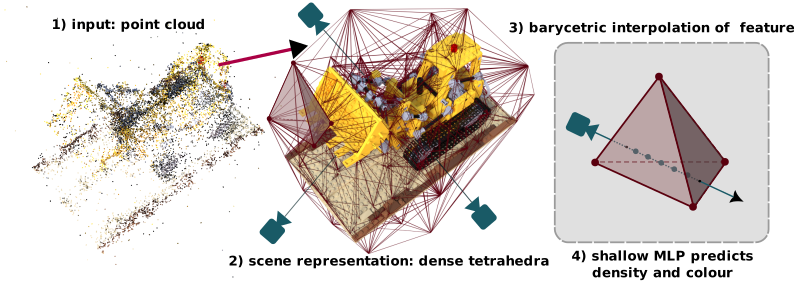
The input to Tetra-NeRF is a point cloud which is triangulated to get a set of tetrahedra used to represent the radiance field. Rays are sampled, and the field is queried. The barycentric interpolation is used to interpolate tetrahedra vertices, and the resulting features are passed to a shallow MLP to get the density and colours for volumetric rendering.<br>
[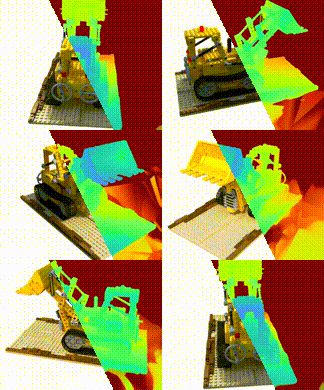](https://jkulhanek.com/tetra-nerf/demo.html?scene=blender-lego-sparse)
[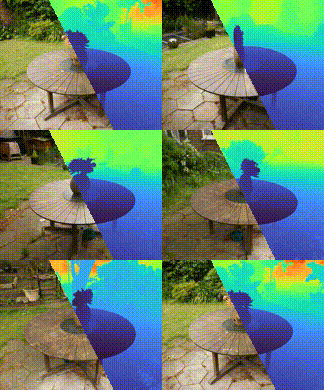](https://jkulhanek.com/tetra-nerf/demo.html?scene=360-garden-sparse)
[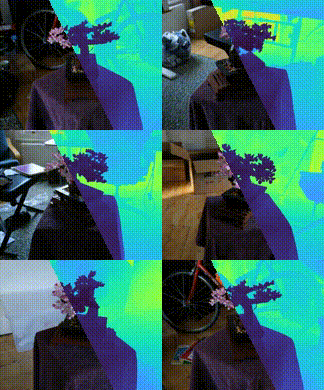](https://jkulhanek.com/tetra-nerf/demo.html?scene=360-bonsai-sparse)
[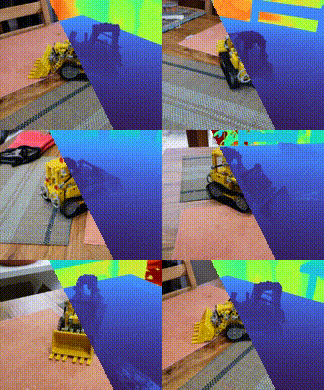](https://jkulhanek.com/tetra-nerf/demo.html?scene=360-kitchen-dense)
<br>
**UPDATE!**
Tetra-NeRF is now faster and achieves better performance thanks to using biased sampling instead of sampling uniformly along the ray.
The configuration from the paper was renamed to `tetra-nerf-original`. And `tetra-nerf` now points to the new configuration.
## Introduction
First, install **Tetra-NeRF**. The instructions are given in the [installation](#installation) section.
If you want to reproduce the results from the paper, please follow the [reproducing results section](#reproducing-results) which
will instruct you on how to download the data and run the training. We also publish the generated images.
If you want to use **Tetra-NeRF** with your own collected data, please follow the [using custom data section](#using-custom-data).
## Using custom data
When training on your own images, first you need the COLMAP model for camera poses and sparse point cloud.
You can run COLMAP yourself or use our script with default COLMAP parameters to build the model.
First prepare a folder with your data. In the folder, a subfolder called `images` and copy all your images
into that folder.
### Without existing COLMAP model
Simply run the following:
```bash
python -m tetranerf.scripts.process_images --path <data folder>
```
This command will create a single sparse COLMAP model from all images to be later used
for both the camera poses and the input point cloud.
However, if you care about correct evaluation, you want the input point cloud to be constructed only from
the training images. In that case, you can use the `--separate-training-pointcloud` flag.
With this flag turned on, the script will create two sparse models:
first with all images to get the camera poses of all images and the second from only the training images.
Finally, start the training:
```bash
ns-train tetra-nerf colmap --data <data folder>
```
### With existing COLMAP
In case you already have a sparse COLMAP model, move it to the data folder. The folder structure should look like this:
```
images
...
sparse
0
cameras.bin
...
```
Finally, start the training:
```bash
ns-train tetra-nerf colmap --data <data folder>
```
## Reproducing results
We first give instructions on how to download and preprocess the data,Excerpt of 12,044 characters
Read on GitHubWould you bet a product on this? Bounded 0–100 and slow moving.
matched fp:08659da7f3fca142, topic:computer-vision, topic:nerf, topic:3d-reconstruction