



RSpec and Minitest matchers to prevent the N+1 queries problem.
Unlike other libraries (such as db-query-matchers, rspec-sqlimit, etc), with n_plus_one_control you don't have to specify exact expectations to control your code behaviour (e.g. expect { subject }.to query(2).times).
Such expectations are rather hard to maintain, 'cause there is a big chance of adding more queries, not related to the system under test.
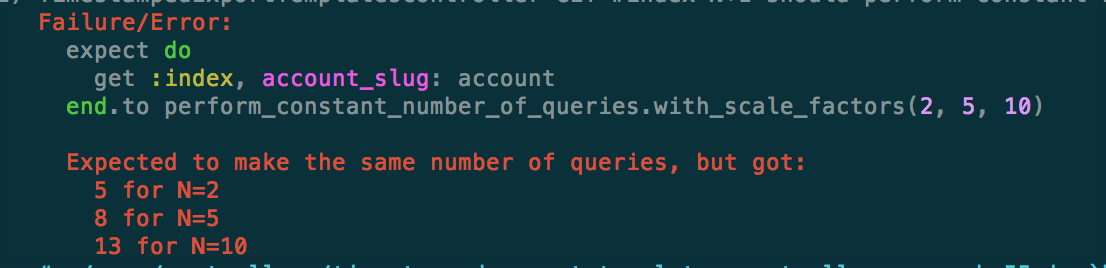
NPlusOneControl works differently. It evaluates the code under consideration several times with different scale factors to make sure that the number of DB queries behaves as expected (i.e. O(1) instead of O(N)).
So, it's for performance testing and not feature testing.
Read also "Squash N+1 queries early with n_plus_one_control test matchers for Ruby and Rails".
Why not just use bullet?
Of course, it's possible to use Bullet in tests (see more here), but it's not a silver bullet: there can be both false positives and true negatives.
This gem was born after I've found myself not able to verify with a test yet another N+1 problem.

Add this line to your application's Gemfile:
group :test do
  gem "n_plus_one_control"
end
And then execute:
$ bundle
First, add NPlusOneControl to your spec_helper.rb:
# spec_helper.rb
require "n_plus_one_control/rspec"
Then:
# Wrap example into a context with :n_plus_one tag
context "N+1", :n_plus_one do
  # Define `populate` callbacks which is responsible for data
  # generation (and whatever else).
  #
  # It accepts one argument – the scale factor (read below)
  populate { |n| create_list(:post, n) }

  specify do
    expect { get :index }.to perform_constant_number_of_queries
  end
end
NOTE: do not use memoized values within the expectation block!
# BAD – won't work!
subject { get :index }

specify do
  expect { subject }.to perform_constant_number_of_queries
end

# GOOD
specify do
  expect { get :index }.to perform_constant_number_of_queries
end

# BAD — the `page` record would be removed from the database
# but still present in RSpec (due to `let`'s memoization)
let(:page) { create(:page) }

populate { |n| create_list(:comment, n, page: page) }

specify do
  expect { get :show, params: {id: page.id} }.to perform_constant_number_of_queries
end

# GOOD
# Ensure the record is created before `populate`
let!(:page) { create(:page) }

populate { |n| create_list(:comment, n, page: page) }
# ...
Availables modifiers:
# You can specify the RegExp to filter queries.
# By default, it only considers SELECT queries.
expect { get :index }.to perform_constant_number_of_queries.matching(/INSERT/)

# You can also provide custom scale factors
expect { get :index }.to perform_constant_number_of_queries.with_scale_factors(10, 100)

# You can specify the exact number of expected queries
expect { get :index }.to perform_constant_number_of_queries.exactly(1)Let's suppose your action accepts parameter, which can make impact on the number of returned records:
get :index, params: {per_page: 10}Then it is enough to just change per_page parameter between executions and do not recreate records in DB. For this purpose, you can use current_scale method in your example:
context "N+1", :n_plus_one do
  before { create_list :post, 3 }

  specify do
    expect { get :index, params: {per_page: current_scale} }.to perform_constant_number_of_queries
  end
endBoth rspec matchers allows you to put additional expectations inside execution block to ensure that tested piece of code actually does what expected.
context "N+1", :n_plus_one do
  specify do
    expect do
      expect(my_query).to eq(actuall_results)
    end.to perform_constant_number_of_queries
  end
endperform_linear_number_of_queries(slope: 1) allows you to test that a query generates linear number of queries with the given slope.
context "when has linear query", :n_plus_one do
  populate { |n| create_list(:post, n) }

  specify do
    expect { Post.find_each { |p| p.user.name } }
      .to perform_linear_number_of_queries(slope: 1)
  end
endFirst, add NPlusOneControl to your test_helper.rb:
# test_helper.rb
require "n_plus_one_control/minitest"
Then use assert_perform_constant_number_of_queries assertion method:
def test_no_n_plus_one_error
  populate = ->(n) { create_list(:post, n) }

  assert_perform_constant_number_of_queries(populate: populate) do
    get :index
  end
end
You can also use assert_perform_linear_number_of_queries to test for linear queries:
def test_no_n_plus_one_error
  populate = ->(n) { create_list(:post, n) }

  assert_perform_linear_number_of_queries(slope: 1, populate: populate) do
    Post.find_each { |p| p.user.name }
  end
end
You can also specify custom scale factors or filter patterns:
assert_perform_constant_number_of_queries(
  populate: populate,
  scale_factors: [2, 5, 10]
) do
  get :index
end

assert_perform_constant_number_of_queries(
  populate: populate,
  matching: /INSERT/
) do
  do_some_havey_stuff
end
For the constant matcher, you can also specify the expected number of queries as the first argument:
assert_perform_constant_number_of_queries(2, populate: populate) do
  get :index
end
It's possible to specify a filter via NPLUSONE_FILTER env var, e.g.:
NPLUSONE_FILTER = users bundle exec rake testYou can also specify populate as a test class instance method:
def populate(n)
  create_list(:post, n)
end

def test_no_n_plus_one_error
  assert_perform_constant_number_of_queries do
    get :index
  end
end
As in RSpec, you can use current_scale factor instead of populate block:
def test_no_n_plus_one_error
  assert_perform_constant_number_of_queries do
    get :index, params: {per_page: current_scale}
  end
endIf you use caching you can face the problem when first request performs more DB queries than others. The solution is:
# RSpec

context "N + 1", :n_plus_one do
  populate { |n| create_list :post, n }

  warmup { get :index } # cache something must be cached

  specify do
    expect { get :index }.to perform_constant_number_of_queries
  end
end

# Minitest

def populate(n)
  create_list(:post, n)
end

def warmup
  get :index
end

def test_no_n_plus_one_error
  assert_perform_constant_number_of_queries do
    get :index
  end
end

# or with params

def test_no_n_plus_one
  populate = ->(n) { create_list(:post, n) }
  warmup = -> { get :index }

  assert_perform_constant_number_of_queries population: populate, warmup: warmup do
    get :index
  end
end
If your warmup and testing procs are identical, you can use:
expect { get :index }.to perform_constant_number_of_queries.with_warming_up # RSpec onlyThere are some global configuration parameters (and their corresponding defaults):
# Default scale factors to use.
# We use the smallest possible but representative scale factors by default.
NPlusOneControl.default_scale_factors = [2, 3]

# Print performed queries if true in the case of failure
# You can activate verbosity through env variable NPLUSONE_VERBOSE=1
NPlusOneControl.verbose = false

# Print table hits difference, for example:
#
#   Unmatched query numbers by tables:
#     users (SELECT): 2 != 3
#     events (INSERT): 1 != 2
#
NPlusOneControl.show_table_stats = true

# Ignore matching queries
NPlusOneControl.ignore = /^(BEGIN|COMMIT|SAVEPOINT|RELEASE)/

# Ignore queries in cache
# https://guides.rubyonrails.org/configuring.html#configuring-query-cache
NPlusOneControl.ignore_cached_queries = false

# ActiveSupport notifications event to track queries.
# We track ActiveRecord event by default,
# but can also track rom-rb events ('sql.rom') as well.
NPlusOneControl.event = "sql.active_record"

# configure transactional behaviour for populate method
# in case of use multiple database connections
NPlusOneControl::Executor.tap do |executor|
  connections = ActiveRecord::Base.connection_handler.connection_pool_list.map(&:connection)

  executor.transaction_begin = -> do
    connections.each { |connection| connection.begin_transaction(joinable: false) }
  end
  executor.transaction_rollback = -> do
    connections.each(&:rollback_transaction)
  end
end

# Provide a backtrace cleaner callable object used to filter SQL caller location to display in the verbose mode
# Set it to nil to disable tracing.
#
# In Rails apps, we use Rails.backtrace_cleaner by default.
NPlusOneControl.backtrace_cleaner = ->(locations_array) { do_some_filtering(locations_array) }

# You can also specify the number of backtrace lines to show.
# MOTE: It could be specified via NPLUSONE_BACKTRACE env var
NPlusOneControl.backtrace_length = 1

# Sometime queries could be too large to provide any meaningful insight.
# You can configure an output length limit for queries in verbose mode by setting the following option
# NOTE: It could be specified via NPLUSONE_TRUNCATE env var
NPlusOneControl.truncate_query_size = 100Take a look at our Executor to figure out what's under the hood.
- More matchers.
It may be useful to provide more matchers/assertions, for example:
# Actually, that means that it is N+1))
assert_linear_number_of_queries { some_code }

# But we can tune it with `coef` and handle such cases as selecting in batches
assert_linear_number_of_queries(coef: 0.1) do
  Post.find_in_batches { some_code }
end

# probably, also make sense to add another curve types
assert_logarithmic_number_of_queries { some_code }- Support custom non-SQL events.
N+1 problem is not a database specific: we can have N+1 Redis calls, N+1 HTTP external requests, etc.
We can make n_plus_one_control customizable to support these scenarios (technically, we need to make it possible to handle different payload in the event subscriber).
If you want to discuss or implement any of these, feel free to open an issue or propose a pull request.
# install deps
bundle install

# run tests
bundle exec rakeBug reports and pull requests are welcome on GitHub at https://github.com/palkan/n_plus_one_control.
The gem is available as open source under the terms of the MIT License.


