



Code repositories for the 1st and 2nd edition are available at
- https://github.com/rasbt/python-machine-learning-book and
- https://github.com/rasbt/python-machine-learning-book-2nd-edition
Python Machine Learning, 3rd Ed.
to be published December 12th, 2019
Paperback: 770 pages
Publisher: Packt Publishing
Language: English
ISBN-10: 1789955750
ISBN-13: 978-1789955750
Kindle ASIN: B07VBLX2W7
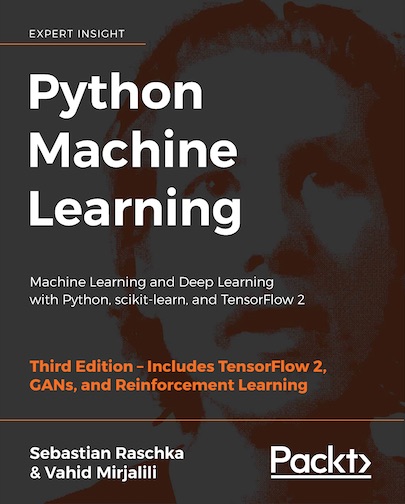
Helpful installation and setup instructions can be found in the README.md file of Chapter 1
Please note that these are just the code examples accompanying the book, which we uploaded for your convenience; be aware that these notebooks may not be useful without the formulae and descriptive text.
- Machine Learning - Giving Computers the Ability to Learn from Data [open dir]
- Training Machine Learning Algorithms for Classification [open dir]
- A Tour of Machine Learning Classifiers Using Scikit-Learn [open dir]
- Building Good Training Sets – Data Pre-Processing [open dir]
- Compressing Data via Dimensionality Reduction [open dir]
- Learning Best Practices for Model Evaluation and Hyperparameter Optimization [open dir]
- Combining Different Models for Ensemble Learning [open dir]
- Applying Machine Learning to Sentiment Analysis [open dir]
- Embedding a Machine Learning Model into a Web Application [open dir]
- Predicting Continuous Target Variables with Regression Analysis [open dir]
- Working with Unlabeled Data – Clustering Analysis [open dir]
- Implementing a Multi-layer Artificial Neural Network from Scratch [open dir]
- Parallelizing Neural Network Training with TensorFlow [open dir]
- Going Deeper: The Mechanics of TensorFlow [open dir]
- Classifying Images with Deep Convolutional Neural Networks [open dir]
- Modeling Sequential Data Using Recurrent Neural Networks [open dir]
- Generative Adversarial Networks for Synthesizing New Data [open dir]
- Reinforcement Learning for Decision Making in Complex Environments [open dir]
Raschka, Sebastian, and Vahid Mirjalili. Python Machine Learning, 3rd Ed. Packt Publishing, 2019.
@book{RaschkaMirjalili2019,
address = {Birmingham, UK},
author = {Raschka, Sebastian and Mirjalili, Vahid},
edition = {3},
isbn = {978-1789955750},
publisher = {Packt Publishing},
title = {{Python Machine Learning, 3rd Ed.}},
year = {2019}
}


