

This work has now been superseded by: https://github.com/sniklaus/revisiting-sepconv
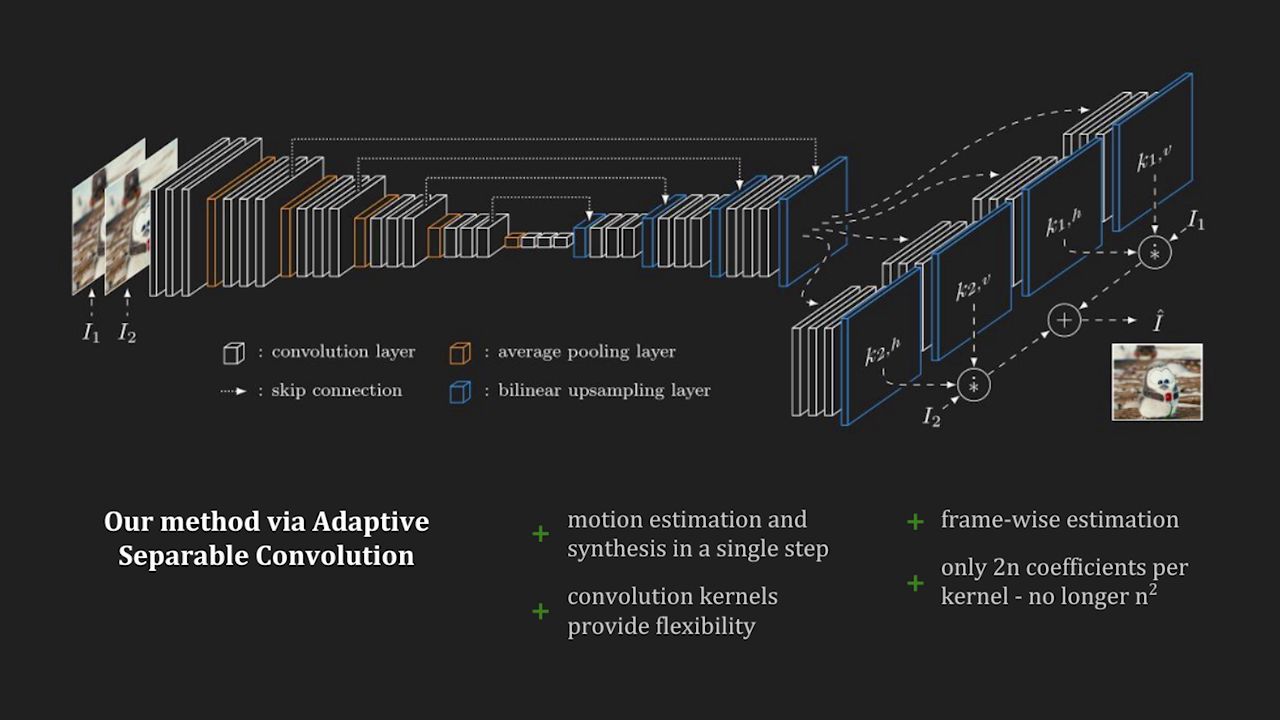
This is a reference implementation of Video Frame Interpolation via Adaptive Separable Convolution [1] using PyTorch. Given two frames, it will make use of adaptive convolution [2] in a separable manner to interpolate the intermediate frame. Should you be making use of our work, please cite our paper [1].

For a reimplemntation of our work, see: https://github.com/martkartasev/sepconv
And for another adaptation, consider: https://github.com/HyeongminLEE/pytorch-sepconv
For softmax splatting, please see: https://github.com/sniklaus/softmax-splatting
The separable convolution layer is implemented in CUDA using CuPy, which is why CuPy is a required dependency. It can be installed using pip install cupy or alternatively using one of the provided binary packages as outlined in the CuPy repository.
If you plan to process videos, then please also make sure to have pip install moviepy installed.
To run it on your own pair of frames, use the following command. You can either select the l1 or the lf model, please see our paper for more details. In short, the l1 model should be used for quantitative evaluations and the lf model for qualitative comparisons.
python run.py --model lf --one ./images/one.png --two ./images/two.png --out ./out.png
To run in on a video, use the following command.
python run.py --model lf --video ./videos/car-turn.mp4 --out ./out.mp4
For a quick benchmark using examples from the Middlebury benchmark for optical flow, run python benchmark.py. You can use it to easily verify that the provided implementation runs as expected.
The provided implementation is strictly for academic purposes only. Should you be interested in using our technology for any commercial use, please feel free to contact us.
[1]  @inproceedings{Niklaus_ICCV_2017,
         author = {Simon Niklaus and Long Mai and Feng Liu},
         title = {Video Frame Interpolation via Adaptive Separable Convolution},
         booktitle = {IEEE International Conference on Computer Vision},
         year = {2017}
     }
[2]  @inproceedings{Niklaus_CVPR_2017,
         author = {Simon Niklaus and Long Mai and Feng Liu},
         title = {Video Frame Interpolation via Adaptive Convolution},
         booktitle = {IEEE Conference on Computer Vision and Pattern Recognition},
         year = {2017}
     }
This work was supported by NSF IIS-1321119. The video above uses materials under a Creative Common license or with the owner's permission, as detailed at the end.
