
Top AI Repos — open-source AI, indexed and scored
Top AI Repos tracks AI repositories on GitHub and answers two different questions about each one: is it moving right now, and would you bet a product on it.
Top AI Repos tracks AI repositories on GitHub and answers two different questions about each one: is it moving right now, and would you bet a product on it.

The local-first LLM Wiki: open-source knowledge graph builder, RAG knowledge base, and agent memory store. Built on Andrej Karpathy's pattern. An Obsidian alternative for personal knowledge management, AI second brain, and durable Claude Code / Codex / OpenClaw memory.
| Date | Stars |
|---|---|
| 2026-07-31 | 635 |
| 2026-08-04 | 639 |
| 2026-08-13 | 652 |
| 2026-08-18 | 659 |
| 2026-08-20 | 662 |
| 2026-08-21 | 665 |
| 2026-08-24 | 667 |
| 2026-08-25 | 670 |
| 2026-08-26 | 672 |
| 2026-08-27 | 673 |
| 2026-08-28 | 672 |
| 2026-08-29 | 673 |
| 2026-09-01 | 676 |
| 2026-09-02 | 677 |
| 2026-09-03 | 678 |
| 2026-09-05 | 679 |
| 2026-09-06 | 680 |
| 2026-09-07 | 681 |
| 2026-09-10 | 683 |
| 2026-09-11 | 685 |
| 2026-09-13 | 687 |
| 2026-09-15 | 689 |
| 2026-09-16 | 691 |
| 2026-09-17 | 692 |
| 2026-09-19 | 693 |
| 2026-09-20 | 694 |
Today
+1 stars today
This week
+7 stars this week
This month
+29 stars this month
Momentum
1.0
growth rate 1.02%/day
# SwarmVault <!-- readme-language-nav:start --> **Languages:** [English](README.md) | [简体中文](README.zh-CN.md) | [日本語](README.ja.md) <!-- readme-language-nav:end --> [](https://www.npmjs.com/package/@swarmvaultai/cli) [](https://www.npmjs.com/package/@swarmvaultai/cli) [](https://github.com/swarmclawai/swarmvault) [](LICENSE) []() **The local-first LLM Wiki, knowledge graph builder, and RAG knowledge base for AI agents.** SwarmVault turns docs, code, transcripts, notes, and URLs into a durable markdown wiki plus a local graph you can inspect, query, and hand to agents. Start with one command, then learn the deeper graph, review, context-pack, and automation workflows when you need them. Documentation on the website is currently English-first. If wording drifts between translations, [README.md](README.md) is the canonical source. <!-- readme-section:try-it --> ## Try It in 30 Seconds ```bash npm install -g @swarmvaultai/cli swarmvault quickstart ./your-repo ``` `quickstart` initializes a vault in the current directory, ingests a local file, directory, or public GitHub repo, compiles the wiki and graph, writes share artifacts, and opens the local graph viewer. It is the beginner-friendly alias for `swarmvault scan`. No repo handy? ```bash swarmvault demo ``` After your first compile, the most useful next commands are: ```bash swarmvault next swarmvault query "What are the key concepts?" swarmvault graph serve swarmvault doctor swarmvault candidate list ``` Not sure what state the vault is in? `swarmvault next` is read-only and tells you whether to initialize, ingest, compile, query, review, or refresh. 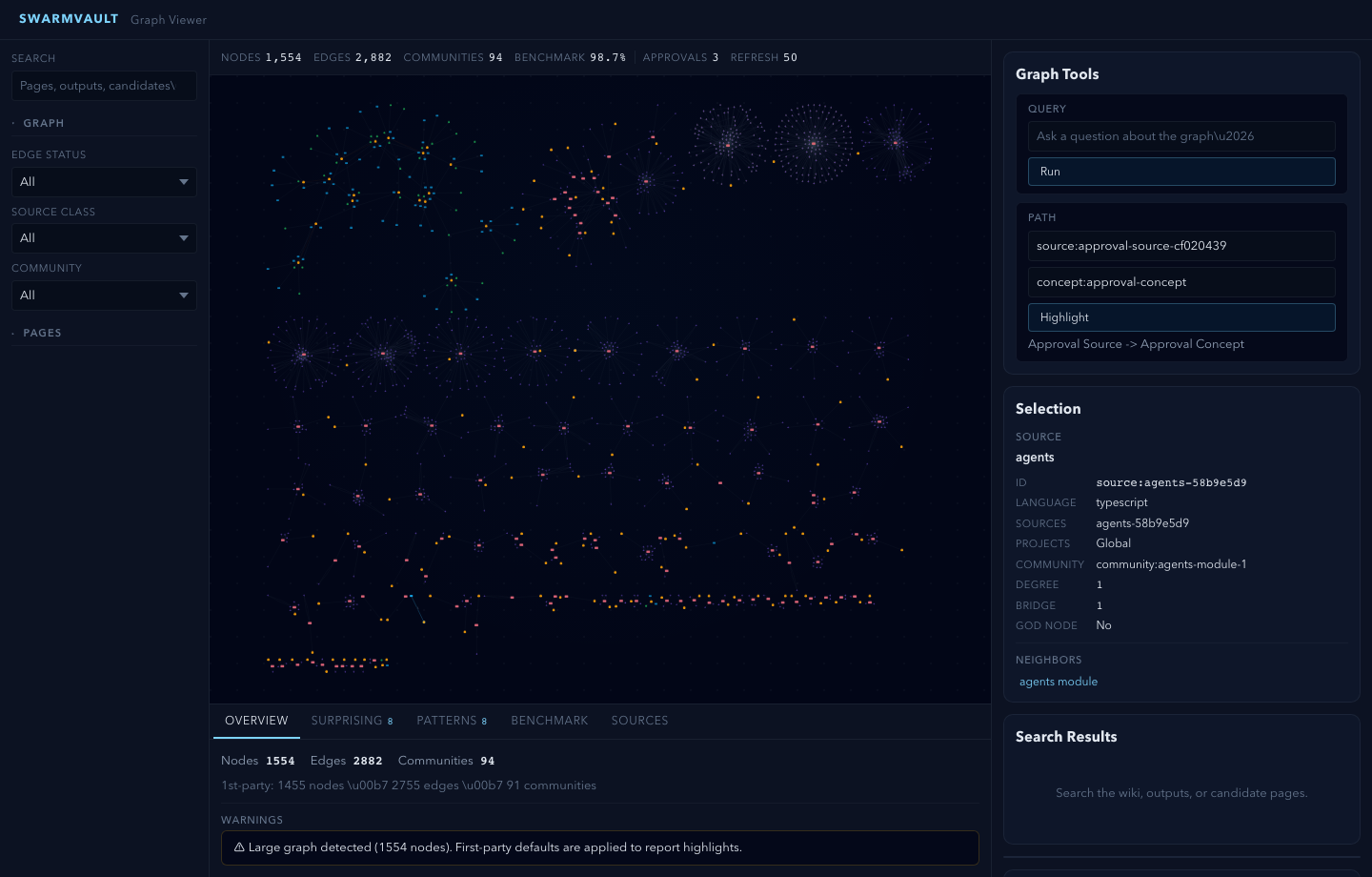 No API keys are required for the first run. The built-in heuristic provider runs locally and offline. **What you get on disk:** - `raw/` - immutable copies of ingested material - `wiki/` - generated markdown pages, saved outputs, graph reports, context packs, and task notes - `state/graph.json` - the machine-readable knowledge graph - `state/retrieval/` - local search index - `wiki/graph/share-card.md`, `wiki/graph/share-card.svg`, and `wiki/graph/share-kit/` - copyable and visual first-run summaries ### Three-Layer Architecture SwarmVault uses three layers, following the pattern described by Andrej Karpathy: 1. **Raw sources** (`raw/`) — your curated collection of source documents. Books, articles, papers, transcripts, code, images, datasets. These are immutable: SwarmVault reads from them but never modifies them. 2. **The wiki** (`wiki/`) — LLM-generated and human-authored markdown. Source summaries, entity pages, concept pages, cross-references, dashboards, and outputs. The wiki is the persistent, compounding artifact. 3. **The schema** (`swarmvault.schema.md`) — defines how the wiki is structured, what conventions to follow, and what matters in your domain. You and the LLM co-evolve this over time. > In the tradition of Vannevar Bush's Memex (1945) — a personal, curated knowledge store with associative trails between documents — SwarmVault treats the connections between sources as valuable as the sources themselves. The part Bush couldn't solve was who does the maintenance. The LLM handles that. Turn books, articles, notes, transcripts, mail exports, calendars, datasets, slide decks, screenshots, URLs, and code into a persistent knowledge vault with a knowledge graph, local search, dashboards, and reviewable artifacts that stay on disk. Use it for **personal knowledge management**, **research deep-dives**, **book companions**, **code documentation**, **business intelligence**, or any domain where you acc
Excerpt of 48,521 characters
Read on GitHub
Wayde
198

1
Would you bet a product on this? Bounded 0–100 and slow moving.
matched fp:f242690846281459, topic:rag, topic:knowledge-graph, desc:knowledge base
matched fp:f242690846281459, topic:mcp, topic:mcp-server