

A source-available Agent Runtime workspace for building, connecting, publishing, and operating AI agents and executable workflows.




Why ZGI · How it works · Capabilities · Product Tour · Quick Start · Development · Docs · Contributing · License

ZGI is an Agent Runtime platform with source code available for teams that need AI applications to execute real work, not just answer in a chat box. It brings agent configuration, visual workflow orchestration, advanced retrieval, structured data, model routing, reusable skills, and sandboxed execution into one self-hostable workspace.
Build an agent once, bind it to approved knowledge, databases, skills, and workflows, then make it available through a WebApp, the internal app center, an API, or scheduled and internal calls. Permissions, runtime logs, and batch tests keep the application observable and governable after it is published.
Build agents and workflows
        ↓
Connect models, knowledge, databases, files, and skills
        ↓
Execute tools, code, retrieval, and human-in-the-loop steps
        ↓
Publish through WebApp, App Center, API, or internal invocation
        ↓
Operate with permissions, logs, and batch testing
| Area | What ZGI provides |
|---|---|
| Agent applications | Configure instructions, models, memory, knowledge, file inputs, skills, and workflow bindings, then publish a usable agent experience. |
| Executable workflows | Orchestrate LLM calls, branches, loops, approvals, user questions, HTTP requests, database operations, code, documents, notifications, and scheduled tasks on a visual canvas. |
| Advanced retrieval | Combine semantic, full-text, hybrid, and knowledge-graph retrieval with reranking, while keeping agents scoped to approved knowledge and data. |
| Skills and sandboxed tools | Package reusable capabilities for files, charts, reports, calculations, databases, and workflow calls, and execute them in an isolated runtime. |
| Model gateway | Manage providers, channels, credentials, defaults, routing policies, quotas, and pricing metadata in one place. |
| Publishing and governance | Expose agents through WebApp, App Center, API keys, or internal calls, with workspace permissions, runtime logs, and reusable batch tests. |
| Self-hosted runtime | Run the console, API, sandbox, runner, PostgreSQL, and Redis locally or in your own infrastructure. |
The views below continue from Agent Studio into orchestration, business data, execution, model governance, and grounded enterprise knowledge.
Connect document extraction, retrieval, models, tools, approvals, and outputs on a visual canvas.

Select approved data tables and turn a plain-language question into traceable KPIs, risks, and recommended actions.

Review run status, duration, steps, and structured output to understand what the workflow ran and what it returned.

Manage providers, channels, routing policies, and availability from one place.

Upload and process files, then link them to approved knowledge bases that agents and workflows can use.

Start the full local stack:
make dev-dockerIf you do not have make, run the startup script directly:
./dev/start-dockerOpen the console:
http://localhost:2679
On first launch, create the first administrator account. ZGI does not ship with a default admin account.
Stop the stack:
make docker-downView logs:
make docker-logsFor source development, install:
- Docker and Docker Compose
- Make
- Go
- Node.js and pnpm
The web app uses [email protected].
Prepare dependencies:
make setupRun the API and web app from source in separate terminals:
make dev-docker
make dev-api
make dev-webRead the product documentation at docs.zgi.ai.
Repository-local README files are kept for development and contribution notes.
For deployment behavior such as the embedded system skill catalog, see
docker/README.md.
For external application Connections, credential rotation, grants, health, and
AIChat usage, see docs/external-integrations.md.
The Exa-specific setup is documented in docs/web-search.md.
Contributions are welcome. Please read CONTRIBUTING.md
before opening a pull request.
Community expectations are documented in
CODE_OF_CONDUCT.md.
For security-sensitive reports, follow SECURITY.md.
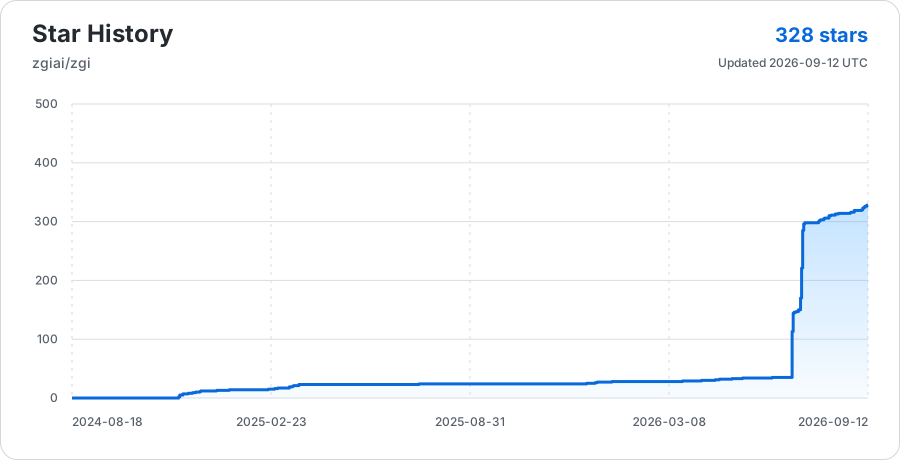
Charts are updated automatically on the star-history branch to keep generated
asset commits off main.
ZGI source code is available under the ZGI Community License, based on Apache
License 2.0 with additional conditions. ZGI is free for personal, research,
educational, and internal organizational use. Hosted multi-tenant services,
white-label distribution, and removal of official ZGI branding require a
commercial license. This license is not an OSI-approved open source license.
See LICENSE for details.
The Apache License 2.0 text referenced by the ZGI Community License is included
in LICENSE-APACHE.