

The first stop on humanity's journey to becoming an interstellar civilization.
A 1:1 real-time solar system explorer — entirely in your browser. Now on your phone.
Powered by NASA JPL ephemerides. The planets are where they are right now.





Zero install · Zero account · Zero backend · Desktop & mobile · ~200 kB gzipped · MIT open source
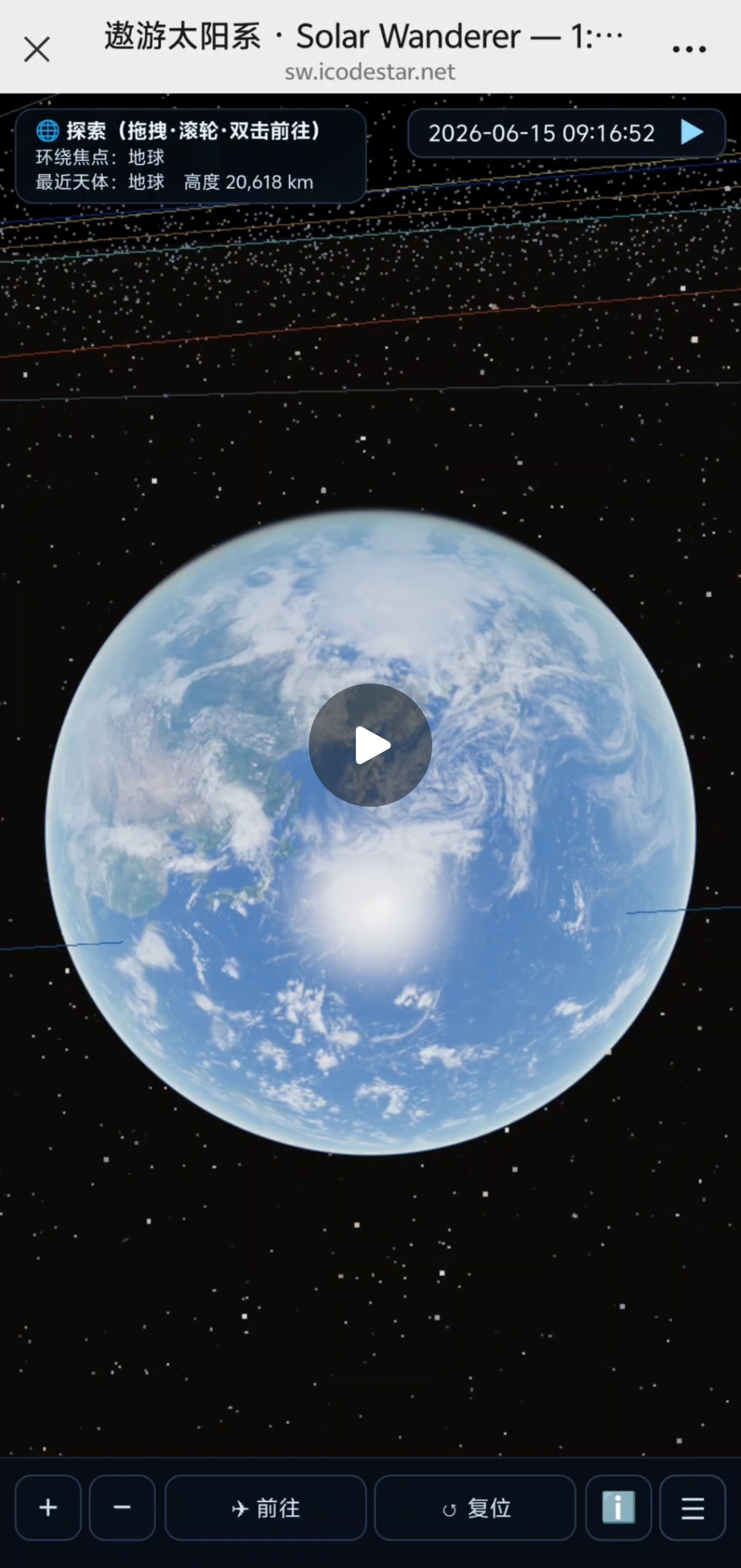

We all learned the names of the planets as children. But have you ever been there?
Most space apps make you choose: either scientifically accurate, or beautiful and immersive. Solar Wanderer does both. It puts the real solar system — every planet, every moon, every AU — into a web page that anyone can open, on any device, for free.
Our mission is simple:
Before humanity becomes an interstellar species, we must first truly see our own backyard.
When a child stands on the Moon, turns around, and sees Earth as a tiny blue marble in the black sky, something changes. When a student pulls back from Earth until the planets shrink to dots and the Oort Cloud appears, their sense of scale changes forever. When a teacher can take an entire classroom to Mars in five minutes, science education changes.
This is not just a simulation. It is an invitation.
| Solar Wanderer | |
|---|---|
| Scale | True 1:1 km — every planet, every moon, every AU, from 0.5 m to 100,000 AU |
| Accuracy | NASA JPL Horizons verified · ≤0.074° for planets · 21 moons fitted from state vectors |
| Immersion | Seamless descent from orbit → atmosphere → surface → walking → underwater (no cuts, no loading) |
| Scope | Sun to the Oort Cloud (100,000 AU) · asteroid belt · Kuiper belt · 28 real TNOs · 4 comets · past the heliopause where Voyager 1 & 2 are now |
| Anywhere | Desktop keyboard/mouse and full mobile touch — same physics, same scale |
| Size | ~200 kB gzipped JS · no server · no GPU farm |
| Open | MIT licensed · all data from public NASA/IAU sources · verifiable against JPL Horizons |
Solar Wanderer already works. But to become indistinguishable from reality and reach billions of people, we need your help.
We are building toward four pillars:
-
🪐 Realism that is indistinguishable from reality
- Real global DEM terrain: Moon (LOLA), Mars (MOLA), Earth (ETOPO1); local HiRISE / photographic surface detail remains future work
- Real solar/lunar/planetary eclipse shadows
- Dynamic weather, clouds, dust storms, auroras
- High-resolution 16K–32K textures
- Real spacecraft with 3D models and mission histories
-
🥽 Immersion that makes you feel you are there
- WebXR / VR support
- First-person spacesuit HUD
- Environmental storytelling: Apollo landing sites, rover tracks, landmarks
- Dynamic time-of-day and seasonal visuals
- Spatial orientation aids and scale references
-
📚 A public science education system
- Structured guided tours and courses
- Voice narration in multiple languages
- Teacher/classroom/museum toolkits
- Real-time astronomical event simulations
- A scalable content platform for facts, stories, and lessons
-
🌍 Reach: let the world know
- Multi-language support
- Video content, blogs, SEO
- Partnerships with schools, museums, planetariums, and space agencies
- Community-driven content and translations
👉 See the full master plan: ROADMAP.md
We welcome contributors of all kinds: developers, astronomers, educators, translators, designers, writers, video creators, and space enthusiasts.
git clone https://github.com/hyqzz/Solar-Wanderer.git
cd Solar-Wanderer
npm install
npm run dev      # → http://localhost:5173
npm test         # 33 precision tests (no network needed)
npm run verify # live cross-check against NASA JPL Horizons (needs internet)| Area | What's needed | Good first issue? |
|---|---|---|
| Real terrain | USGS LOLA (Moon) / MOLA (Mars) DEM tile streaming | ⭐ Yes |
| Eclipse shadows | Sun–Moon–Earth shadow volumes | Advanced |
| Sound | Ambient radio hiss, surface crunch, underwater | ⭐ Yes |
| Translations | English/Chinese already done; Japanese, Spanish, French, Arabic… | ⭐ Yes |
| Education content | Guided tours, facts, quizzes, lesson plans | ⭐ Yes |
| VR / WebXR | Immersive headset support | Advanced |
| Accuracy | VSOP87 + ELP2000 for ±3000 year validity | Advanced |
| Bookmarks | Save/restore position + time | ⭐ Yes |
| Spacecraft models | Voyager, New Horizons, Juno, Cassini 3D models and trajectories | ⭐ Yes |
| Outreach | Blog posts, videos, social media, school partnerships | ⭐ Yes |
Check our Issues tab — we are turning the master plan into actionable issues. Pick one, comment, and jump in.
Please read CONTRIBUTING.md for code style and PR process.
No install. No account. Just open and go.
Recommended first experiences:
- Open the directory → tap Moon → pinch all the way in → land → look up: the blue Earth hangs in the black sky.
- Pull back from Earth until the planets become dots, then keep going until the Oort Cloud appears.
- Double-click Saturn and zoom in until you can see the Cassini Division in the rings.
- Three.js 0.165 · Vite 5 · native ESM · WebGL2 · logarithmic depth buffer
- Pure-function ephemeris layer (Node-testable)
- Floating-origin rendering for 1:1 km scale
- GPU auto-tiering across three tiers (High / Medium / Low), by GPU generation rather than vendor alone
The app picks a tier from the WebGL renderer string, then keeps adjusting the render scale at runtime to hold the frame rate. Physical scale, DEM and ephemerides are identical in all three tiers — only rendering work differs.
| Tier | Picked for | What it adds |
|---|---|---|
| High | RTX / GTX 1060+ / RX 5500+ / Arc A / Apple M-Pro·Max·Ultra | Volumetric clouds, 1.5× pixel ratio, 8K textures, 2048 shadow maps |
| Medium | Mid-range and older discrete GPUs (GTX 750 Ti–980, RX 480–550, base Apple M1/M2/M3) | Procedural surface detail, 4K textures, 1536 shadow maps — no volumetric clouds |
| Low | Integrated GPUs, software rendering, mobile | Flat shading detail off, 1024 shadow maps |
Override with ?quality=high, ?quality=medium or ?quality=low (lite is accepted
as an alias for low). Volumetric clouds are High-only: measured on the same scene they
cost about 3.2× Medium, and Medium is already 2.0× Low.
| Model | Validation and coverage |
|---|---|
| Sampled JPL states (65 targets) | 2025-01-01 through 2035-01-01 TDB, sharded by year; off-grid comparisons across the whole window pass <0.001° and <10 km |
| Planet fallback | VSOP87 / analytic models; use npm run verify for live comparison |
| Moon fallback | Complete Meeus periodic terms; checked separately when sampled states are unavailable |
| Satellite fallback | Empirical fitted elements from a 7-epoch least-squares fit; ~0.003° at the fit epoch, degrading to ~2° within 180 days (tracked by tests, not hidden) |
| Rotation | IAU models; independent of the sampled orbital states |
Sample interpolation differences are not absolute physical uncertainties. States load progressively, one year-shard at a time, so a 10-year window costs roughly the same per body as the previous 16-month window; outside the shard that is loaded, or during resource failures, the application uses approximate models, identified per target in the HUD. Refresh with npm run fetch-ephemeris (resumable; cached shards are reused) and validate with npm run verify-release before extending the interval.
The renderer does not yet reproduce every surface at photographic detail. Global DEM tiles are coarse, unobserved regions use procedural assumptions, and clouds / solar and comet activity are not current observation reconstructions. Release evidence and limitations distinguish integrated-GPU Low, discrete-GPU High, and hardware that has not been tested.
If Solar Wanderer made you feel small in a good way, please:
- ⭐ Star this repo
- 🔗 Share sw.icodestar.net
- 📺 Make a video or write a post about your experience
- 🏫 Tell a teacher, a student, or a museum curator
Together, we can make the solar system feel like home — and prepare humanity for the stars.
| Ephemerides | NASA JPL (Standish 1992 planetary elements · Horizons API state vectors) |
| Textures | Solar System Scope CC-BY-4.0 · Steve Albers SOS · NASA JPL Photojournal (public domain) |
| Rotation models | IAU/WGCCRE reports |
| Bright stars | Hipparcos catalog |
MIT © 2026 hyqzz
Built with Three.js · Verified against NASA JPL · Made to feel small


