
Top AI Repos — open-source AI, indexed and scored
Top AI Repos tracks AI repositories on GitHub and answers two different questions about each one: is it moving right now, and would you bet a product on it.
Top AI Repos tracks AI repositories on GitHub and answers two different questions about each one: is it moving right now, and would you bet a product on it.

TidyBot: Personalized Robot Assistance with Large Language Models
| Date | Stars |
|---|---|
| 2026-07-31 | 696 |
| 2026-08-06 | 695 |
| 2026-08-20 | 696 |
| 2026-08-28 | 695 |
| 2026-09-01 | 694 |
| 2026-09-20 | 694 |
Today
— stars today
This week
— stars this week
This month
-2 stars this month
Momentum
0.0
growth rate 0.00%/day
# tidybot This code release accompanies the following project: ### TidyBot: Personalized Robot Assistance with Large Language Models Jimmy Wu, Rika Antonova, Adam Kan, Marion Lepert, Andy Zeng, Shuran Song, Jeannette Bohg, Szymon Rusinkiewicz, Thomas Funkhouser *Autonomous Robots (AuRo) - Special Issue: Large Language Models in Robotics*, 2023 *IEEE/RSJ International Conference on Intelligent Robots and Systems (IROS)*, 2023 [Project Page](https://tidybot.cs.princeton.edu) | [PDF](https://tidybot.cs.princeton.edu/paper.pdf) | [arXiv](https://arxiv.org/abs/2305.05658) | [Video](https://youtu.be/bCkDynX1KmQ) **Abstract:** For a robot to personalize physical assistance effectively, it must learn user preferences that can be generally reapplied to future scenarios. In this work, we investigate personalization of household cleanup with robots that can tidy up rooms by picking up objects and putting them away. A key challenge is determining the proper place to put each object, as people's preferences can vary greatly depending on personal taste or cultural background. For instance, one person may prefer storing shirts in the drawer, while another may prefer them on the shelf. We aim to build systems that can learn such preferences from just a handful of examples via prior interactions with a particular person. We show that robots can combine language-based planning and perception with the few-shot summarization capabilities of large language models (LLMs) to infer generalized user preferences that are broadly applicable to future interactions. This approach enables fast adaptation and achieves 91.2% accuracy on unseen objects in our benchmark dataset. We also demonstrate our approach on a real-world mobile manipulator called TidyBot, which successfully puts away 85.0% of objects in real-world test scenarios.  | 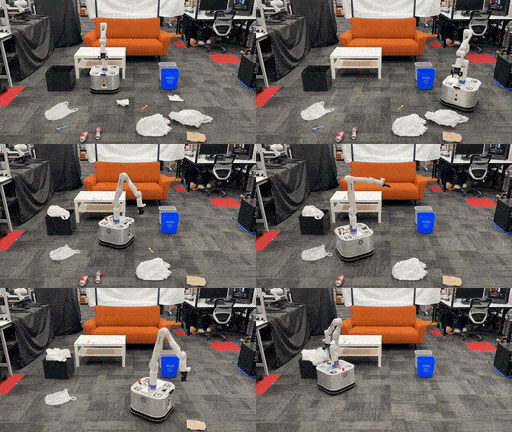 | 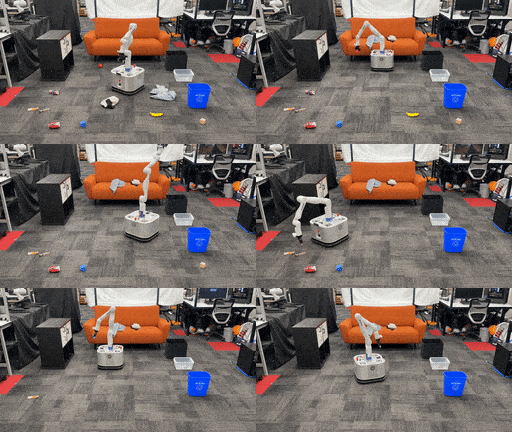 :---: | :---: | :---:  |  |  ## Overview Here is an overview of how this codebase is organized: * [`server`](server): Server code for TidyBot (runs on GPU workstation) * [`robot`](robot): Robot code for TidyBot (runs on mobile base computer) * [`stl`](stl): Files for 3D printed parts * [`benchmark`](benchmark): Code for the benchmark dataset ## Setup We recommend using [Conda](https://docs.conda.io/en/latest/miniconda.html) environments. Our setup (tested on Ubuntu 20.04.6 LTS) uses the following 3 environments: 1. `tidybot` env on the server for general use 2. `tidybot` env on the robot for general use 3. `vild` env on the server for object detection only See the respective READMEs inside the [`server`](server) and [`robot`](robot) directories for detailed setup instructions. ## TidyBot Quickstart Unless otherwise specified, the `tidybot` Conda env should always be used: ```bash conda activate tidybot ``` ### Teleoperation Mode We provide a teleoperation interface ([`teleop.py`](server/teleop.py)) to operate the robot using primitives such as pick, place, or toss. First, run this command to start the teleop interface on the server (workstation), where `<robot-num>` is `1`, `2`, or `3`, depending on the robot to be controlled: ```bash python teleop.py --robot-num <robot-num> ``` On the robot (mobile base computer), make sure that the convenience stop and mobile base driver are both running. Then, run this command to start the controller: ```bash python controller.py ``` Once the server and robot both show that they have successfully connected to each
Excerpt of 10,258 characters
Read on GitHub
13
Would you bet a product on this? Bounded 0–100 and slow moving.
matched fp:6b8bbc18b5c654ce, topic:large-language-models
matched fp:6b8bbc18b5c654ce, topic:robotics